

Speaking this month, Fed Governor Waller suggested that a 50-basis-point hike at the next Federal Open Market Committee (FOMC) meeting on December 9th was a distinct possibility. The probability of that move rose from 0% to 12% on CME’s FedWatch monitor, while the odds of at least a 25-basis-point hike increased from 65% to 88%, putting the chance of a hike next month at 100%. After voting last month to hold the target range for the Fed funds rate at 3.75%-4.00%, the Fed has continued to see economic data paint a stable picture of employment and consumer health. However, the data have reinforced the troubling message that inflation remains above the Fed’s 2% target. The Personal Consumption Expenditure (PCE) Index, the Fed’s preferred inflation gauge, has remained above 2% since March 2021, contrary to the Fed’s repeated expectation that inflation would soon return to target.
Whether the Fed raises rates by 25 or 50 basis points next month will likely have little effect on demand for business credit, much of which is driven by Artificial Intelligence (AI) investments and data centers. Credit news remains strong across the board and appears immune to tighter monetary policy. Bank management reported last month that asset quality metrics, even among lower-income borrowers whose economic stress is being compounded by inflation, are holding steady as this segment adjusts. However, depositors in this group are drawing down their balances to maintain spending.
While bank treasurers may be neutral on rate hikes in the short term, what really matters to them is the shape of the yield curve. A steeper curve would allow them to reinvest cash flows from legacy, low-yielding, interest-earning assets originated before 2022 into higher-yielding, longer-term assets. By contrast, a flatter curve would limit the benefits of reinvesting those proceeds. The broader picture is that interest rates continue to rise, though we remain far from the rate environment that prevailed before the Global Financial Crisis (GFC). As tracked by the New York Fed, R-Star—the theoretical, unobservable, neutral, risk-free real overnight rate—ticked higher in the first half of 2026 (see Slide 4 in this month’s chart deck for more information).
The Financial Accounting Standards Board (FASB) approved a major change to hedge accounting, allowing bank treasurers to hedge securities held in held-to-maturity (HTM) accounts. Previously, they could hedge bonds in available-for-sale (AFS) accounts and loans held for investment, but not HTM bonds. This left them with a choice: book investment bonds in HTM to shield capital from fair-value changes while remaining exposed to interest-rate risk in earnings, or book them in AFS to hedge interest-rate risk but not fair-value risk. The change to Generally Accepted Accounting Principles (GAAP) will especially benefit large banks, which hold bonds in HTM because they must include fair-value changes on AFS bonds in regulatory capital.
Q3 2026 call reports show that commercial banks held $5.7 trillion in investment portfolios, including $2 trillion in HTM, with banks with more than $100 billion in total assets accounting for $1.8 trillion of HTM holdings. The final draft of the Basel 3 Endgame, which the industry expects regulators to publish by next month, will lower the regulatory capital threshold for the fair-value exemption from $250 billion to $100 billion. In addition, bank treasurers are looking forward to the final draft of the rules, which may include changes to the Fed’s evaluation of a bank’s liquidity management and contingency funding plans and may allow credit for collateral pre-positioned at the Fed’s discount window.
The Federal Reserve released its semiannual report this month. It identified several leading threats to financial stability: a major equity market correction triggered by disappointing earnings from AI-related businesses, persistently high long-term interest rates, sustained high energy costs, fiscal debt sustainability, and a cyberattack. The Office of the Comptroller of the Currency also released its Semiannual Risk Perspective report, raising concerns about cyber-risk vulnerabilities. On November 16, major banks reassured depositors who had trouble accessing their accounts online that the issues were unrelated to a cyberattack. The incident followed an outage involving Microsoft Outlook and another affecting flight control software. On November 17, the National Security Agency reported an outage on its highly classified internal network. The public was told that all these events were also unrelated to cyberattacks. Together, these events underscore how vulnerable financial stability could be to panic if such an event were to occur.
The Fed’s report continued to characterize the banking industry as highly liquid and well-capitalized, while noting that leverage at non-depository financial institutions continues to rise. Issuance in the nonagency asset-backed market—a key headline risk during the GFC—remains robust, the report said. However, issuance remains well below pre-crisis levels, and financing deal terms and conditions are nowhere near as unfavorable as they were then, the report concluded.
Bank treasurers generally aren't losing sleep over the prospect that AI could pair with deposits to create “smart” deposits that automatically seek the best rates and move to another bank without human intervention. But they are wary of a financial system where money moves instantaneously around the clock, since that would ultimately require banks to hold more low-risk liquid assets and limit their ability to extend credit to the public. The Fed’s instant payment service, FedNow, reported that settled payments totaled $371 billion in Q3 2026 and $917 billion during the first nine months of the year, already exceeding its full-year 2025 total of $853 billion.
The Bank Treasury Newsletter

Dear Bank Treasury Subscribers,
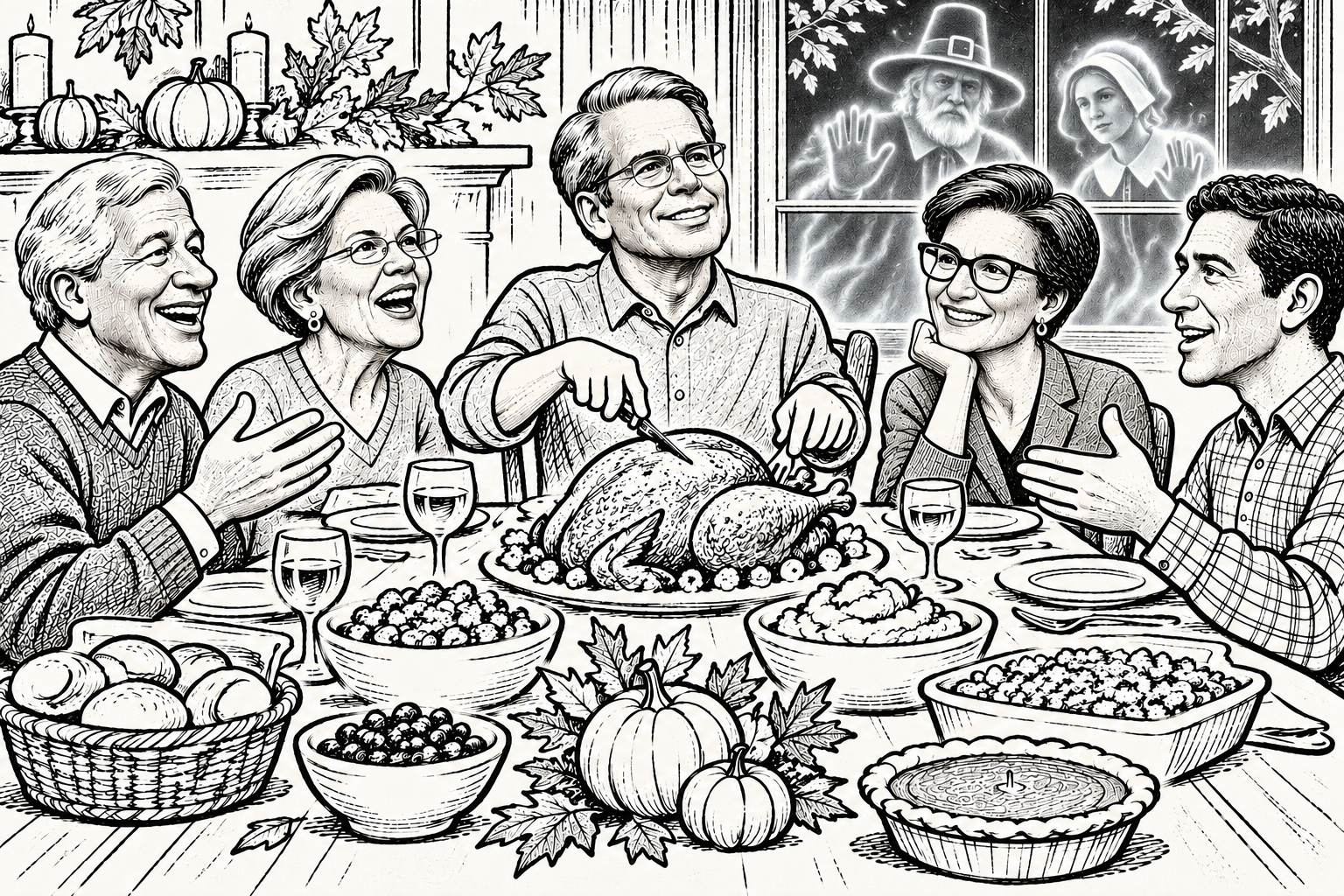
Let’s be honest. Abraham Lincoln wasn't thinking about the Pilgrims when he proclaimed a national day of Thanksgiving and prayer on the fourth Thursday of November and made it a federal holiday. He wasn't recalling the turkey meal William Bradford and his Mayflower friends shared with Squanto and his New England tribesmen. Unless you lived in New England, few people ate much turkey; they ate whatever they could, or didn’t eat because they didn't have much food. Maybe they even fasted on Thanksgiving to give thanks.
For that matter, he was not thinking about Black Friday specials. It was 1863, for heaven’s sake, and he had just fought the bloody Battle of Gettysburg. Soldiers were dead and maimed; it was terrible. In 1621, the Pilgrims held a feast to give thanks for a bountiful harvest. Lincoln was just thankful the country was still in one piece.
And by the way, not everyone in the country was interested in celebrating Thanksgiving. The southern states resisted it even before the Civil War, viewing it as a Yankee holiday. After Reconstruction ended, they embraced the holiday, but only because it was a good way to attract business investment to the region. Thanksgiving and business always go together.
For that matter, Franklin Roosevelt wasn’t thinking about the Pilgrims either when he made Thanksgiving a national holiday you got off work for. Read his proclamation. Nothing in there about Pilgrims. He wasn’t even thinking about moving up the White House turkey dinner when he briefly shifted Thanksgiving to the second Thursday in November. His “Franksgiving” stunt was meant to give retailers more time for holiday shopping, but it backfired spectacularly, so he quickly reversed course and made it the fourth Thursday in November permanently. That is history, for you!
Oh yeah, and this is fun. The Pilgrims didn't even celebrate the first Thanksgiving in the New World. The first Thanksgiving was on September 8, 1565, when the Spanish conquistadors invited some natives over for dinner and a Catholic Mass. (Come on, I know you want to get into the bank treasury stuff, but when you go to Thanksgiving dinner with family and friends, don’t you want some fun trivia to distract people from asking you about the Fed’s December meeting, the odds of a 50-basis-point hike, and your thoughts on putting money in CDs?)
Sorry, but Lincoln wasn't the first president to declare Thanksgiving a national observance. Presidents have been calling for days like these since George Washington. You want to know which president first mentioned the Pilgrims and Thanksgiving in the same speech? Warren Harding. That's right: the Teapot Dome guy who supposedly died in office with his pants down was the first president, in 1921, to stand on Plymouth Rock and praise the “Pilgrim Spirit.” He made the speech and pretty much died right after.
Which brings us to a favorite topic of the newsletter: the Fed. Of course! What doesn’t lead there?
So, get this: In 1921, the Treasury Secretary was also the ex officio head of the Fed (you knew that, right?). Talk about Fed independence! It was not until 1935 that those roles were separated. Oh, and you want to know about corruption? You think it is bad now? You know who Harding’s Treasury Secretary was? Andrew Mellon, who never divested his banking and other business interests when he joined the cabinet. It gets better. In 1921, the head of the OCC was Dan Crissinger, who also held an ex officio seat on the Fed’s Board of Governors and, wait for it, was one of the president’s longtime friends and a next-door neighbor, too.
Oh, and before it reorganized into the bastion of independence it is today, the Fed had a day-to-day leader, let’s call him a de facto chairman. In 1921, Fed Governor William P.G. Harding was the “guy.” No, Harding was not related to the President. Warren Harding never even appointed him to the Fed. He went there when it opened in 1914. (Yeah, a charter member.) And our subscribers will appreciate this: he started as an accountant at a small bank in Alabama and was promoted to bank treasurer. From there, he became a bank president, all before joining the Fed’s board.
Our bank treasury subscribers would have loved the late Fed Governor Harding. We’re talking about a guy who believed the Fed should pay its member banks higher dividends. Raise your hand if you even know how much the Fed pays the banking industry in semiannual dividends today. That’s right, who cares? It’s a rounding error for the Fed and the banking industry, considering that its paid-in capital today equaled $41 billion, the largest banks account for the majority of the Fed’s “equity,” and the dividend rate the Fed pays to large banks is fixed at the lesser of 6% or the rate on the 10-year Treasury. Do the math, and consider that the industry generated $1 trillion in net interest and noninterest income last year.
Did we mention that Dan Crissinger, Warren Harding’s neighbor, succeeded him as de facto head of the Fed? Harding left the Fed in 1922 to advise Cuba on its finances. Pretty amazing CV for a bank treasurer! He returned to the U.S. and ran the Boston Fed a year later. Sad truth: according to the Fed’s website, Harding is the only Fed official to have died in office in 1930. Literally at his desk (maybe)! Who knows whether he was thinking about the Pilgrims when he passed?

Feeling More Relieved Than Thankful
But when you think about the Thanksgiving holiday and what you are thankful for, you have to wonder: aren’t we glad we take Fed independence for granted today, even if its credibility always seems to be on the line? Massachusetts Senator Elizabeth Warren may have branded Kevin Warsh a presidential sock puppet earlier this year when he took the chair at the head of the Fed’s board table in the lavishly renovated, cost-overrun Eccles Building. But at least he denied the charge. And it is not as if, during his hearing, he was also running his own bank, the U.S. Treasury, and the Fed at the same time!
Since his confirmation last March, over her objections, our self-declared anti-sock puppet and dedicated inflation fighter has worked tirelessly with his fellow FOMC members to bring the scourge of inflation to heel and finally slay the PCE beast. Contrary to the President’s insistence that interest rates come down, over the course of four FOMC meetings in May, July, September, and October, while inflation doggedly defied the chairman’s demands to yield, he courageously led the Fed to tighten monetary policy, raising the target range for the Fed funds rate by a full 25 basis points.
With Fed Governor Waller putting a 50-basis-point hike on the table for next month’s FOMC meeting, the chairman will have another excellent opportunity to demonstrate his independence. You have to be thankful that he and his fellow FOMC members still worry so much about risking the Fed’s credibility by testing the President’s wrath, which has kept the real range of the Fed funds rate, adjusted for last month’s PCE inflation of 3.6%, to a whopping 10 to 20 basis points.
Maybe the word, though, is not “thankful”; maybe it is “relief.” Their meanings overlap, but they are a little different, a glass-half-empty, half-full kind of thing. Maybe the reason writing our annual Thanksgiving edition of the newsletter is such a struggle is that bank treasurers aren't really very thankful people. There are many reasons to be thankful if you are a bank treasurer these days. You still have a job, for one thing, considering that the consolidation underway in bank and credit union land has left some of our subscribers temporarily without a seat. But generally speaking, they are more relieved than thankful because they know worse is just around the corner—just not today.
So, bank treasurers can be thankful, at least for today, that conditions are likely the best they have been in years. The financial system is stable, regulators seem intent on easing the regulatory burden, and they listen to you rather than dismissing everything you say. Those are reasons to be thankful. That can change after the next election, which is a definite problem when you try to navigate a relationship with your bank supervisor. As they know, unlike monetary policy, bank supervisory policy makes no pretense of independence, which is why the OCC and the FDIC submitted drafts of their final Basel 3 Endgame capital rules to the White House for review this month. But they can be thankful because the ease is nice while it lasts.
Thankful is probably the wrong word to describe how bank treasurers view the Fed’s cautious approach to raising rates so far. They will be relieved if forward rates still point to only a few rate hikes over the next two years. Financial stability and sudden changes in interest rates don't mix well. But they cannot stop worrying about what could happen if the chairman and other FOMC members realize one day that they were wrong about their heretofore tepid response to persistent inflation and are forced to move faster and higher next year.
Maybe they can thank providence that, even with $41 trillion in national debt and upward pressure on the long end of the yield curve, the 10-year Treasury rate remains around 5%. Not too long ago, it seemed headed toward 6% and possibly beyond. And sure, mortgage rates are high and killing home sales, but they are not the primary reason first-time homebuyers are holding back—prices are. There are reasons to be thankful, or at least relieved, because conditions could be worse today, and they are not.
They can be thankful that, with the Fed’s hawkish stance, deposit costs are generally tame. Federal Financial Institutions Examinations Council data shows the cost of interest-bearing deposits for all banks in the nation at 2.3% in Q3 2026. Costs were higher last year. And be thankful the yield curve is positively sloped. Remember when it was inverted? You can make real spread in this environment. My lord. You could buy bonds and make easy money. Bank treasurers have not been able to do that in years. Listen to this chief financial officer (CFO) at a regional bank on the West Coast explain to a room of equity analysts why he is thankful,
“It's never been a better time in the last 20 years to buy bonds…There used to be a quip…California thrifts would take deposits at three, make loans at five, and California bankers would be at the beach or on a golf course by three. Three, five, three. But taking deposits at three has been viable…It's been rare for me to invest in a Ginnie Mae security with zero risk and earn more than 5% like I can now. And that means it's pretty easy to maintain a 3% margin…to be a banker if you're somewhat risk-averse and have a high appreciation for liquidity.”
Bank treasurers should be thankful that they can buy bonds without feeling embarrassed about having been ripped off by the dealer, as the treasurer and chief investment officer at a global bank said,
“We have tended to avoid longer-dated investments for a long period of time with a view that the market just wasn't correctly pricing them…It's a little harder to maintain that stance than it was four years ago. I think you…look at it and go, the market is more fairly priced.”
Sure, they are thankful, but for the most part, bank treasurers feel relief. Whether the Fed raises or doesn’t raise, and whether it goes 25 or 50, is irrelevant. First, they are neutral on short-term rate changes. But more importantly, they just want financial stability. No sudden changes, less uncertainty, peace, and prosperity. AI might eat the world one day, but right now, as long as it finishes the spreadsheet and doesn’t hallucinate, it's a relief. Because everything could be worse. And it makes perfect sense that bank treasurers feel relief more than any other emotion. Bank treasurers live in a fixed-income universe. The only direction is down.
Like fixed-rate mortgage loans, there is a reason banks have been scaling back their fixed-rate mortgage lending. Making a fixed-rate mortgage loan is economically equivalent to selling the borrower a free option to repay the loan at will. Negative convexity alone is reason enough to avoid these interest-earning assets. (If only it weren’t for that yield pick-up you can get over Treasurys.)
Frankly, if financial stability is their top concern, they should be thankful for the Fed we have today. According to New York Fedresearch, the Fed has done a much better job over the last 30 years with monetary policy, if the preservation of financial stability is any guide. The Fed’s response to shocks, whether on the financial side or the supply side, has improved significantly. When William Harding and Dan Crissinger were at the Fed in the 1920s and 1930s, the country frequently saw financial panics. Economic crises and depressions were common, and the Fed’s responses were slow and limited. The runaway inflation in the 1960s and 1970s stemmed from the Fed’s ineffective response to a shock.
Since Paul Volcker, economic dislocation caused by shocks has declined because he and his successors, Greenspan, Bernanke, Yellen, Powell, and now Warsh, know that response time is critical to good outcomes you can be thankful for. In July 1982, unemployment peaked at over 10%, and Volcker brought rates down immediately. Greenspan’s put was a relief to the markets throughout his tenure as Chairman. Bernanke’s determination not to repeat the Fed’s ineffectiveness during the 1920-1930 banking crises led him to the zero lower bound and quantitative easing (QE) in response to the GFC—his equivalent of helicopter money. A Congressional study concluded that Powell’s timely implementation of rate cuts, QE2, and other measures during COVID saved the financial system from ruin.

AI: White Meat or Dark Meat?
If we cannot be thankful, let’s at least talk turkey. Did you know where that expression comes from? Originally, saying you were talking turkey didn’t mean you were being candid, frank, not mincing words, or brutally honest. It meant you were being pleasant. Talking turkey meant flattering someone, like when you tell yourself that everything is going to be fine and that you are doing a great job selling free options to borrowers and buying all the 2%-3% Mortgage-Backed Securities (MBS) at par back in 2021 because of the yield pick-up over Treasurys.
Yeah! But sometime around the turn of the 20th century, when people across the country began channeling the Pilgrims at the first Thanksgiving and hosting Norman Rockwell-esque dinner-table festivities, the meaning of talking turkey shifted to its present usage. As New Englanders are known for, it comes with no B.S.; it can be kind, not necessarily nice.
So, let’s talk turkey. Would you like dark or white meat? Those are your choices. Is AI going to destroy us or save us? It could destroy civilization and certainly undermine the creative spirit. Massachusetts District Court Associate Justice Brian Palmuccithinks it could get lawyers who use it to write their briefs into trouble when it hallucinates. But his bigger concern is that it undermines judgment and analytical skills.
On the other hand, it is proving excellent at fraud detection; it can write computer code in its sleep (does AI sleep?), and it’s a whiz at reading through a 1,000-page draft of proposed rule-making by the Fed and finding all the salient points one would need to know in literally no time, as the CFO of a large domestic bank on the East Coast told analysts. AI, whatever it is, cannot be ignored.
“We're focused on getting people to adopt it, use it, learn how to use it. And we don't want to wake up one day where other people are ahead of us in how we're using and deploying AI. It could be a game changer…It could help deliver more products and services. We don't really know all the capabilities. We know that it's a tool we need to be good at using.”
But you know what the problem with AI is? It’s disruptive. It's hard to say how civilization will turn out in a few years, but one thing is certain: people will do things differently. Remember life before cell phones? No, right? How did you survive crossing a busy street while texting and listening to music or a podcast on noise-canceling headphones? AI is going to be transformative and disruptive.
What it might disrupt in banks is what has worried bank treasurers. What if you had smart deposits? Deposits that could think for themselves, find the best rate, and then move there? Could that threaten the basics of core deposit banking? Here is a basic truth, though: people do not keep their money in a bank to earn interest. As the above-quoted treasurer and CIO explained,
“We would hope that -- and if a super intelligent agent had to recommend the best bank account in the world, then hopefully, it would recommend us…But I guess you have to remember, the motivations for people in their banking, right? There is definitely a convenience function to having a number of days of cash ready to cover your payments and unforeseen expenses. I don't think what we're looking at is fundamentally changing the business model of checking…yes, on the margin, there's probably a sliver of people who could be more optimized. But generally, our customers -- I mean…if you want a high-yielding product, you can go into the app, and you can press one button; that is objectively still simpler than an AI agent.”
The chairman and CEO of a large domestic bank based on the East Coast made the same point,
“Look, it's easy to see…that the ability to move…money is going to get faster. You can argue that we’ve been that way for a long time…I think what people forget, though, is that…the money you keep in your checking account…versus your investment account…isn't really going to change.”
Here is another basic truth: No one in their right mind is going to let a machine touch their money. At least not today, which bank treasurers can be thankful for; however advanced the software, it still is not perfect, and the human touch is still needed. At least that is the turkey they feed themselves, but relief might be short-lived. The CEO of a regional bank on the West Coast dismissed the risk of smart deposits,
“I was at a function we hosted for some of our family-owned businesses, and I asked them whether they ever saw a day when they would trust AI to move their money around, either personally or with their business. And without exception, they were: absolutely not. Do I think it's a real thing? Yeah. In all seriousness, I don't want to diminish the potential for that to happen. But…I don't think that our customer base is going to be a fast adopter…same thing with stablecoin and tokenized deposits. We don't see a demand or a need from our customers.”
Not today but maybe tomorrow? Bank treasurers can be thankful that the agentic AI bots depositors could use to move money don't operate at the same speed they can “think.” As the CFO of a large domestic bank based on the East Coast noted, he has seen a few instances of the AI bot,
“These types of agents…they are trained to act like humans so that it's not going to all go in real fast. It's going to go in at the pace a human enters information. Right now, we've only seen extraction of information on account balances, the customer's credentials and information, and what rates we're paying, but we haven't seen any movement of money or requests to change products or services.”
But if depositors can end up, through a combination of AI, stablecoins, or tokenized deposits, able to move money faster, and incrementally optimize interest on their savings, see through rate offerings and offer them more transparency than ever before, it will definitely make it harder to rely on the so-called sleepy deposits to fund loans, or fund any long-duration earning asset. At some point, a bank balance sheet would operate like a stablecoin under the GENIUS Act. As the above-quoted global bank CIO and treasurer worried,
“To the extent that it creates incremental deposit velocity…the more velocity there is in deposits and the higher beta deposits have, then the less demand banks have for duration-bearing assets and credit-raising availability. So I also would say that people need to be quite mindful about the second-order effects of this in fixed income. Like there is a -- not that we're going to get there, but in extremis, high velocity deposits at 100 beta mean that banks leave all their money in cash. And that really kind of changes the question of where leverage is created in the economy.”


Want Some More Turkey?
You want some more turkey talk? The Fed’s conduct of monetary policy has been ineffective. Its economists have done a miserable job. In 2021, its officials insisted that the surge in inflation was temporary and transitory. A year later, they reversed course and hiked rates sharply from March 2022 to July 2023. But inflation remained stubborn. So they insisted for more than a year that a 5.25% Fed funds rate would tame inflation, even though their assurances noted a lag before the restrictive policy took effect.
Then, in the summer of 2024, economists began to worry that their rate hikes were about to trigger a recession. Economists always see a recession around the corner—they don’t call economics the dismal science for nothing! A few weak employment numbers spooked them. But after other central banks took the lead and cut, the Fed cut 50 basis points in September 2024. It didn’t have to go 50; it could have gone 25 and made its point. By its last meeting in December that year, it had cut Fed funds by 100 basis points, all on the theory that inflation was getting back in line, that we were maybe one or two more economic prints away from “Mission Accomplished,” and that if the Fed didn’t cut soon, we would face a catastrophe.
In 2025, inflation remained above 2%, yet the Fed still decided the economy needed an even lower Fed funds rate and cut by another 75 basis points in its last three FOMC meetings. Then, all of a sudden, we went back to rate hikes this year. Is this any way to run monetary policy? There is no sugarcoating it. Inflation is still above target. Is that success? A Fed chair is appointed to a four-year term, so six months into the job, Chairman Warsh has not succeeded at what he pledged to do. It has been four months since he last told Congress in July,
“The members of our committee have no tolerance for persistently elevated inflation. And we share a resolute commitment to restoring price stability.”
Of course, tamping down inflation by monkeying around with the overnight Fed funds rate, while the economy continues to go gangbusters and demand for business credit doesn’t seem to care about the cost of credit, cannot be easy. As the chief wholesale banking officer at a large bank based in the Southeast said, higher rates have not altered the basic economic landscape.
“Loan growth and client loan demand are steady. I mean, obviously there have been changes in the interest rate environment, but when you look at it, the foundation is strong. Strong GDP growth, we've got strong consumer spending, there's still plenty of demand out there.”
An industrial revolution is underway, but it is not solely about AI, as the chairman and CEO of a leading private capital firm attested during his latest earnings call.
“In this global industrial renaissance…we're building everything all at once. It's not just AI and data; it's energy transmission, it's next-gen manufacturing, it's defense, it's infrastructure, and it is worldwide. While most of the focus has been on the United States, Canada will spend $1 trillion, the Gulf will spend $1 trillion, and Europe will spend at least that. We see this unfolding over a multi-year period, with a strong upward trend but with cycles.”
If anything is holding back business loan demand, it is not interest rates. Uncertainty, on the other hand, could delay deal closings, which makes sense. Macroeconomic turmoil is never good for business. But as the CEO of a West Coast-based regional bank explained, uncertainty might slow demand, but it won't go away.
“We do a survey every year, a business barometer, about 1,200 small, medium, and probably up to half a billion in revenue businesses across the country. And there are 60 questions. We got the results back in April, and it was surprisingly optimistic. I've had a follow-up with a few people, and the optimism has waned a bit over the last several months because of the things going on in the macroeconomic world, but they are still optimistic, still surprisingly so. You got a lot of customers who have pent-up demand to do something. They want to make an investment. They've been on the sidelines. They're like ready to go. At some point, I think that can be unleashed, but they're still cautiously kind of sitting on the sidelines and optimistic that they'll get that chance in the near future.”
One reason economists have been so poor at predicting the direction of the economy is that it seems to defy basic economic laws. That has been a surprise. As the CFO of a regional bank on the West Coast said,
“Despite all the headlines we read…and what you might think would be the outcome of the tariffs, U.S. goods imports are at record highs. They're higher than they were in 2016. They're higher than they were under the last Administration. In fact, they're the highest they've ever been. And combined goods and services are still growing even faster. In fact, world trade, despite everything you might read in the headlines, is at an all-time high.”
Higher prices for food and gas are putting stress on the economy. That stress isn't as apparent in the data. The K-shaped economy is real, and Fed research shows how it could explain a breakdown in the historical connection among spending, consumption, income, and wealth. The top percentile of the economy is doing great, spending on entertainment and luxuries, while the rest of the economy struggles to pay its bills. There is no question that concentrated wealth creates fragilities in an economy. But so far, delinquencies are tame, and the effects of these fragilities are muted, as Dallas Fed research found. As the head of the consumer banking group at a large regional bank based in the Southeast told analysts,
“We talk a lot about gas prices. That's always something we're all complaining about a little bit. When you kind of look at it down to the customer level, it equates $25, maybe $50 a month, and people have been able to digest that. In other words, they've been able to adjust their spending habits. It's not been causing any sort of major pain at this point. Now, you never want to see that last for a long period of time, but we've got low unemployment and just solid fundamentals in the economy, which really benefits all banks and the business environment in general.”
But maybe the data isn't capturing the whole picture. Maybe economists are having such a tough time predicting the economy because conventional data isn't sufficient. According to bank executives, lower-income borrowers are still paying their bills for the most part, so tracking delinquencies right now won't tell you much. But anecdotally, what are bank treasurers also seeing?
Lower-income bank customers are keeping smaller balances in their checking accounts. They moved whatever balances they were comfortable moving from checking into higher-paying CDs last year, but this year banks are seeing some pressure on deposits because their depositors don't have as much money to leave in their accounts as they used to. As the CEO and chairman of a large East Coast bank said,
“You see consumers at the lower end of the income spectrum spending down their balances for the first time…We're…getting in front of more people and continuing to grow deposits at the same rate we grow loans, but it's getting tougher.”
Economic data is also affected by the ongoing AI technological revolution. Richmond Fed research suggests that productivity, which had been declining since the 1990s, began to improve in the last decade. Yet a growing share of economic activity is simply about replacing your iPhone, as today’s new “thing” is obsolete by tomorrow. Exaggerated or not, obsolescence is nothing new, and replacing old tech with new tech has been going on for decades, at least since 1947, when the St. Louis Fed began capturing the data in its FRED database. However, the contribution of replacing depreciated assets to total gross domestic product (GDP) is growing.
Real GDP measures all goods and services produced domestically, while Real Net Domestic Product equals real GDP minus the production needed to replace depreciated goods. In 1947, the difference between these two measures, as shown in Figure 1, accounted for 9%-10% of real GDP through the 1950s and 1960s. Starting around the 1970s and continuing through the last quarter, the obsolescence factor in the economy has been growing faster and, in the last couple of years, has averaged 21%.
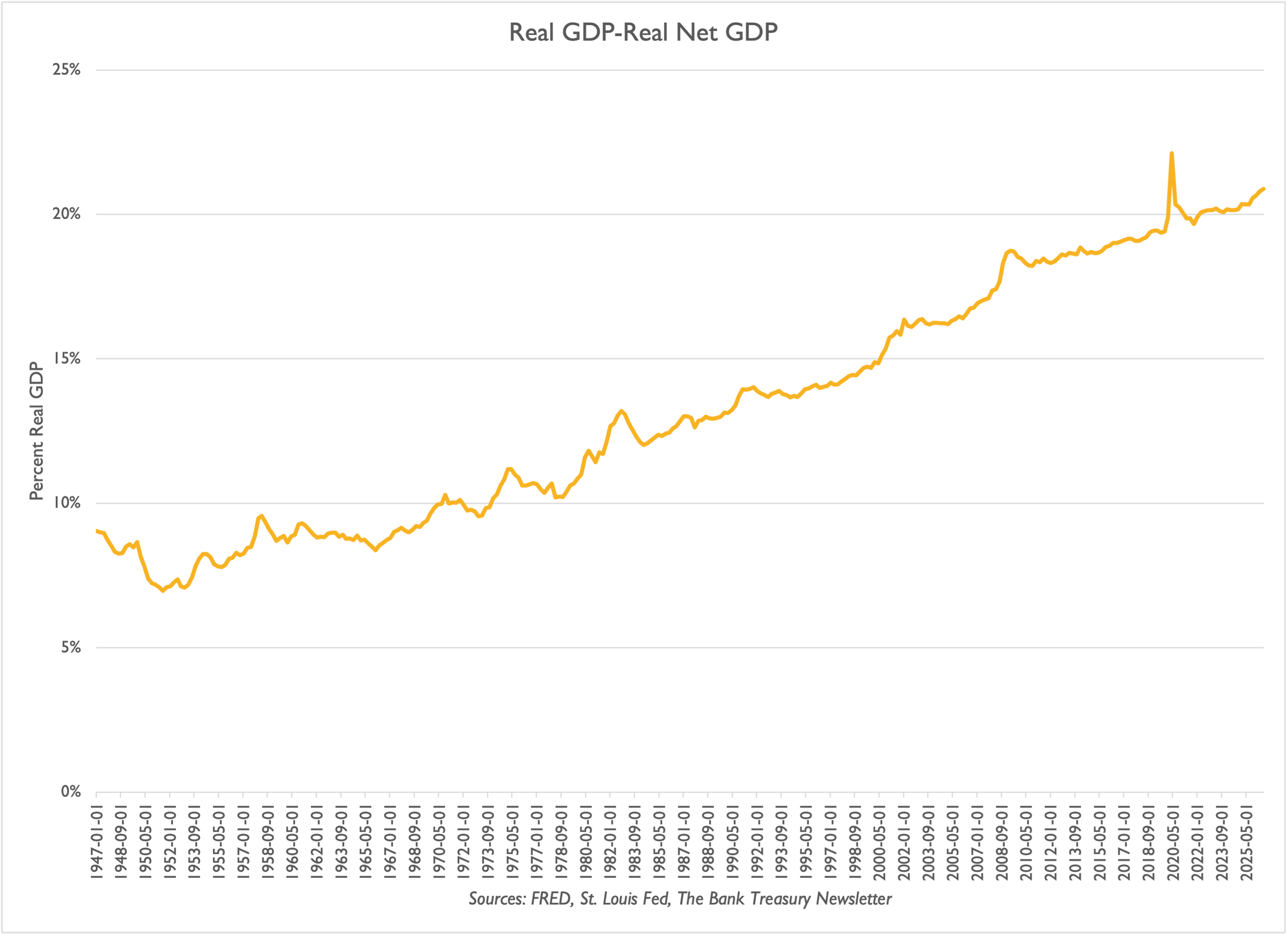
Figure 1: Real GDP Minus Real Net GDP Divided By Real GDP

Bipartisan Politics and the Turkey Dinner
Around 100 years ago, eating turkey on Thanksgiving became an American tradition. People had eaten it before, especially in places like New England, where the Pilgrims were never forgotten, but by the 1920s, if you didn't have turkey, you didn't eat a Thanksgiving meal. Which is great unless you are the turkey. It took decades for a president to consider sparing the poor things. George Bush Sr. was the first president, in 1989, to officially pardon a turkey and spare its life. Presidential turkey pardons have been a bipartisan affair ever since.
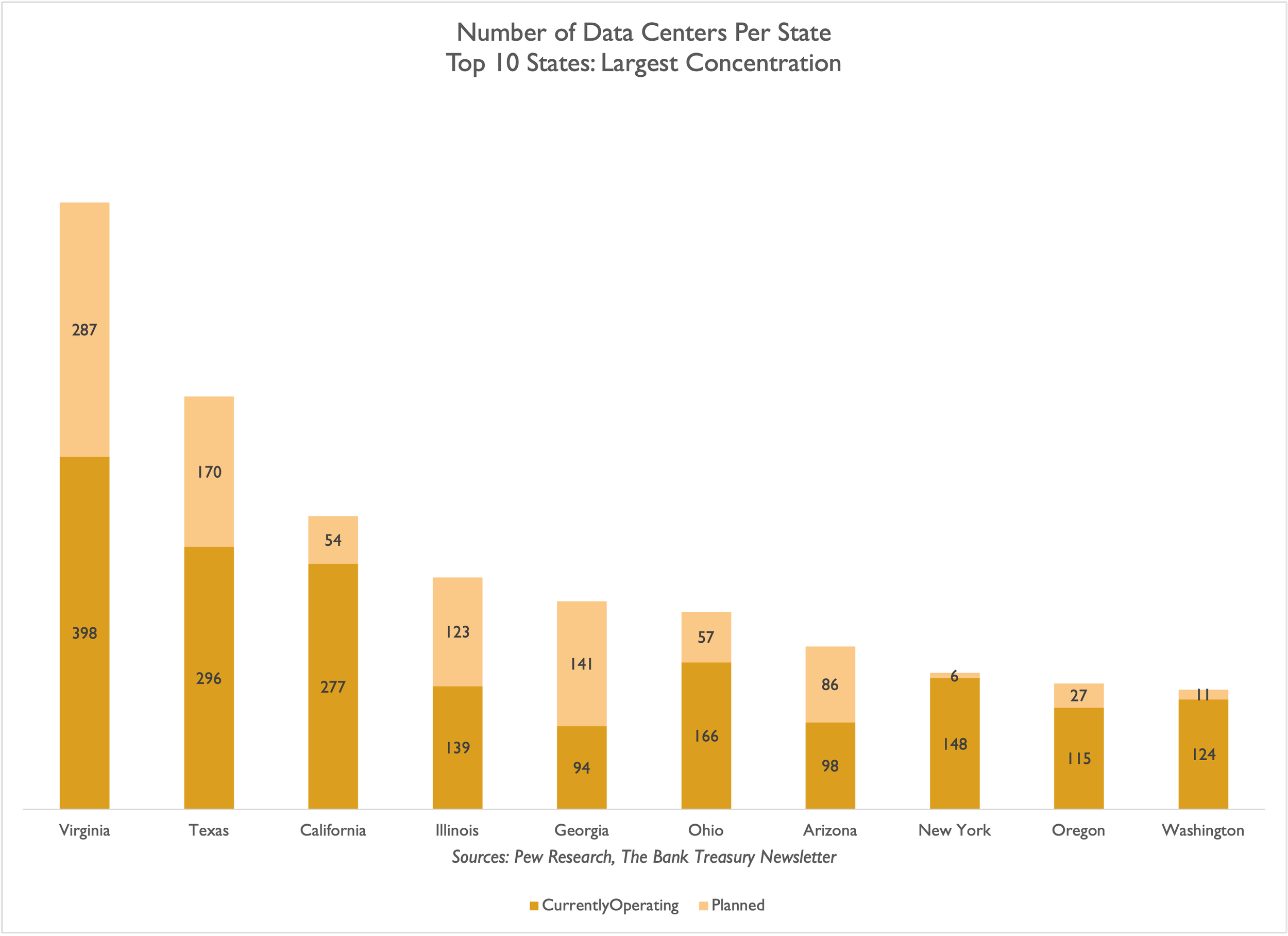
Elections still have consequences, but as far as bank treasurers can see, the outcome of the Midterm elections will not fundamentally change their picture. Elections are unlikely to slow the AI boom, at least not right away, given the data centers already in the pipeline (see Slide 10 in this month’s chart deck). The Treasury is still on track to post another multi-trillion-dollar deficit next year and will raise $1.04 trillion through coupon issuance in the next quarter alone, not counting the growing size of its Bill auctions. Dealer balance sheets will need to absorb more inventory and higher repo financing demand, which new Fed research concludes will strain secondary market liquidity.
The Fed remains hawkish, whatever that means, as it debates whether to raise rates by 25 or 50 basis points next month, with the effectiveness of its monetary policy and its credibility to rein in inflation still in doubt. Having not responded when the Fed funds rate held at 5.25% for 14 months, most probably the forwards are wrong, and the Fed will need to hike more. The only thing not in doubt is that the confluence of these factors, including Fed credibility, has caused a paradigm shift in the real rate of interest, the neutral rate, r*, as the treasurer and CIO at a global bank saw.
“We have come back a long way for how many hikes are priced into the end of 2027, and it is just over two now. That is…the lower end of the range of what is credible. I…would be cautious about the upside…but I don't think the policy outcomes in 2027 matter very much. I think what really matters…is what…the market is going to settle on as…the neutral rate…Four years ago, you had medium-term forward rates at 3%; now they're at 5%. That's been the real paradigm shift: this realization that we're in a high-growth, high-investment, high-inflation, much, much higher neutral-rate environment. I think the Fed is acknowledging that, but that's led to curve steepening.”
The election doesn’t change the outlook for rates, he continued. The truth is, it will not change any of the dynamics that are driving the AI miracle. It probably will not even challenge the deficit spending that is challenging all fiscal prudence. Spending is a bipartisan pastime, after all. As he continued,
“I don't see anything in the election that…massively changes your prognosis for short-term rates…The two parties are going to need to find a place to work together. And I think the only thing that they agree on is that there are certain things we need to spend on. They disagree on the things you need to spend on, but they could probably agree that…you spend on both…In the short term, I think the dynamics driving inflation have very little to do with…politics. We’ve got relatively interest-rate-insensitive aspects of the economy growing fast, and the investments being made are viewed as an imperative and will keep being made. That dynamic is politically insensitive.”
The election will not change the reality that the economy will need to learn to live with a higher neutral rate and a steeper yield curve. If the economy continues on the path we are on, a steeper yield curve is almost inevitable. Every bank treasurer knows this is good for bank Net Interest Income (NII). As the CFO of a large bank based on the East Coast said,
“A steeper curve improves NII; a flatter curve hurts NII.”
If you are a bank with fixed-rate assets funded in 2021 and those assets are rolling off, a steeper yield curve is something to be truly thankful for. As the chairman and CEO of a bank based in the Southeast, in just such a position, told analysts, his growth projection for his bank’s NII is based on three factors,
“We've got…legacy loans that aren't marked that are coming due over the next five quarters that are fixed repricing…And then we have a securities book…And then the third component is new production. And of course, as we get a steeper yield curve, that's better. If we get a flatter yield curve, not as much.”
Unlike monetary policy, bank supervision is inherently political and of interest to both political parties, shifting depending on who is in the White House. The current Administration, for example, through the OCC, FDIC, and Federal Reserve, has approved mergers at a rapid pace and granted new trust and industrial loan company charters. If a bank wants to buy another bank, the time to do it is in the next two years, if Democrats carry through on their midterm success and retake the White House. The head of a global bank’s investment bank saw a window closing soon, which will spur more business.
“Look, there is very clearly a view that it may be now or never. Because if you go back to an FTC and a DOJ the way it was under the Biden administration, which could very easily come back in '28, and then that could be there for four years, could be for eight years, could be for 12 years, there is an opportunity to get something done now that you may never have the opportunity to do…I think, given what just happened in the Midterms, that's going to come back to the forefront of the conversation…I think you are going to see transactions. This year and in '27, but like that will be driven by folks thinking there's a real regulatory window. Like it's just, it's a reality.”
It is now or never, especially if you want to win in the retail banking space, where size matters. As the chairman and CEO of a large East Coast-based domestic bank explained, retail banking will be controlled by just a handful of banks. Even if the political chessboard does not change, the reality is that the game of thrones is ending soon, so whatever is spent to achieve domination will be worth it.
“You have a handful of banks consolidating retail in this country at the expense of everybody else…I don't really care how we get that share. We can build branches everywhere. We'll do digital. We'll do whatever we want, but when the music stops, you must have a critical share to be a real retail player in the country. If 10 years from now, branches are completely irrelevant, which I don't think they will be, but if they were, and we end up with material share. I will be happy to write them off. It was a great investment. So we've got to do this today because the game is going to end. And we've got to be a winner that comes out of the back end of that.”
You know, the political environment can change, and a new president could return us to the tighter supervision that existed during the prior Administration. So, if you want to get a deal done, elections have moved up the clock. But, as the CFO of a southern-based regional bank said, elections are not going to change the economics of any deal. Either it makes sense, or it doesn’t, and bank managers have only one responsibility: to generate positive shareholder value, not destroy it.
“I think the clock's always ticking down to do something…We could get back to…where it’s much harder to get a deal done, but it's not going to make you take a deal that is unfair to you as a seller or overbid on somebody. We still have a fiduciary responsibility to our shareholders to do the right financial deal. We sat here two years ago, and it was a red wave, and everyone said, there's going to be nothing but consolidation. There's going to be so many fewer banks. That didn't happen. I heard an investor say that every bank that goes up for sale is getting a buyer. I said, no, every bank that you hear about that's for sale is getting a buyer. There are lots of banks that have been shopped for years, but you look at the math, and you're just like, who would want to buy that?”
And if there is one lesson bank treasurers can take from the outcome of the Midterms, as the CFO of a large regional bank based in the Southeast said, you need to be adaptable. If you maintain your balance, political outcomes should not interfere with your ability to generate shareholder value. You need to be as politically neutral as you are about interest rates (at least in the short term).
“I don't know that I'd say scared. I think when I look at the elections, it's just a reminder you have to be adaptable.”
Adaptability is always a good policy. You know what successful bankers also do? It is a simple truth. If you want to do business with someone, it pays to pick up the phone and call them. Getting in front of customers is banking 101, as the above-quoted CFO of a smaller regional bank based in the Southeast said.
“Our best defense with clients is to be in front of them. The more opportunities you have to talk to your clients, the more opportunities that they feel if another banker calls on them and they call and say, ‘Hey, this banker just called me. They're offering that, and they give you the option to negotiate with them.’ You give them the option. If a banker's not talking to a client and somebody else's bankers are, that's where there's a problem.”

Just Desserts: HTM Hedge Accounting
Like turkey, pumpkin pie is a national tradition, a must-have on the Thanksgiving table. If you Google it, you’ll learn that Sarah Hale was the reason. Sarah Hale lobbied Abraham Lincoln to establish Thanksgiving as a national holiday, but before that, in 1827, she wrote “Northwood,” a novel in which she described the perfect, traditional Thanksgiving menu. (Just for the record, pumpkin pie is great, but it didn’t take off until 1929, when Libby introduced canned pumpkin—isn’t Google AI great!) As she wrote,
“The roasted turkey took precedence on this occasion, being placed at the head of the table…There was a huge plum pudding, custards, and pies of every name and description ever known in Yankee land; yet the pumpkin pie occupied the most distinguished niche.”
So, in that tradition, saving the best for last, this Thanksgiving edition of the newsletter’s equivalent of pumpkin pie is the FASB’s approval this month to amend GAAP to permit fair value and cash flow hedging of interest rate risk for securities carried in HTM. Bank treasurers may adopt the new accounting standard early, but it will otherwise take effect by the end of 2027.
Suffice it to say, this is a major move that will benefit bank treasurers, a complete win-win, especially for those who work for large banks that held most of the $2 trillion in securities the industry held in HTM at the end of last quarter. Previously, when they bought a bond, they had a choice: they could book it in AFS or HTM. If they booked it in AFS, they had to record it at fair value and reflect changes in its fair value in stockholders’ equity as Accumulated Other Comprehensive Income (AOCI).
If your bank’s total assets are under $250 billion, you do not include AOCI in your regulatory capital calculation. The industry widely expects that the final draft of the Basel 3 Endgame will lower that threshold to $100 billion. But regulatory capital is only one consideration, as other GAAP-based measures, including tangible equity and earnings per share, are also affected by AOCI. Large negative AOCI balances, as exist today, are undesirable with or without a regulatory exemption.
On the other hand, if they book the bond in HTM, they must hold it to maturity unless they merge with another bank, in which case a one-time sale is permitted. The good news with HTM is that you do not have to carry it at fair value or hold capital as a buffer against fluctuations in the bond’s fair value, as you do with AFS bonds. The bad news is that if you bought a fixed-rate MBS in 2020-21, you are underperforming the current MBS rate by at least 3 points.
Even worse, you cannot do anything about it because you cannot sell it. Until the FASB’s final decision this month, you couldn’t even hedge the interest rate risk that would have let you avoid the underperformance. You have to wait for the homeowner to move, die, or get divorced for the bond to pay off. Just ask the managers of the Fed’s System Open Market Account (SOMA) portfolio how that is going. The Fed bought a ton of Agency MBS during QE in 2020-21. Today, its Agency MBS balance is $1.9 trillion, down from $2.7 trillion at its peak five years ago, a decline entirely attributable to paydowns and maturities. Based on its current payoff rate of 10% a year, the Fed will own an Agency MBS portfolio for another decade (Figure 2). That is the slug of underperforming interest-earning assets that bank treasurers just hope they will stay in their jobs long enough to say farewell.to maintaining ample reserves, some bank funding desks might bid for Fed funds at the end of the day, while others might try to sell what they didn't leave at the Fed. Ample reserves may reduce the likelihood of bottlenecks, but they cannot eliminate them. Money moves around. And as Gertrude Stein was fond of saying,
“Money is always there, but the pockets change; it is not in the same pockets after a change, and that is all there is to say about money.”
Deposits move around the system constantly, and bank treasurers' first order of business is preparing for contingencies as cash flows in and out. But managing liquidity is much easier when deposits are still growing. Deposits increased by $1 trillion last year. Even with higher rates, customers left more in their noninterest-bearing deposit accounts than last year, on average, though not at every bank.
FDIC data show that noninterest-bearing deposits at all insured banks rose by $163 billion over the past year to more than $4 trillion. The balance remains well below its mid-2021 level of $5.5 trillion, before the Fed raised rates. However, like their lending outlook, bank executives say they are very confident in their deposit story for next year. As the CFO of one of the global banks told analysts, interest rates have a more muted impact on noninterest-bearing deposit balances today because rate-sensitive depositors have already moved their money.
“We're anticipating that we can continue to grow non-interest-bearing deposits as we have done over the course of the past year. Remember, whether rates go up by 25 basis points or not, non-interest-bearing deposits are ultimately more sensitive to inflation and GDP…Much of the rate rotation happened when rates moved from 25 basis points to 5.25% and then down to 4.5%. We've been in that environment now for three or four years. There's been a lot of time for consumers and wealthy clients to sort of settle into that environment.”
Another senior executive at a global bank agreed,
“The impact of higher rates is a lot less than it once was.”
The chairman and CEO of a large bank headquartered on the East Coast predicted no significant change in noninterest-bearing deposits this year.
“You got to remember that back in '23, the big change was driven by non-interest-bearing deposits moving to interest-bearing deposits. Most of the excess deposits are out of the system.”
At 20% of total deposits, bank treasurers generally do not expect the ratio of noninterest-bearing deposits to total deposits to change much as the Fed hikes at least one or two more times this year. In fact, the ratio has been stable for over a year. According to the CFO of a large regional bank in the Southeast, the only reason deposit balances for individual accounts could be falling is that, after spending on gas and food, there is less left over to save, not interest rates.
“We're not seeing a mix shift, and we haven't seen it for well over a year now. Rate-sensitive customers had already taken advantage of that in a rising-rate scenario, and we stabilized. What we are seeing is that the cost of inflation has them with less money in their operating and checking accounts, right? They're spending it more quickly, so their average days at a higher balance is a little bit lower.”
Of course, if you are one of the banks with more deposits than you can lend out, competition is not much of a factor in pricing deposit products. As a result, the system's cost of deposits fell to 1.8%, its lowest level in the past three years, according to FDIC data. The president, CEO, and chairman of a global bank noted that its cost of deposits was below the national average.
“We don't see the dynamic because we have a lot of room to grow loans without having any pressure to raise funds for them…149 basis points against the current rate environment is a pretty good place to be.”
And no one is worried about competition for deposits, even with stablecoins and new entrants, including industrial loan companies and trust banks chartered this year. For one thing, research suggests that the decision to hold a stablecoin or a bank deposit depends more on pricing than on rates, per se. Banks control their destiny. Agentic AI and tokenization are taking much of the pricing power banks had over deposits. As the president and CEO of a regional bank based in the Southeast lamented,
“The historical inefficiency in deposit pricing is being sucked out of the industry, and I think it's going to just be more that way with technology.”
But competition is part of the territory in deposits, as the chairman and CEO of a large bank in the Northeast told analysts.
“Any quarter we talk about, it's always going to be competitive for deposits.”

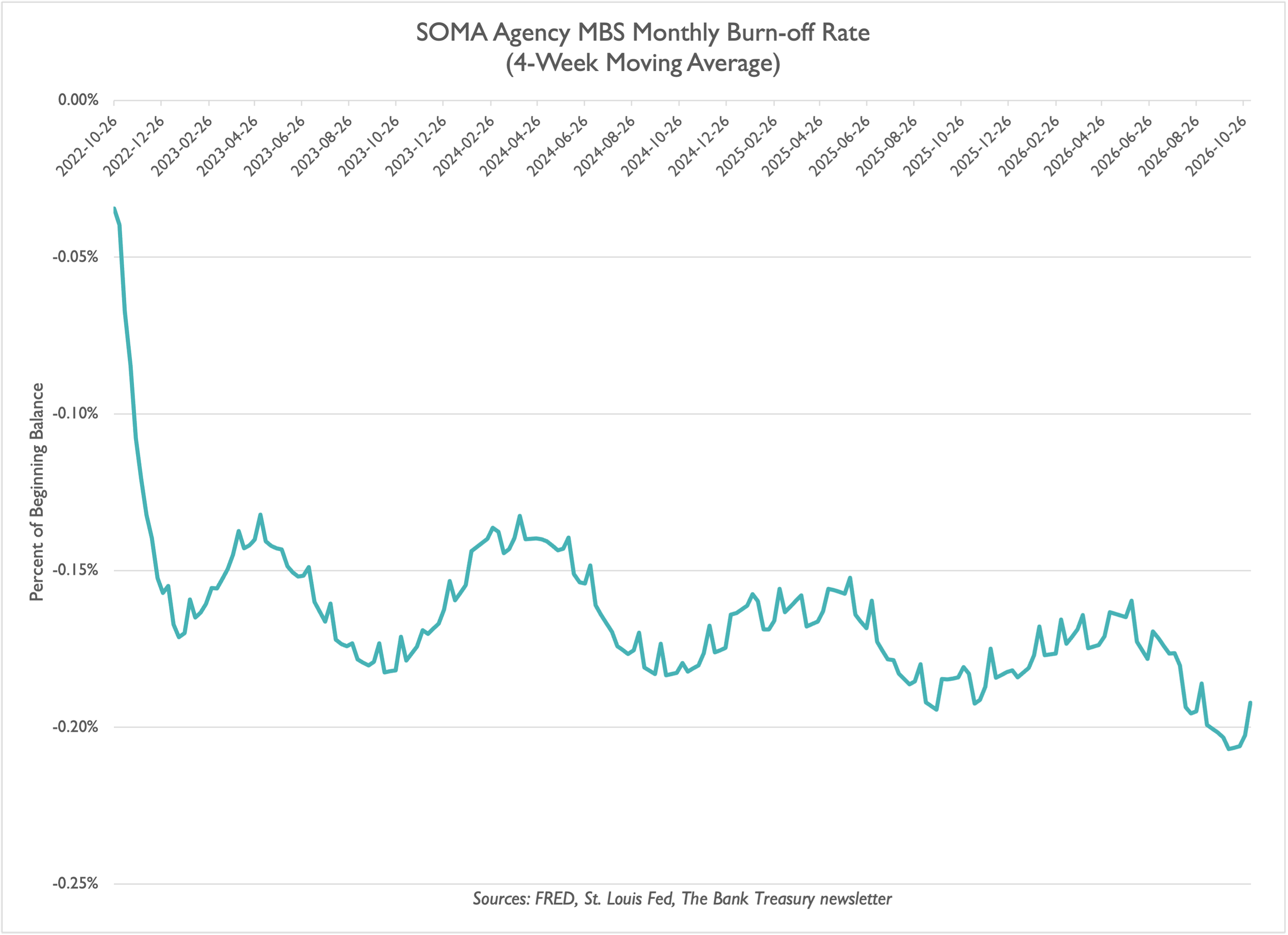
Figure 2: SOMA Agency MBS Monthly Burn-off Rate (4-Week Moving Average)
FASB just gave bank treasurers a huge incentive to book more bonds in HTM. Yes, they cannot sell them if they need liquidity, but they can use them as collateral for repo. And while the bonds a bank carries in its AFS portfolio are part of its core liquid assets on the assumption that they can be sold to fund other assets, in reality bank treasurers rarely, if ever, rely on their AFS portfolio for unforeseen liquidity needs. They have contingency funding for that purpose.
The above-quoted CIO and treasurer of a global bank saw FASB’s accounting change as a significant change in his calculations on where to book bonds,
“I think it's great…There are two things that are quirky about HTM…One thing about HTM is it is hugely more capital efficient than AFS. And as such…you could be incentivized to own things that you might not otherwise own because of the capital benefit. And own them in a way that's very, very structurally illiquid, like, i.e., you can't sell them.”
Then there is another quirk with HTM, as he continued
“The other thing about HTM is that when you couldn't hedge it, you had to think about how much duration you were willing to hold in HTM…at both ends of the rate range. In a high-rate environment, we will need fewer fixed-rate assets…And so it puts an upper bound on your HTM duration. If you can hedge it, it doesn't, right? It immediately kind of frees up that constraint about managing through the cycle without having to kind of take the unnecessary volatility in the AOCI capital. Otherwise, you're carrying Common Equity Tier 1 (CET1) just as a buffer for rate volatility, which is an inefficient use of CET1.”
Changing the accounting rules for HTM is only fair. You could hedge interest rate risk on fixed-rate loans carried at amortized cost, but until FASB changed GAAP, you couldn’t hedge fixed-rate bonds in HTM. Yet the two assets are economically equivalent; you cannot sell loans carried for investment any more than you can sell bonds held in HTM. Lines need to be drawn in accounting, but the line here seems arbitrary.
Then again, many distinctions, when you think about them, are arbitrary. For example, what counts as liquidity is arbitrary, based on the idea that liquidity gives you immediate or near-immediate cash. Bank treasurers generally do not include their bank’s untapped line at the Fed’s discount window in their contingency funding plans, or the collateral they preposition at the window, at least not explicitly. But they do include bonds in HTM that need to be repo’d or sold in functioning markets to provide liquidity when needed. This means there is an inherent inefficiency built into bank liquidity management, as he continued,
“We have liquid assets…we also have a huge discount window capacity that we give zero value to. And by the way, I'm not actually a proponent of giving it full value because you should think -- everyone needs a bit of contingency, but there is a very arbitrary distinction between the two, right? There is a -- there are high-quality assets with no liquidity value. And then there is the thing just on the other side of the line, which is like 100%. It's a little bit…arbitrary cutoff unreflective of the behavior that banks in practice would exhibit in a stress. And that I think on the margin is quite curtailing liquidity capacity in the system.”
Bank treasurers should be thankful that the Fed is listening. To encourage banks to improve their readiness to use the discount window in an emergency and to incorporate access to it into their contingency funding plans, the Fed is considering allowing banks to include prepositioned collateral at the discount window. If adopted, this could improve liquidity in the financial system at a time when the Fed would like to reduce its balance sheet, even as reserve deposits remain ample.
Did we mention that the Treasury said it expects its Treasury General Account to exceed $1 trillion next quarter, which will directly reduce reserves dollar for dollar unless the Fed offsets it by increasing its holdings of Bills in its SOMA portfolio? An understanding Fed, a more liquid financial system—how can you ask for more? A fitting and filling way to end a feast.
The Bank Treasury Newsletter is an independent publication that welcomes comments, suggestions, and constructive criticisms from our readers in lieu of payment. Please refer this letter to members of your staff or your peers who would benefit from receiving it, and if you haven’t yet, subscribe here.
Copyright 2026, The Bank Treasury Newsletter, All Rights Reserved.
Ethan M. Heisler, CFA
Editor-in-Chief
This Month’s Chart Deck
Financial system liquidity is generally stable, but cracks are emerging as we head into year-end. In the Treasury repo market, for example, the daily effective Fed funds rate spiked negative, below the Secured Overnight Financing Rate (SOFR) (Slide 1), suggesting that collateral supply tightened relative to cash supply. On the other hand, some of the change in the spread could be seasonal; it is certainly not as severe as the negative spike in the spread at this time last year. In addition, primary dealers report an upward trend in fails to receive and deliver (Slide 2) in Treasurys over the last year. There also seems to be more stress in the bank treasury world. On paper, for example, banks have more deposits than they can deploy in loans, even as loan growth continues to chug along. Yet borrowings are up over the last year to levels last seen after the regional bank failures in 2023 and early 2024 (Slide 3), suggesting liquidity on bank balance sheets is not as abundant as it seems.
A key question for bank treasurers is where interest rates are headed and, if they rise, how much. For example, r*, the theoretical real, risk-free overnight interest rate, has trended higher over the past 2 years (Slide 4). On the bright side, bank treasurers can earn over 500 basis points on a jumbo mortgage loan compared with the average rate they pay for a 1-year CD, the highest spread they have seen in a decade (Slide 5).
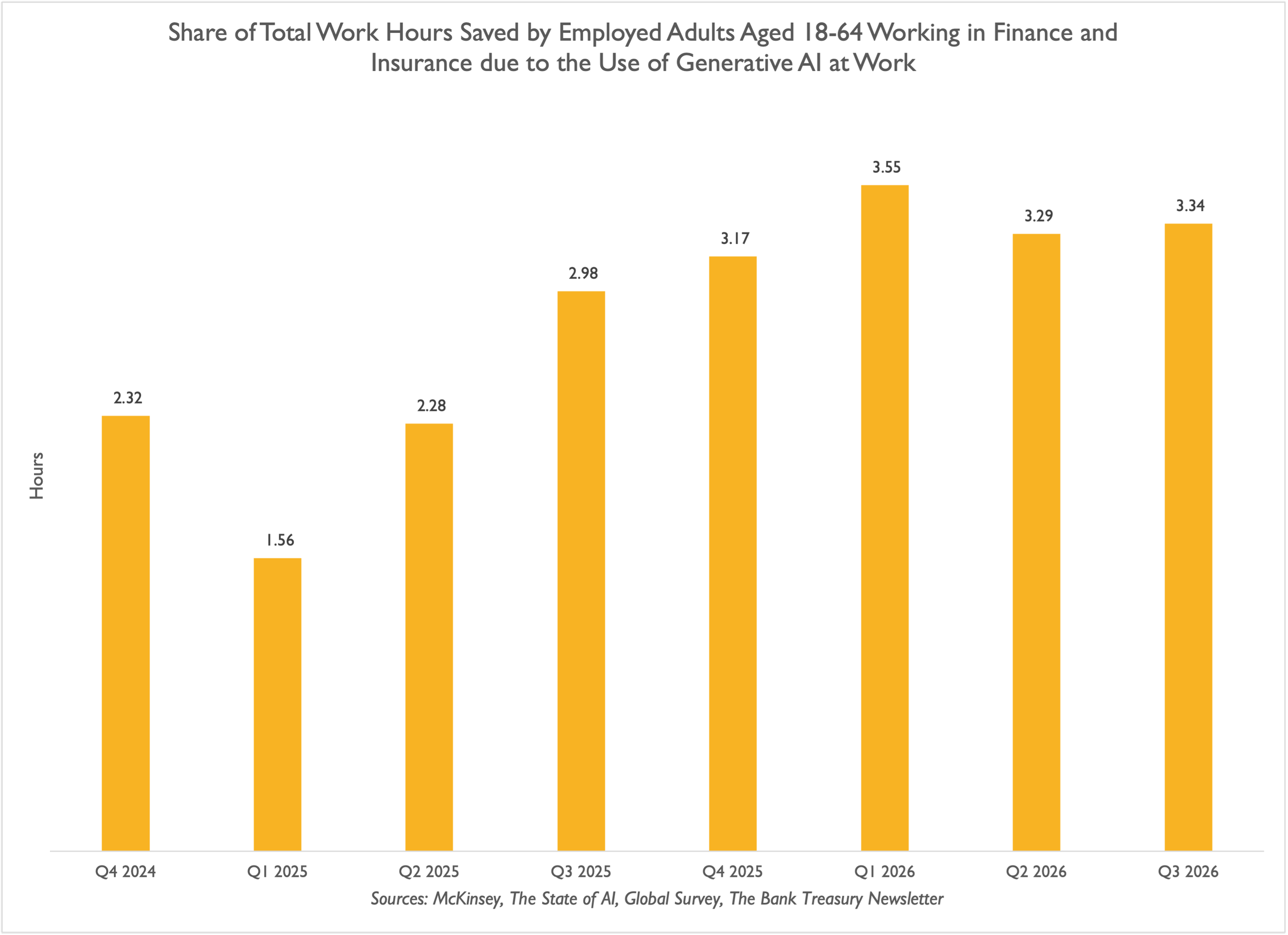
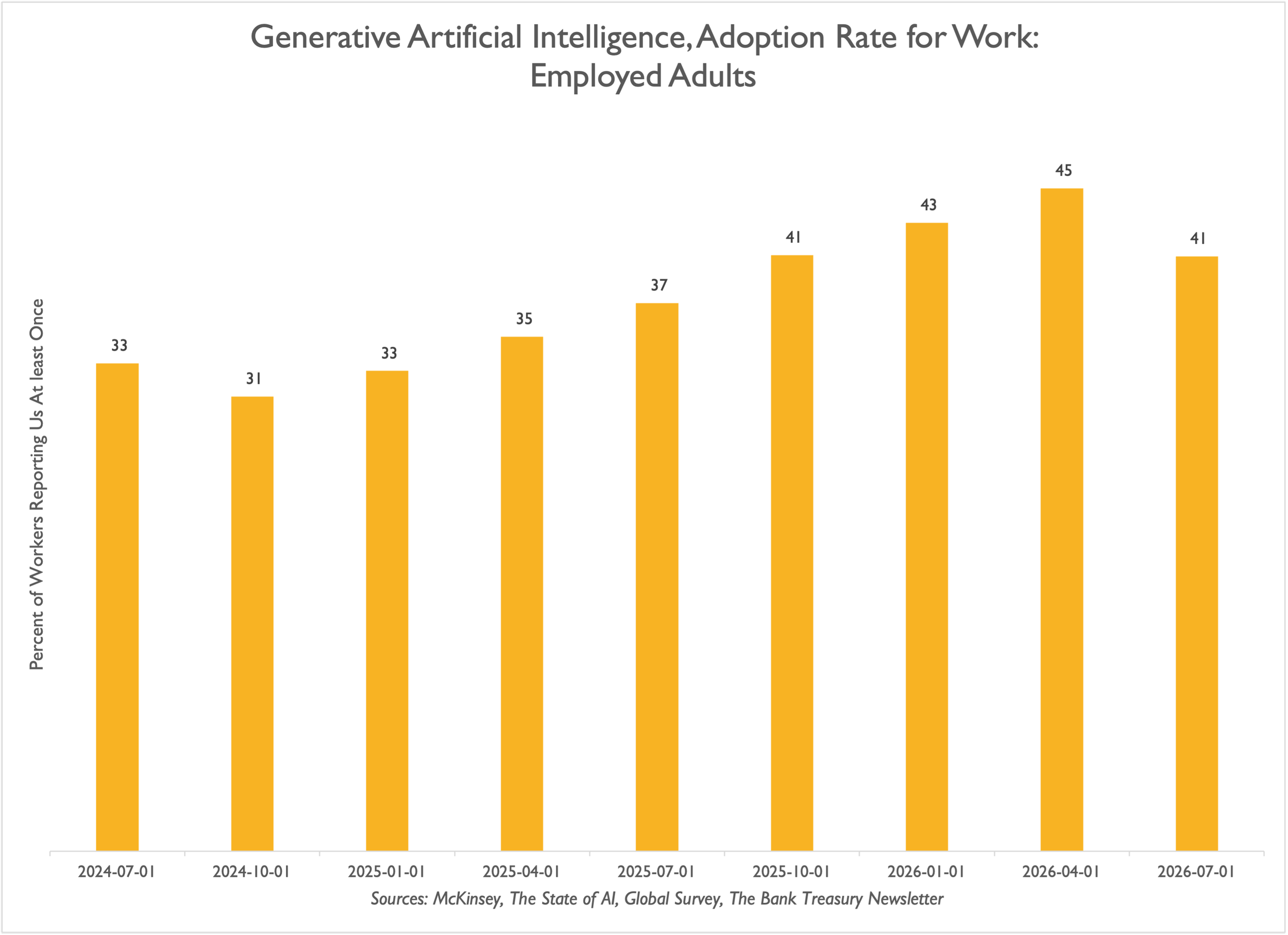
Artificial intelligence (AI) remains top of mind for bank treasurers, and for good reason. According to a 2026 McKinsey survey, companies reported that their workers used AI in at least one business function over the past year (Slide 6), with banks leading the way. For example, McKinsey’s survey found that banks are among the top users of AI coding tools to build in-house functionality without buying outside vendor software (Slide 7). However, this year’s survey respondents at banks and insurance companies did not report a material improvement in the time saved using AI compared with last year's survey (Slide 8). The survey also found that the use of generative AI at work may be peaking (Slide 9).
Data centers, which support AI’s vast computing power needs, were a flashpoint in the Midterms, no more so than in the state of Virginia, where the number of data centers exceeds even the number in Texas, including those already in operation and those planned or under construction. According to Pew Research, published this month (Slide 10), Virginia had 398 data centers in operation, compared with Texas, which has 296. But Virginia also has another 287 data centers in the works, compared with Texas, which has only 170 in the planning stage or still under construction.
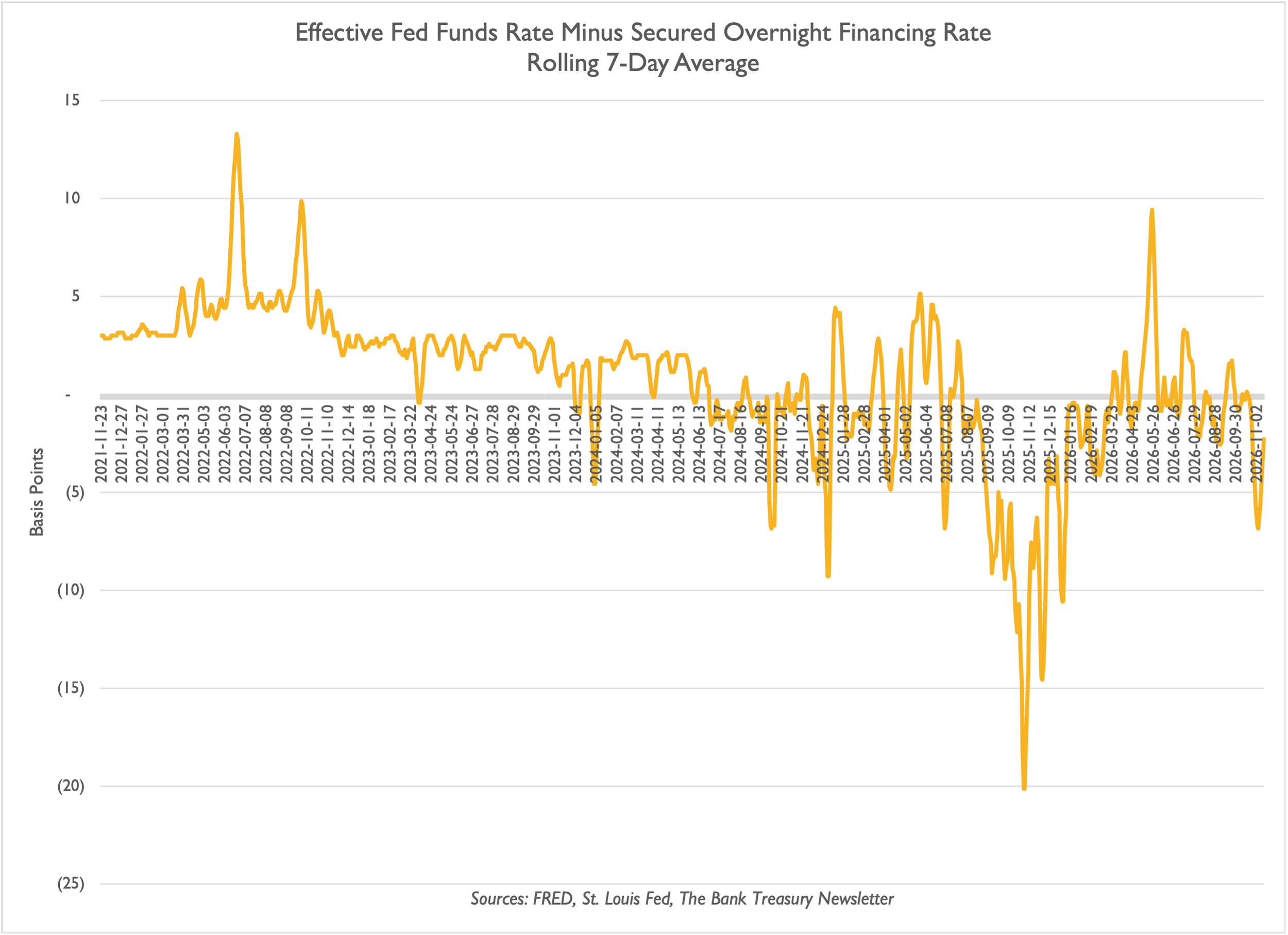
Collateral Supply in Treasury Repo Tightens
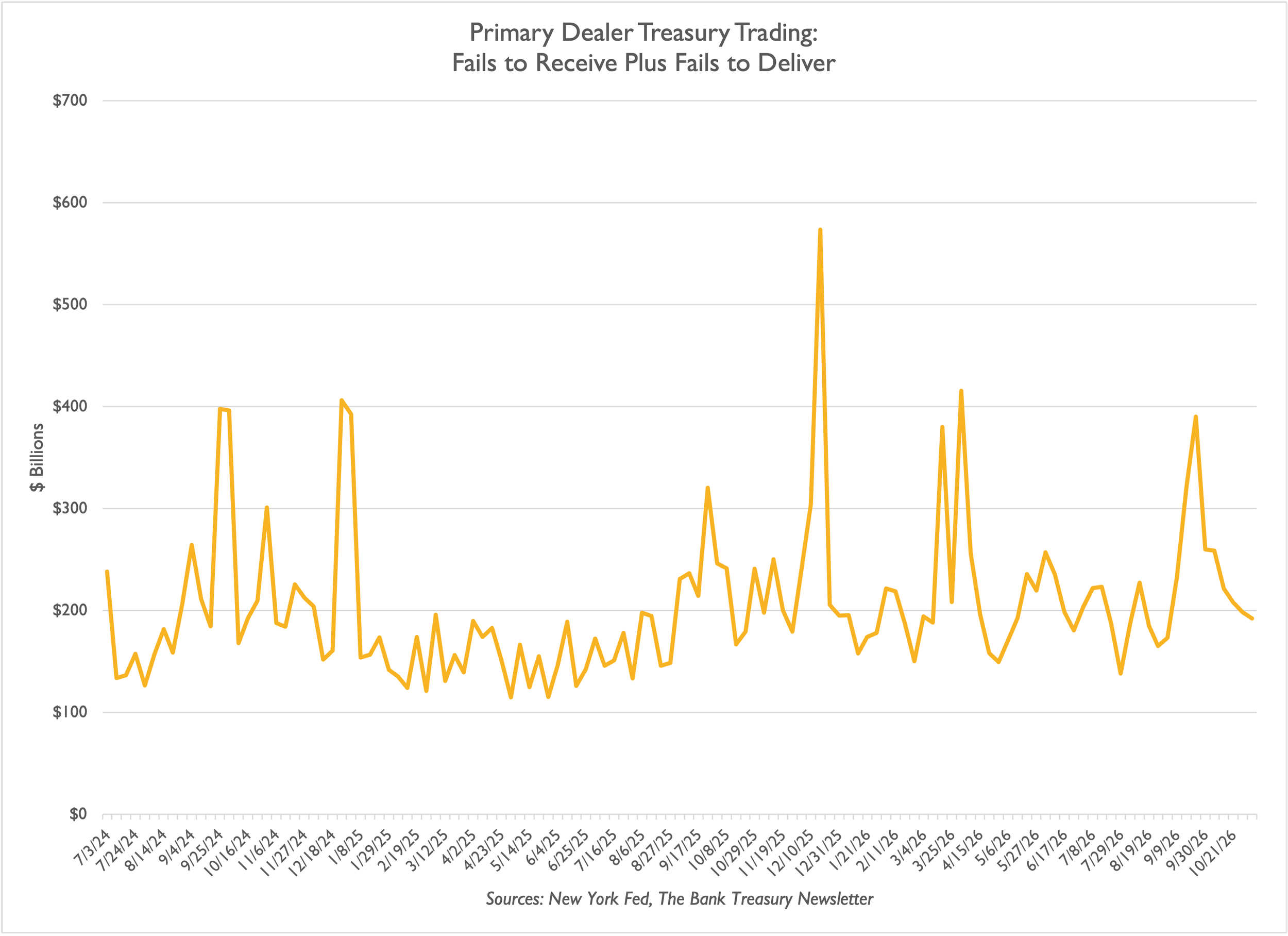
Fails to Receive/Deliver Trend Higher
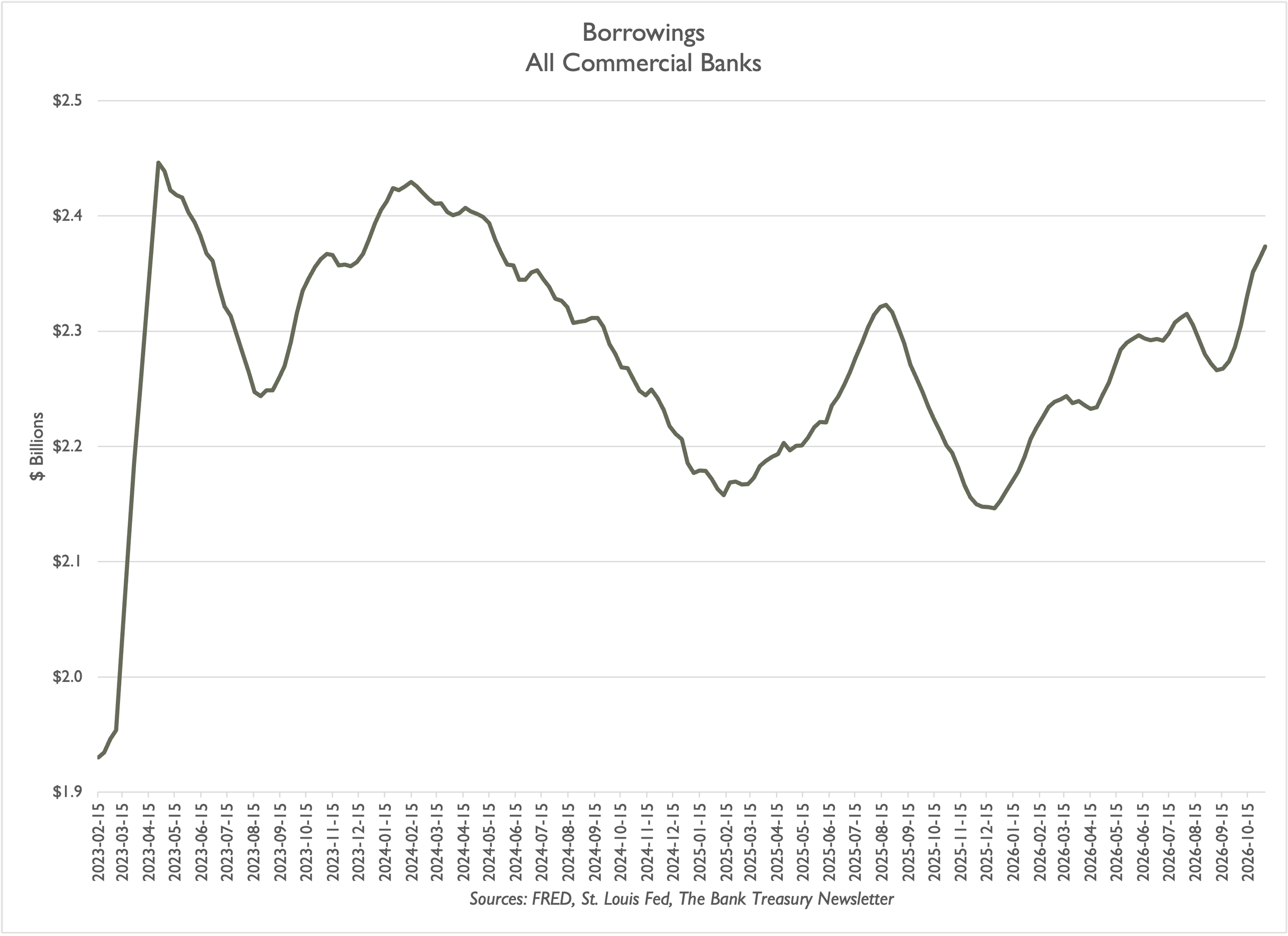
Banks Tap Their Wholesale Funding Sources
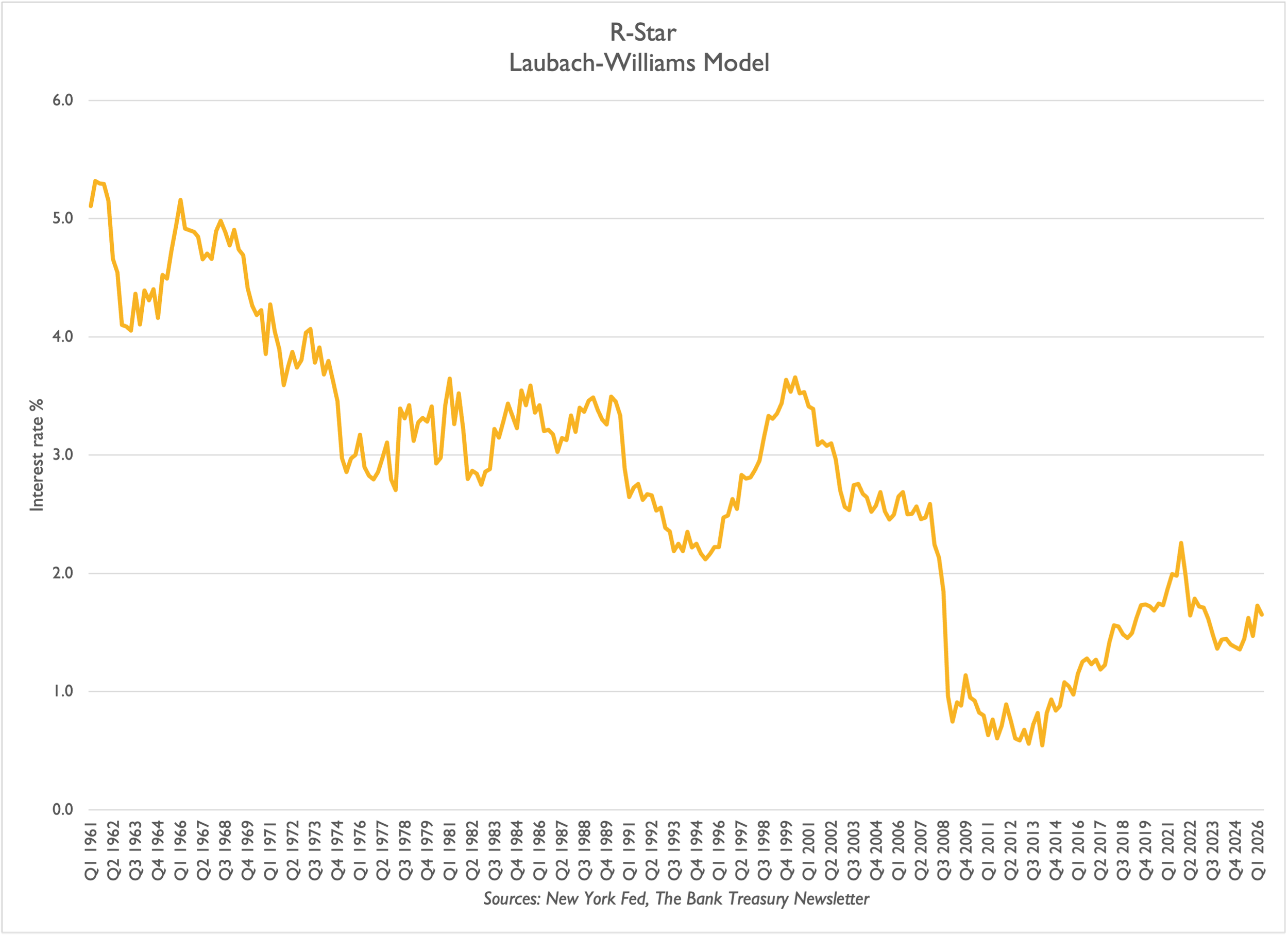
R* Rising
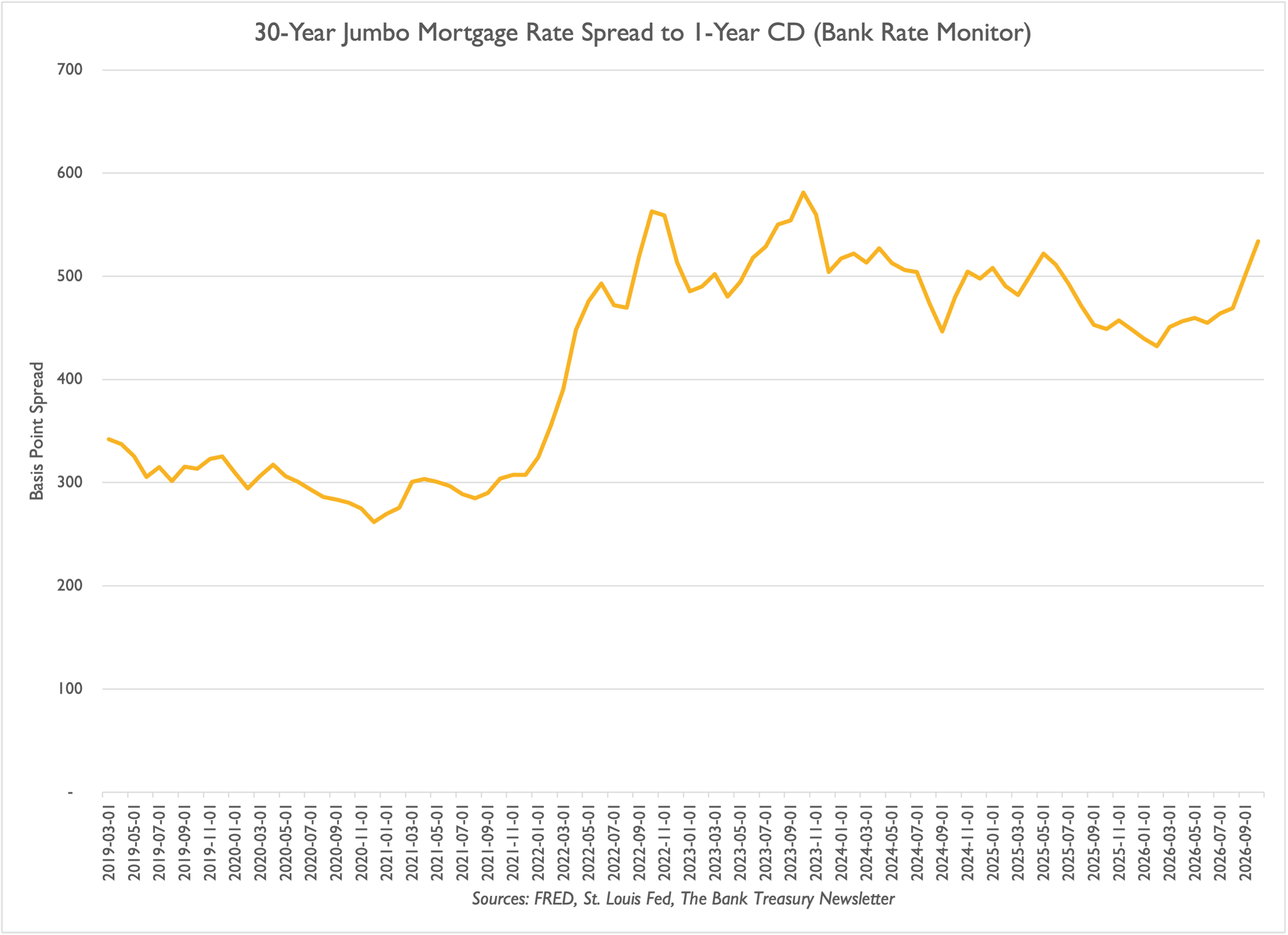
Good Time To Buy MBS If You Are A Bank
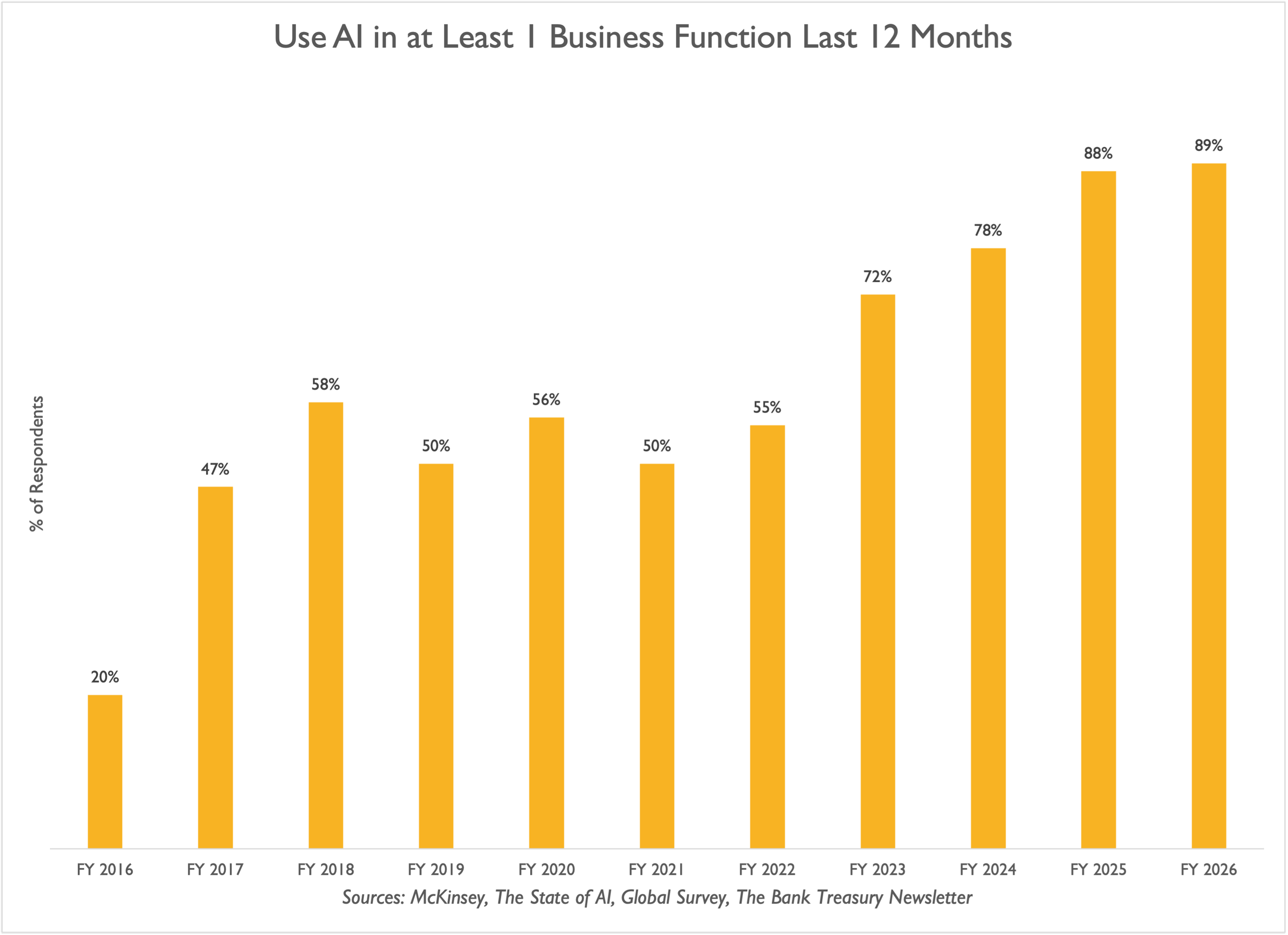
AI Adoption Rate Climbs Higher
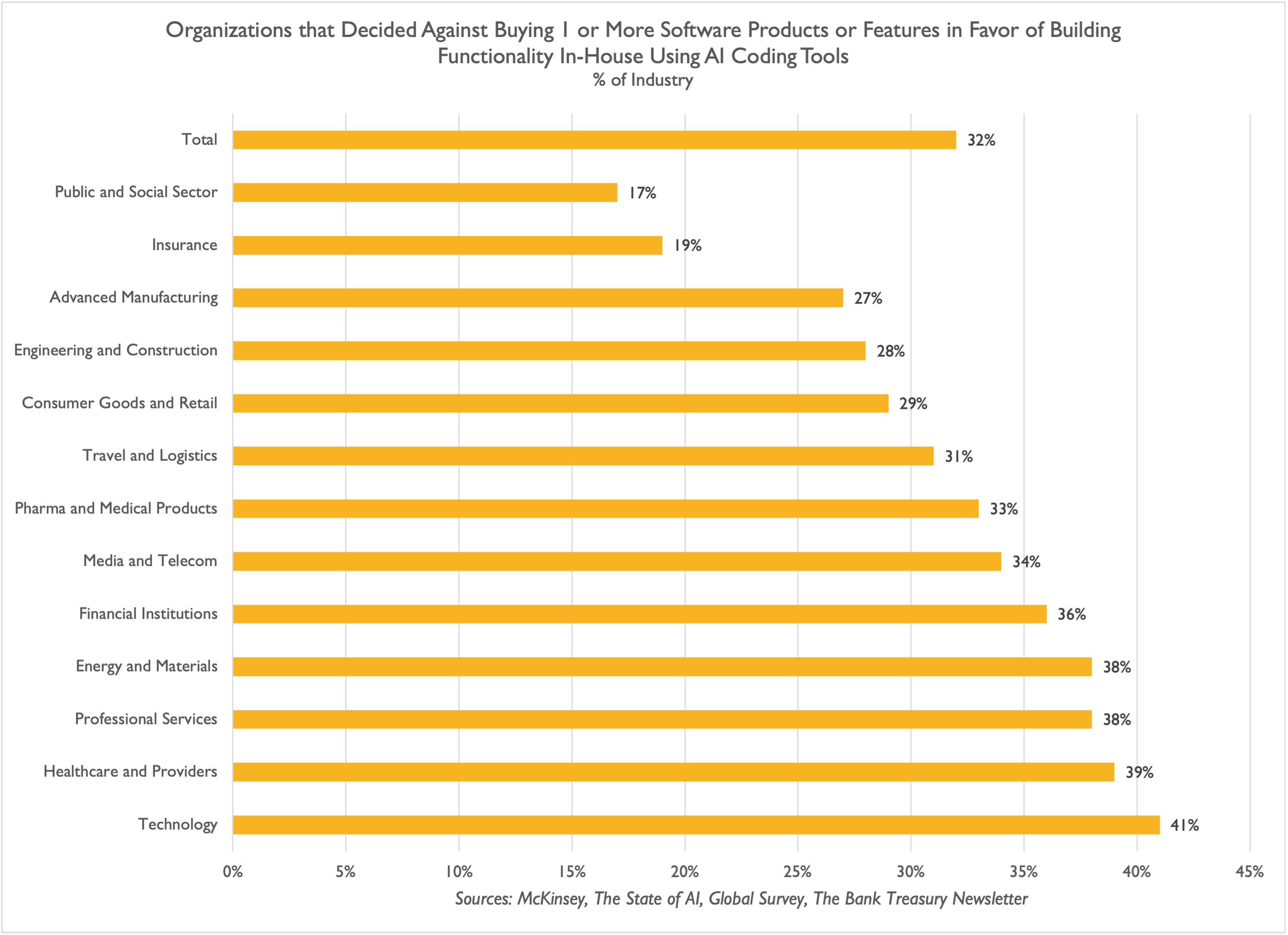
Businesses Can Do Their Own Coding Now
Gen AI Saves Time
Gen AI Adoption Rate Flattened
AI Data Center Plans To Expand