

The Fed’s hawkish turn benefited the banking industry in Q3 2026, as banks reported that their neutral-to-asset-sensitive balance sheets continued to support a wider net interest margin (NIM) thesis through year-end. The capital expenditure (CapEx) artificial intelligence (AI) super-cycle—and its cascading positive effects across the U.S. economy, from AI-adjacent and near-adjacent businesses to more distant industries—shows no signs of slowing. It is driving balance sheet growth and, ultimately, net interest income. The only dark spot is commercial real estate, where higher rates are slowing growth in multifamily projects.
The industry’s results contrast with less-than-ideal banking conditions on the rate front. As the Fed’s fight against inflation just began, the yield curve continued to flatten last quarter, with the 2s-10s spread averaging 34 basis points last month. The spread has narrowed throughout the year, falling from an average of 68 basis points in January. Looking back 50 years on FRED, the average spread has been 84 basis points. The news isn't all bad, though. The 10-year Treasury term premium rose to more than 100 basis points, its highest level since the Global Financial Crisis (GFC). The spread between 3-month T-Bills and the 5-year Treasury—which is of particular interest to bank treasurers—also widened to 75 basis points this month, compared with negative 40 basis points in October 2025.
Credit conditions remain solid. Although senior banking executives worry about an AI bubble bursting, a surprise in bank loan books is unlikely. In January 2020, the Financial Accounting Standards Board (FASB) replaced the incurred loss model with the Current Expected Credit Loss (CECL) model. The new standard requires credit reserves to cover the life of a loan through a credit cycle and to reflect both its historical performance and term. Reserve balances can still rise or fall, but when preparers follow the standard, changes should be limited and rare—even during an economic downturn. In retrospect, although the banking industry and even bank supervisory heads complain that CECL is too burdensome, particularly for community bank accounting departments, the standard significantly reduces credit surprises that could trigger another bank crisis.
Banks continue to benefit as low-coupon, interest-earning loans and securities run off and are replaced with higher-yielding assets. Some institutions have used this year's market conditions to restructure lower-yielding assets, but most are trying to avoid the upfront hit to Tier 1 capital. According to the Federal Financial Institutions Examination Council (FFIEC), mid-year 2026 data for all banks indicate that negative Accumulated Other Comprehensive Income (AOCI) still represents nearly a 10% hit to Tier 1 capital.
Funding remains tight as wholesale and commercial deposit rates rise, and solid loan growth adds further pressure. However, the Fed continues to maintain ample reserves, and the money supply, as measured by M2, remains plentiful—up $1 trillion over the past year to $23 trillion. Bank executives said borrowers seem undeterred by higher rates. Depositors also haven't been deterred from keeping more money in their accounts, with balances rising $100 billion last quarter to $20 trillion. According to the Fed’s H.8 data, loans totaled $14 trillion at the end of last quarter.
The outlook in bank land remains bright. Bankers expect the Fed to issue its final rule implementing the Basel 3 Endgame before year-end. They expect key provisions to include lower risk weights for corporate loans and low loan-to-value mortgage loans, relaxed risk weighting for mortgage-servicing assets, and lower capital charges for large banks. They also expect regulators to allow banks subject to the Basel 3 Liquidity Coverage Ratio (LCR) to count collateral posted at the Fed’s discount window as High-Quality Liquid Assets (HQLA). However, this treatment may offer only limited relief. Fed research, drawing on experience from other financial systems where instant payments and 24x7 banking have taken off, suggests that, on a consolidated basis, the banking system—which already holds a third of its balance sheet in cash and liquid securities—will hold more HQLA, not less, over time.
The Office of the Comptroller of the Currency (OCC) published its final rule implementing the Guiding and Establishing National Innovation for U.S. Stablecoins (GENIUS) Act, which governs stablecoins, three months after the legal deadline. The final rule eases provisions in the original proposal, lowering the daily liquidity requirement from 10% to 5% of total reserves and removing both the 30% weekly liquidity requirement and the requirement that reserve assets have a weighted average maturity of less than 20 days. The regulator appears to be “bending over backward” to promote cryptocurrency. Although the OCC bars anyone it has not authorized from issuing stablecoins, the final rule allows applicants to issue coins temporarily while the OCC reviews their applications or considers a waiver. Stablecoin reserves may not include other stablecoins, but they may include tokenized assets such as Treasury bills maturing in less than 93 days, tokenized bank deposits, and tokenized government money market funds. The FASB proposed revising its definition of a cash equivalent to include stablecoins, even though a stablecoin is technically a non-maturity asset, unlike a typical cash equivalent, because holders can redeem it at any time and expect to receive its par value in cash. The comment period for the proposed Accounting Standards Update (ASU) ends on November 19th.
Tokenization remains a buzzword in banking circles. Although tokenization and blockchain-based tokenized assets could make capital markets more efficient, the total value of tokenized financial assets—including deposits, Treasurys, repo, stocks, and other financial assets—remains small, at less than half of 1% of outstanding financial assets. Tokenized assets could be programmable, raising bankers’ concerns that a depositor’s money might one day move from one bank to another without human intervention. So far, however, they say they have seen nothing like that.

The Bank Treasury Newsletter

Dear Bank Treasury Subscribers,
“Come with me, and you will be in a world of pure imagination,” said Willy Wonka to Augustus Gloop, Veruca Salt, Violet Beauregarde, Mike Teavee, and Charlie Bucket, who stood outside his factory one fine morning, each clutching the golden ticket they’d found hidden in their Wonka Bars. His factory had been shrouded in secrecy and mystery. No one had seen him in years, not since he fired all his factory workers, replaced them with the Oompa Loompas (who, unlike his former employees, worked 24x7, might we add), and closed it to the public.
Without hard facts, the public imagined all sorts of stories about him and how he made his delicious Magic Hats pralines, Purplypurple chocolate bars, Oompa Loompa gummies, and Magic Garden Ropes, to name just a few of his unbelievable concoctions. The contestants would be the first to glimpse how the sausage was made, so to speak. Brought into his inner sanctum and taught his art of creation, he planned to choose one to inherit the business and reward the rest with a lifetime supply of chocolate. The future never looked brighter for the winner, or as Charlie Bucket sang in the 1971 movie starring the late Gene Wilder,
“I never thought my life could be anything but catastrophe, but suddenly I begin to see a bit of good luck for me. 'Cause I got a golden ticket, I've got a golden twinkle in my eye…”
True confession: our editors decided to open with the Willy Wonka bit this month, confident our subscribers would instantly see the connection to bank treasury. But we might be stretching the taffy a bit too thin, so to speak. After all, if candy from a chocolate factory can defy imagination, what’s money?
Because you know that saying about money not growing on trees, right? Get this. Wonka Bars literally grow on trees, or at least the chocolate in them does. That’s right. Chocolate is a nut that grows on trees. Who knew? Willy Wonka imported his from South America, delivered right to his factory door like an Amazon package. And, remarkably (some might say, magically), he never had any supply chain issues with his deliveries. Amazing. Yet, to be clear, while people might call him a magician, his factory machinery and the ingenious concoctions he created were based on science, technology, brilliant engineering, and pure hard work. It just looked like magic.
Like banking, which magically moves money from place to place, sometimes in one day and sometimes in up to three business days. You can even move money instantly nowadays. Fancy that! And credit intermediation, asset-liability management, and liquidity management, the way bank treasurers oversee and direct all the cash flows going in and out of their banks, are pure wizardry.
That is the magic. But behind the scenes, the infrastructure that makes payments and the other banking operations seem so effortless is a complicated web of nodes and connections. The wonder of payments is a carefully synchronized system involving banks, central banks, and nonbank customers of banks, and it takes a village of personnel in compliance, settlement, clearing, records, and accounting departments to make it work. You only realize it is there when something goes wrong, which is very rare.
But money—money doesn’t grow on trees; it comes out of thin air. Sure, the paper currency in our wallets may have arboreal content, but its moneyness rests on “say-so.” Fiat say-so. And that paper currency, $2.5 trillion and counting in circulation, is only a fraction of the $23.3 trillion in the outstanding money supply.
Money is pure imagination. M1 and M2 (the Fed discontinued M3 in March 2006) exist as mere entries on a general ledger sheet. But unlike Wonka Bars, or maybe a fresh stack of $100 bills, you cannot touch, taste, smell, hear, or even see money, and you certainly cannot see a GENIUS Act-compliant stablecoin that does not pay interest (and not just because one has not been issued yet), even if you can establish its value through the composition of its reserve account.
Money is only money by agreement. Nothing backs it but universal acceptance. The richest man in the world claims to have nearly $1 trillion, but he wouldn’t be worth a hill of beans unless the financial system counts his money as legal tender. And the only legal tender is the money the government says is legal. If he lived among the Maasai tribes, for example, he would starve unless some of his money was in the form of cattle. If he went to prison, cash is banned as contraband, so he would need cigarettes or something tradable like that to get by.
In fact, even gold is useless unless someone else wants it enough to trade you something in exchange. Remember King Midas, who could turn everything into gold? He starved to death. For a long time, gold and silver served as money in this country and in many others, but not anymore. Gold and silver are no longer legal tender. The only legal tender is what the government declares legal, backed by its full faith and credit. Its value is only as good as the government says.
Willy Wonka was not really a magician. He couldn’t just summon chocolate into existence. Chocolate grows on trees, and he turned it into candy. But bank treasurers are true conjurers. They, along with the “oompa loompas” in their loan departments who seem to be working overtime these days, create money. That is what banks do. Banks are money factories. When they make loans, they automatically deposit the proceeds into a checking account that bank treasurers set up for the borrower. Shazam, more money supply.
But money is an illusion, like all magic, and magic only works if you believe. Do you believe? Bank treasurers do. They’re singing a happy song about bank lending continuing into next year, and despite gravity-defying A.I. valuations, they see everything going even higher. Just like Charlie Bucket. So they’ll keep making more loans and churning out money. Money starts with imagination, and they imagine a bright tomorrow because “they have a golden ticket and feel lucky today.”

Banks Feeling Lucky Today
The world looks brighter than ever to financial-system leaders thanks to AI, even if they all worry because of AI. The founder of a major hedge fund told a conference audience that he worries about an AI bubble and its potential impact on the economy.
“There’s almost certainly bubbles within this moment in time. And any radical transformation of our economy is generally intertwined with a bubble.”
While the sky always seems about to fall somewhere and on someone, it is mostly sunny in bank land. This month, the chief financial officer (CFO) of a large global bank told bank analysts that even if commercial customers are worried, it is never about them.
“I think the theme for some time now has been that people are worried about other people while doing fine themselves. The theme is always like, oh, we run these surveys, and they're always like, oh, I'm worried about this, I'm worried about that. And they're like, how are you doing? Oh, I'm doing great…No question that higher rates…inflation, diesel—like these things are tough for middle market clients…But I think balance sheets are strong, people have been through a lot over the last few years, and so they're well prepared.”
AI is powering the economy, and while there may be ups and downs ahead, its impact will endure for generations, as the chairman and Chief Executive Officer (CEO) of another global bank said.
“The growth of the U.S. economy…and even the global economy is powered by this A.I. CapEx cycle…It is a meaningful 50-70 basis points of real GDP in the U.S. That is no small matter. And then how many years it takes…It will be complicated; there will be moments of uncertainty, and I have no doubt there will be times when…it's going too fast, and there is overbuilding. And then there can be other times when it's not fast enough, and there's a bottleneck in the ecosystem; perhaps it's power. But the reality is the capital is going to have to be provided for this once in a multi-generation change.”
Business spending last month was the best in five years! With the economy moving full steam ahead, borrowers want to borrow as much as bank loan officers want to lend, according to the chairman and CEO of a large Midwest-based bank.
“C&I loan demand is quite robust and broad-based.”
Loan demand is not driven solely by loans for data centers, chips, and AI technology development. AI-adjacent businesses that rely on AI also seek loans to expand. As the CFO of the same bank detailed,
“How much of growth and credit impact is related to AI? I mean, obviously adjacent sectors like energy and telecom are seeing the benefit in loan growth, but then there are other areas that are more broad-based such as retail, food, beverage, and insurance…There's a lot of momentum in the business community to want to grow.”
Of course, it would be irresponsible for bank executives not to worry about what could go wrong and to budget for that contingency. But the truth is, they feel almost giddy about the bright future they see before them, as the president and CEO of a regional bank based in the Southeast admitted.
“Could lending slow with higher rates? Well, yeah, it could. That's not actually what we're thinking. But that's not actually what we're forecasting. We continue to see activity to be quite robust in '27.”
And talk about resilience! Higher rates aren't slowing loan demand among technology businesses, and even businesses typically sensitive to higher rates seem undeterred by current levels. As the chairman and CEO of a large bank in the Northeast explained,
“This whole AI ecosystem build-out is full on. It's a very strong dynamic, and that cascades into a lot of the supply ecosystem that gets those centers built. And even with higher rates, the players aren't really batting an eye…I think that's relatively inelastic to pricing. There'll be kind of some other sectors, maybe you get another couple of hikes, and then maybe some of the PE and leverage sectors start to become a little more circumspect, but we haven't seen that yet.”
Higher rates aren't a problem. The CFO of a global bank reassured analysts on this month's quarterly call, telling them to stop listening to the worrywarts.
“As we sit here today, things look pretty good despite what you're seeing in terms of rates or the overall sentiment that you're hearing about.”
One of the analysts asked the chairman and CEO of another global bank whether he was as optimistic today about the AI CapEx supercycle as he had been six months ago, and he answered,
“I do…This technology is real. It's going to accelerate in terms of its deployment. There's going to be infrastructure built around it that's going to be quite significant…and it's not going away.”
Everything is doing well, except for borrowers in the commercial real estate space, as higher rates are hurting even the fast-growing multifamily residential loan sector, the president and CEO of a large regional bank based in the Southeast said.
“Production was up year-over-year…And in addition to that, line utilization is up year-over-year…Customers are investing in their business and still have a positive view of the economy. And so -- and we'd expect that activity to continue. One place where we are seeing the impact of interest rates is in the investor real estate portfolio. We see -- while we're seeing growth in multifamily because of previous commitments that are funding, the level of new activity is slowing because of rising costs and difficulty to make the economics of those transactions work.”

A Dollar is a Dollar is a Dollar
Banks are money factories. It all starts with optimism. Optimism encourages bank loan departments to extend lines of credit and borrowers to draw down on those lines. And the money is magical, like Willy Wonka bars. And we are not overreaching with metaphors about fantastical chocolate factories, because the Willy Wonka movie connection is not just a wonkish theoretical discussion by your editor-in-chief about money and banking.
No, the magical connection runs deeper: while the movie, which cost $3 million to produce, flailed at the box office and earned only $4.3 million in ticket revenue in the summer of 1971, on August 15th, Richard Nixon severed the last link between the U.S. dollar and gold. Franklin Roosevelt began severing that link on April 5, 1933, when he made it a crime, punishable by 10 years’ imprisonment, a $10,000 fine, or both, for a U.S. citizen to possess gold coins, bullion, or certificates after May 1, 1933.
Until then, Americans had always been able to take their maturing government bonds back to the Treasury or, after 1914, to a local Fed branch and redeem them for gold at the window. Paper money was widely accepted because it was backed by gold. But after a devastating, wealth-destroying bank crisis following the Great Crash of 1929, Americans stampeded to the gold window, demanding gold. The U.S. did not have enough gold to meet demand, quickly testing the viability of fractional-reserve banking as a modern organizing principle for financial systems as public faith in the almighty dollar eroded.
Roosevelt closed the gold window to save the country from ruin. Thereafter, fiat money became the sole legal tender for settling debts and obligations. From then on, the U.S. government could print its way out of debt problems, regardless of the inflationary effects on the economy and the wealth destruction it caused, confident that no one could challenge the value of its money by demanding its full weight in gold. After Roosevelt closed the window by executive order, to crudely paraphrase Gertrude Stein, a dollar was a dollar because it was a dollar, and it was a dollar because the government said so.
But if you were a foreign central bank holding U.S. debt, you could still have sent someone from your New York City rep office to 33 Liberty Street, shown up at the Fed’s gold window with $35, and gone home with a troy ounce of gold. Franklin Roosevelt closed the gold window to U.S. citizens for a good reason: the country was running out of gold. Richard Nixon finished the job, for good reason, too. In 1971, the country didn't even have enough gold to cover the debt it had printed that foreign central banks held to finance the expansive guns-and-butter economic policies his predecessors had begun during the Vietnam War and the Great Society. Presumably, he decided it would be better to declare that you do not owe anything than to default.
And when you are the United States of America, with your currency as the world’s reserve currency and your economy producing a third of global Gross Domestic Product (GDP), as it did in 1971, you can get away with that. That is the beauty of fiat currency. Spend what you want because the only limit on the money supply is imagination. When the Treasury spends money, it credits the public’s bank accounts, thereby expanding the money supply. What politician would be against that, even though inflation from such fiscal policies isn't popular on the campaign trail this fall?
But generally, it has worked out for them because what is not to like about more money for your constituents, even money that comes out of thin air? Political officials have a lot of imagination, which sets them apart from ordinary people who confront the reality of financial limits. As Gertrude Stein wrote after Roosevelt’s gold ban,
“Is money money or isn't money, money? Everybody who earns it and spends it every day in order to live knows that money is money; anybody who votes it to be gathered in as taxes knows money is not money…When you earn money and spend money every day, anybody can know the difference between a million and three. But when you vote money away, there really is not any difference between a million and three.”
What is the real difference between the $23 billion budget deficit the U.S. ran in 1971 and the $2 trillion budget deficit the Treasury just announced for Fiscal Year 2026? It is just money, just numbers on a piece of paper or an electronic ledger. You can still say your money is worth a dollar, even if a dollar buys less gasoline today than before, because you, in 2025, produced 25% of global GDP and most of your debt is still held domestically.
There is no substitute for the U.S. dollar. According to SWIFT, it accounted for 50% of all cross-border payments last month and 82% of trade finance. China, a potential rival, accounted for a distant 3% of cross-border payments and 8% of trade finance flows. SWIFT data from a year ago also suggests the U.S. dollar gained against its international peers.
Then again, the U.S. can keep saying whatever it wants about its money and national debt as long as it keeps delivering and dominating global productivity. But it is hard to ignore how fast China has been growing lately (Figure 1). In 1971, a year before Nixon’s historic trip there, China was a mere blip on the global economic stage. Today, its economy is the world's second-largest.

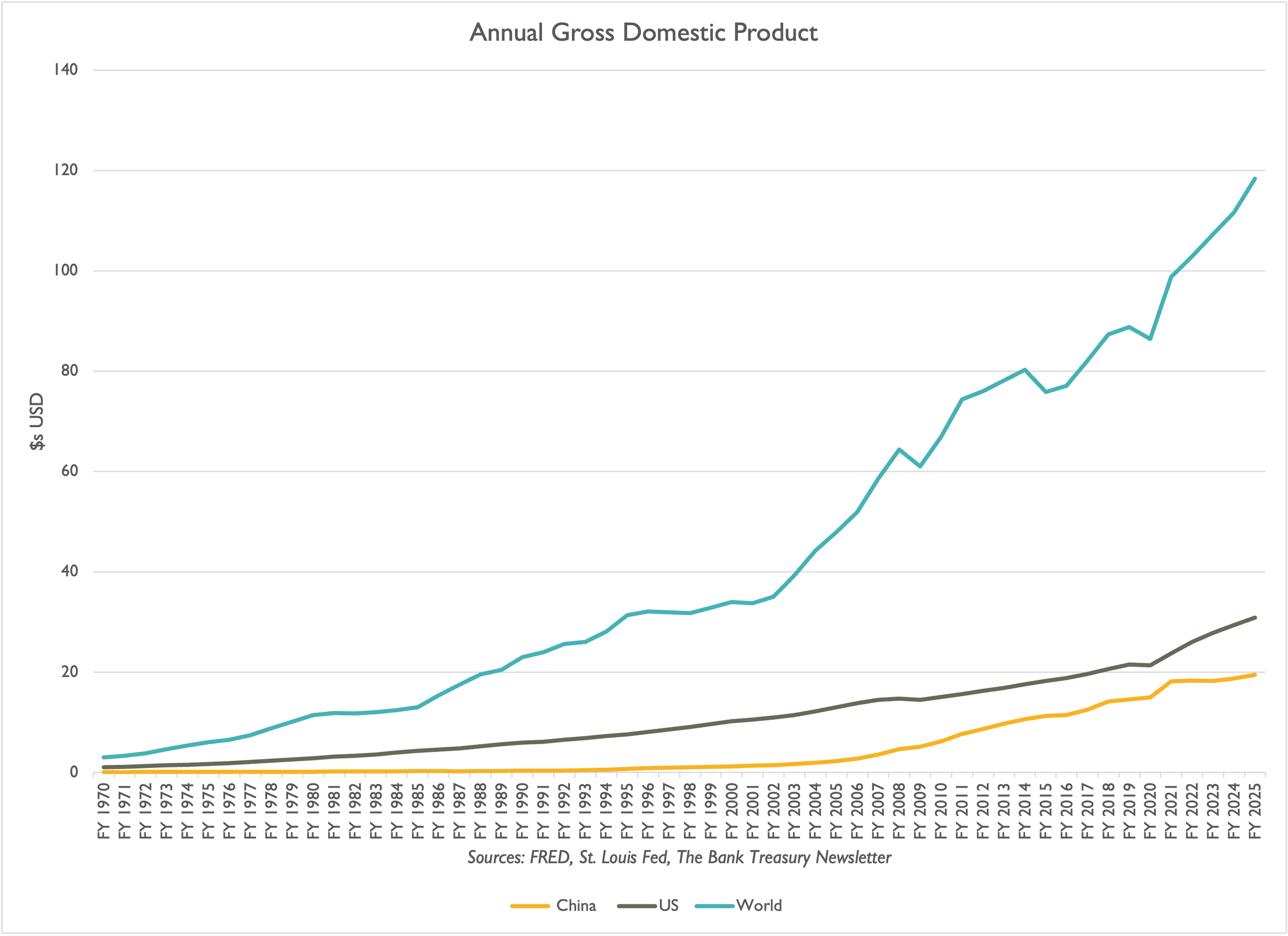
Figure 1: Annual Gross Domestic Product, U.S. Dollars

The U.S. Treasury is a magical money factory. It creates money out of thin air by spending more than it taxes. And as long as the Treasurys it issues are TINA, as in There Are No Alternatives, the U.S. can keep spending as it pleases, inflation be damned. Treasurys are not money, but they are money-like: a safe store of value and a destination when investors are in flight-to-safety mode. Investor demand is insatiable because they have to invest their money somewhere and need something that is risk-free and a safe store of value.
Then again, maybe investors are doubting whether the magic is real. Treasurys are losing some of their money-ness lately. Something is definitely going on with Notes and Bonds, given how much the yield curve steepened this year. The Fed's failure, after more than five years of trying to bring inflation back to 2%, doesn't instill much public confidence that it has things under control.
For example, the term premium on a 10-Year Treasury zero-coupon note rose from a low of negative 61 basis points in 2021, when investors paid to extend maturities, to 110 basis points this month. The term premium is the price investors demand to lock up money for 10 years rather than invest overnight and roll the principal, compounding interest every business day, for the same term (Figure 2).

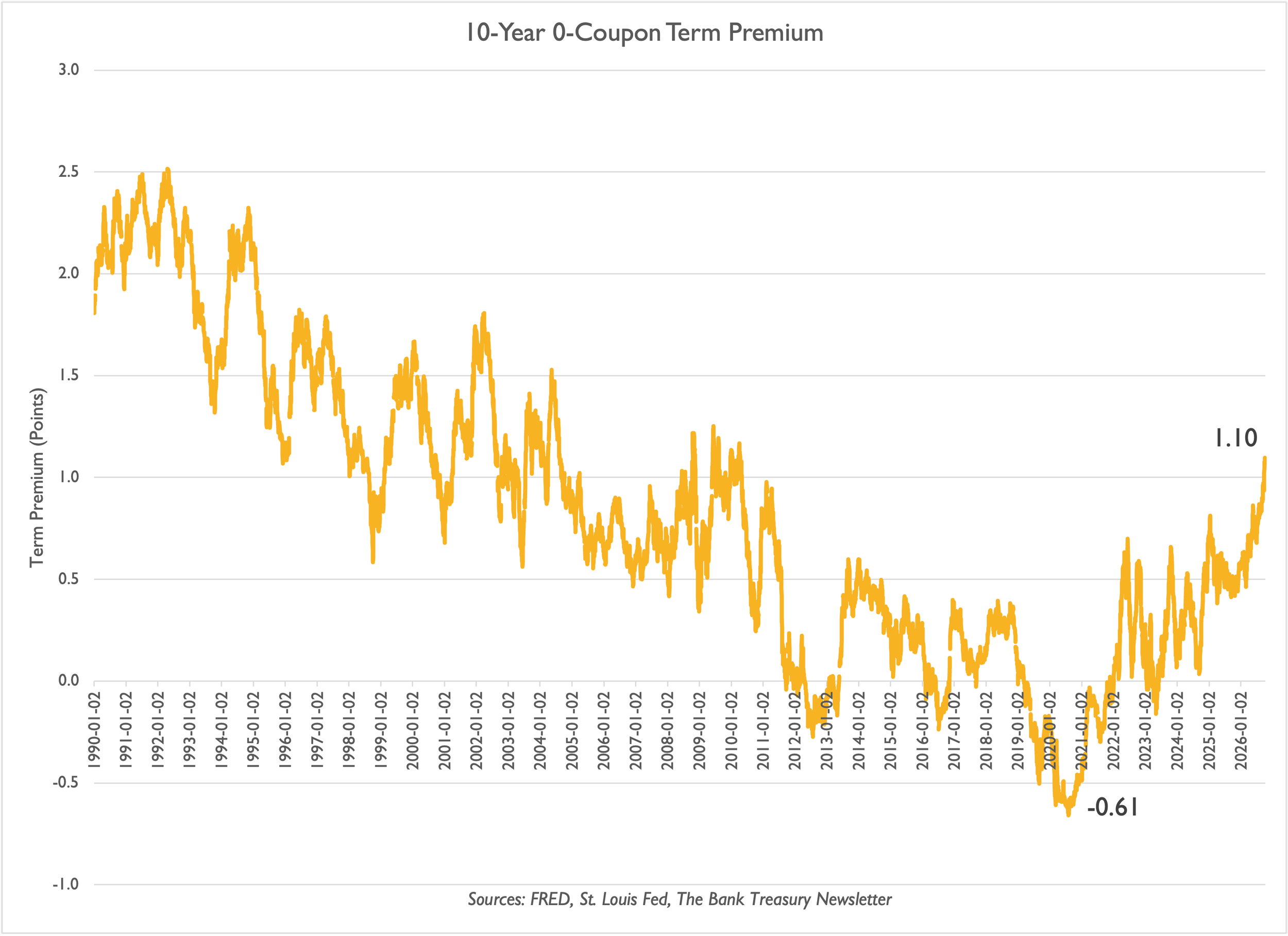
Figure 2: 10-Year 0-Coupon Term Premium
The term premium has not been this high since the GFC. But it was higher in the 1990s, when fiscal deficits were much smaller and the Fed under Alan Greenspan kept inflation under control. So either borrowers at the long end of the yield curve are in for higher rates, or investors haven't given up on the Fed just yet. Thus, all eyes are on this month's FOMC meeting.
But higher rates are not what worries bank treasurers the most; they worry more about abrupt changes. As the chairman and CEO of a global bank noted, he's not worried about a 5% 10-year.
“I think from the beginning of July to now, we've seen a 75 basis point move on the 10-year…We've operated since the financial crisis in an environment where rates were fundamentally low…A 5% 10-year Treasury doesn't scare me in terms of an operating environment…In my career, the 10-year Treasury has been higher…What creates headwinds for markets is when you have very abrupt moves.”
Treasury rates are supposed to be stable. You are not supposed to lie awake at night, worrying that negative AOCI will erode your capital ratios. But if investors are souring on Treasurys, maybe nothing is risk-free anymore. Sometimes it is best to believe in magic rather than to peer at the man behind the curtain.
Even if some investors are looking at alternatives, stablecoin issuers can be counted on to hold Treasurys, especially Treasury Bills. The OCC published a final rule this month to implement the GENIUS Act, which would require that the maturity of Treasurys in a stablecoin reserve not exceed 93 days.
Disclosures are limited, and the stablecoin market is small relative to the Treasury market. But stablecoin reserves currently include roughly $200 billion in Treasury Bills, compared with $7 trillion outstanding. According to San Francisco Fed research, T-Bills held in stablecoin reserves could double by 2030, to $400 billion. CoinDesk sees that number going much higher, maybe reaching $1 trillion in the next two years.

Liquidity, Money-ness, and Cash Equivalence
In a world of pure imagination, money is money, and cash is king. You are either liquid and have money, or you are illiquid and need money. But there is money, and then there is money. For example, bank treasurers think of Treasurys as cash. When they say they are holding cash, they mean they are holding Treasurys, not mortgage-backed securities (MBS), corporate bonds, or loans. But technically, Treasurys are not legal tender and, by the strictest definition, not cash.
But they are, or can be, cash equivalents and thus a source of liquidity. For example, the Basel 3 LCR categorizes Treasurys, from Bills to Bonds, as HQLA, right under Federal Reserve deposits in Level 1 assets. Agency debt, MBS, municipal bonds, and corporate bonds also count as HQLA but are classified as Level 2 HQLA and split between Levels 2A and 2B depending on their degree of liquidity. The only requirement for an asset to qualify as HQLA is that it be an unencumbered, Fed-eligible asset sufficient to cover a bank’s cash outflows over a 30-day stress scenario.
Under this definition, the LCR allows banks to count securities in their held-to-maturity portfolio if they can demonstrate they can use them as collateral to borrow in the repo market. Yet the current rules do not allow banks to count their undrawn FHLB advances or their borrowing capacity at the Fed discount window as HQLA, on the premise that the only certain source of liquidity is the cash a bank holds on its balance sheet. This view makes even more sense today than when the LCR was first published after the GFC, as the growth in instant payments and 24x7 banking make even brief uncertainty or a delay in obtaining funds potentially fatal.
Bank treasurers, however, expect supervisors to revisit the Basel 3 LCR when they issue their final rule for the Basel 3 Endgame this year. Michelle Bowman, vice-chair of Supervision, hinted last March that bank supervisors are considering allowing banks to count prepositioned collateral at the discount window toward their HQLA requirements under the LCR. However, undrawn advances will likely still not count as HQLA.
Bank supervisors are also unlikely to approve bank treasurers holding any portion of their HQLA in a third-party-issued stablecoin under the GENIUS Act, at least for now, given the limited market for such stablecoins. Indeed, the OCC’s final rule published this month prohibits them in the stablecoin reserve. But maybe stablecoins should count as HQLA, since they are functionally equivalent to money. It is an open question in bank supervision circles.
Under current rules, it is costly for banks to hold stablecoins. They don't count as HQLA, and Bank for International Settlements guidelines would require a bank to cover 85% of a stablecoin’s par value with stable funding under the Basel 3 Net Stable Funding Ratio. But these rules were written before the GENIUS Act, and at least one bank supervisor (Canada’s) is on record suggesting that GENIUS Act-compliant stablecoins should theoretically count as HQLA.
The contractual right to redeem is a critical feature of a GENIUS Act-compliant stablecoin. The FASB does not consider stablecoins cash under generally accepted accounting principles (GAAP), but it would treat them as cash equivalents under its proposed ASU. Under existing GAAP, a cash equivalent must have an original maturity of three months or less at the time of purchase. If you bought a 10-Year Treasury 10 years ago and it matures in 3 months, it is not a cash equivalent under the standard.
However, a stablecoin is a nonmaturity asset, so it should be excluded from the cash equivalent category, regardless of the maturity of its reserve assets. FASB’s draft tries to fix this by focusing on a stablecoin holder’s redemption rights. If a holder can redeem the coin at any time, the reserves backing the stablecoin are sufficient (meaning at least 1 for 1), and comprise short-term assets that can be liquidated with insignificant risk that the value of the assets can change with respect to interest rates, FASB would treat the stablecoin as a cash equivalent. As FASB wrote,
“The Board observed that stablecoins do not have stated maturities but that a direct on-demand redemption right is equivalent to immediate maturity… The Board observed that direct on-demand contractual cash redemption rights are an important differentiator between digital assets that are readily convertible to known amounts of cash, and digital assets that are more speculative in nature.”

Bank Deposit Magic Made Easy
A bank is a money factory, though less so than the U.S. Treasury these days, given that the U.S. budget deficit in the last fiscal year was $2 trillion and the banking industry, in aggregate, expanded loans by $1 trillion. But a bank and the Treasury are very different money factories. The Treasury has no real competition. There is nothing safer than Treasurys and U.S. dollars. But a bank is theoretically competing against 4,000 other banks, plus an equal number of credit unions that offer deposit accounts. Banks also compete with money market funds and the broader capital markets.
In a highly competitive market, a bank can create the illusion of money by extending credit, but that illusion can only last so long before a borrower withdraws funds and deposits them in another bank or a money market fund. In the aggregate, the banking industry appears to be swimming in money. Commercial banks are funding their balance sheets with deposits totaling $20 trillion, including checking and savings accounts, as well as operational and nonoperational business deposits. According to Fed H.8 data, the average loan-to-deposit ratio (LDR) is 70%.
But averages and aggregates can be deceiving: a bank just one standard deviation above the average has a 90% LDR. Some banks have more deposits, and some have fewer. According to Q2 2026 call reports, more than 500 institutions reported LDRs above 100%, while about an equal number reported LDRs below 50%. Deposits are more plentiful in some regional markets and scarcer in others. For example, according to FFIEC data, the average LDR for banks in Texas was 58% at midyear, compared with 90% for banks in Massachusetts.
Even with the Fed committed to maintaining ample reserves, some bank funding desks might bid for Fed funds at the end of the day, while others might try to sell what they didn't leave at the Fed. Ample reserves may reduce the likelihood of bottlenecks, but they cannot eliminate them. Money moves around. And as Gertrude Stein was fond of saying,
“Money is always there, but the pockets change; it is not in the same pockets after a change, and that is all there is to say about money.”
Deposits move around the system constantly, and bank treasurers' first order of business is preparing for contingencies as cash flows in and out. But managing liquidity is much easier when deposits are still growing. Deposits increased by $1 trillion last year. Even with higher rates, customers left more in their noninterest-bearing deposit accounts than last year, on average, though not at every bank.
FDIC data show that noninterest-bearing deposits at all insured banks rose by $163 billion over the past year to more than $4 trillion. The balance remains well below its mid-2021 level of $5.5 trillion, before the Fed raised rates. However, like their lending outlook, bank executives say they are very confident in their deposit story for next year. As the CFO of one of the global banks told analysts, interest rates have a more muted impact on noninterest-bearing deposit balances today because rate-sensitive depositors have already moved their money.
“We're anticipating that we can continue to grow non-interest-bearing deposits as we have done over the course of the past year. Remember, whether rates go up by 25 basis points or not, non-interest-bearing deposits are ultimately more sensitive to inflation and GDP…Much of the rate rotation happened when rates moved from 25 basis points to 5.25% and then down to 4.5%. We've been in that environment now for three or four years. There's been a lot of time for consumers and wealthy clients to sort of settle into that environment.”
Another senior executive at a global bank agreed,
“The impact of higher rates is a lot less than it once was.”
The chairman and CEO of a large bank headquartered on the East Coast predicted no significant change in noninterest-bearing deposits this year.
“You got to remember that back in '23, the big change was driven by non-interest-bearing deposits moving to interest-bearing deposits. Most of the excess deposits are out of the system.”
At 20% of total deposits, bank treasurers generally do not expect the ratio of noninterest-bearing deposits to total deposits to change much as the Fed hikes at least one or two more times this year. In fact, the ratio has been stable for over a year. According to the CFO of a large regional bank in the Southeast, the only reason deposit balances for individual accounts could be falling is that, after spending on gas and food, there is less left over to save, not interest rates.
“We're not seeing a mix shift, and we haven't seen it for well over a year now. Rate-sensitive customers had already taken advantage of that in a rising-rate scenario, and we stabilized. What we are seeing is that the cost of inflation has them with less money in their operating and checking accounts, right? They're spending it more quickly, so their average days at a higher balance is a little bit lower.”
Of course, if you are one of the banks with more deposits than you can lend out, competition is not much of a factor in pricing deposit products. As a result, the system's cost of deposits fell to 1.8%, its lowest level in the past three years, according to FDIC data. The president, CEO, and chairman of a global bank noted that its cost of deposits was below the national average.
“We don't see the dynamic because we have a lot of room to grow loans without having any pressure to raise funds for them…149 basis points against the current rate environment is a pretty good place to be.”
And no one is worried about competition for deposits, even with stablecoins and new entrants, including industrial loan companies and trust banks chartered this year. For one thing, research suggests that the decision to hold a stablecoin or a bank deposit depends more on pricing than on rates, per se. Banks control their destiny. Agentic AI and tokenization are taking much of the pricing power banks had over deposits. As the president and CEO of a regional bank based in the Southeast lamented,
“The historical inefficiency in deposit pricing is being sucked out of the industry, and I think it's going to just be more that way with technology.”
But competition is part of the territory in deposits, as the chairman and CEO of a large bank in the Northeast told analysts.
“Any quarter we talk about, it's always going to be competitive for deposits.”

Tokenized Dreams
Stablecoins in circulation totaled $319 billion as of last month, representing less than 1% of banking system deposits, credit union deposits, and money market funds. Today, they remain a small number, more of a science project than an imminent threat. Bankers report seeing no demand for them beyond curiosity. And for all the talk that tokenized deposits are a trend to watch, or, for that matter, tokenized anything, customer demand for these services is low. To the extent that banks are investing in tokenization technology, it is in the spirit of “build it, they will come.” As the chairman, president, and CEO of a large bank based in the Midwest told analysts,
“There is not much client demand at all. What there is now is client curiosity. Even two quarters ago, we had quite a few clients wanting to experiment with us on what this might do…We are building out the product set in anticipation of being able to do something that creates value for customers, but we would not say that there is very robust demand, and most of the conversations are around the corporate payment space.”
You have to really believe that, in the future, all financial assets will be digitized and that the uncertainty and risk surrounding clearing and settlement will disappear. The only investors who hold stablecoins use them to invest in other cryptocurrencies. The tokenization of financial assets, or any real assets, is negligible today unless we are talking about AI tokens, a new form of money in the tech world. As demand for agentic AI drives up the cost of computing time, tech companies are rationing it, giving rise to a new branch of economics called “tokenomics.”
Dreams can come true, but reality is sobering. For example, there are $32 trillion in outstanding U.S. Treasurys. Of that, according to research by the National Bureau of Economic Research and presented at the Fed’s Jackson Hole conference last August, only $15 billion is held in tokenized form. All other tokenized “real-world assets” combined total only around $15 billion. The $30 billion in outstanding tokenized assets grew by a factor of 10 in the last two years. Treasury repos are a key application for tokenization, but tokenized repo today constitutes less than 5% of $6 trillion in daily repo volumes, and most of those repos are between affiliates of the same firm.
Digital money comes in different flavors, like Wonka Bars. There are tokens, tokenized deposits, and stablecoins. Your choice depends on your preferences.
Tokens digitally represent a wide range of assets, from AI computing units to investment securities, deposits, homes, and businesses, and the technology offers investors fractional shares with monetizable value. Anyone can own a token, even a deposit token, without being a bank depositor. Tokenized deposits are digital representations of bank deposits that give owners all the benefits of a deposit account, including deposit insurance and interest, plus the ability to transfer them on a blockchain. They are technically unsecured, except for FDIC insurance and the assumption that the issuing bank is safe and sound, but the bigger hurdle is that they only work as payment within a limited network of other banks.
Stablecoins can exist on a blockchain as both a digital token and a tokenized deposit. Unlike tokenized deposits, they don't pay interest and aren't FDIC-insured. They are more like bearer bonds, allowing holders to make purchases or redeem them from the issuer at any time for little cost, similar to cash.
Tokenizers believe tokenization will benefit capital markets, streamline cross-border payments, and improve transparency in global finance. However, no substitute exists for the safe cash settlement that central banks like the Fed provide. Although a Fed-issued central bank digital currency--essentially paper money issued by the Fed in a digital format--is off the table for the Fed by Executive Order, something like that is needed, and stablecoins and tokenized deposits do not yet offer it. Neither stablecoins nor tokenized deposits nor deposit tokens are reserve deposits at the Fed, and until the Fed decides to tokenize reserves and make them available on a blockchain open to nonbanks, tokenization will struggle to take off.
You cannot settle clearinghouse margin requirements or buy Treasury Bills in the weekly auctions with stablecoins. Only reserve deposits will do. Tokenized deposits are a bit easier to use, which is why banks are focusing more on them. As a top executive at a global bank who has put most of its investments in tokenization technology explained, stablecoin adoption has been slow.
“A stablecoin is a bit clunky. It adds more complexity in compliance, accounting, and tax when moving money around the world, whereas tokenization offers the least hassle and the easiest way to do it. That's why we've been seeing more growth there.”
Cross-border payments, totaling $1 quadrillion in 2024, are another key application for tokenization technology, but like repo, they face hurdles when a payment moves from a party connected to one central bank to a party connected to another. As a senior executive at a global bank explained, investments in tokenized deposits aim to better serve customers who contend with a process that is too slow and lacks transparency.
“What we're doing in tokenized deposit payments really starts with how do you do a better job servicing the cross-border payment needs of our customers…Some of the negatives of the existing cross-border payment rails are that they take too long, lack transparency…I think what this allows us to do is completely change that experience…And then, more broadly, it gives us the blockchain technology to do a whole bunch of other stuff if the use cases start to materialize around other tokenization of real-world assets, tokenized securities, whether it's crypto trading in our wealth business or a whole bunch of other different places.”
A lot more still needs to be worked out. One of the best features of the current payments system is atomic settlement, in which asset transfers occur simultaneously, all-or-nothing: either both parties exchange assets or neither does. Tokenized deposits offer atomic settlement and pay interest to the holder, but they may be harder to use across borders and may not be accepted by banks outside a consortium's network. Stablecoins overcome that hurdle, but for large wholesale transactions, locking up $billions in interest-bearing stablecoins is expensive and may cost as much as using the existing SWIFT network.
Even if they overcome these hurdles, banks and regulators need to reassess how they measure liquidity. The chairman and CEO of a global bank explained why.
“You still have a market that needs to work itself out. The Clarity Act was one example of that. But really, when you think about the notion of atomic settlement, and how you think about what liquidity means, and more importantly, how regulators think about liquidity. The rules of the road and the normalization of that need to occur.”
The River Song
Tokenization, instant payments, distributed ledgers, and AI technology offer many benefits to the financial system. As the Fed explains on its FedNow page, instant payments help individuals and businesses manage cash more effectively. Individuals can instantly fund a new bank account, buy a home, or transfer money between banks in a blink. Businesses can reduce payroll administration costs and reconcile accounts quickly. Instant payments make account-to-account transfers, consumer-to-consumer payments, business-to-business transactions, and business-to-consumer payments faster, safer, and cheaper.
Everything is just a left or right-click away these days. Maybe you will not even need to click; AI will do it for you and speed things along. But maybe not everything you can speed up should be. Sometimes speed is not of the essence. Sometimes you need to take a second and ask yourself: is this really what you want to do? Once you click send, there's no going back. And we are getting to the point where you may not even make a decision because the AI will do it for you.
Here is what bank treasurers worry about yet still cannot take seriously: Take a deposit, tokenize it, then make the tokens smart so they can automatically move from one bank to another to seek the highest possible rate. If that is not scary enough, throw in a financial crisis precipitated by AI-drone bank deposits suddenly running on a bank. Could it happen? Is the banking system not even one double-click away from a run? How can bank treasurers keep their deposits stable in that world?
The CFO at one of the global banks said he believes bank treasurers who worry about what will happen to core deposits are approaching the question incorrectly.
“In a world with agentic consumer cash movement, it's easy to create a story where it becomes even easier to move cash in a crisis, but I think the right way to ensure that your deposits are stable is …you're probably not supposed to be hoping that your deposits are stable because the money is difficult to move.”
People leave their money in a bank for a reason. No AI bot will improve on that decision, as the chairman, president, and CEO of a third global bank told analysts.
“People optimizing their deposits comes down to why a customer puts money in a bank…They've already optimized the cash that they put with us for investment purposes…I don't see where the agent is going to change that dynamic.”
The public already has plenty of alternatives for putting its money to work and acting immediately, as the top executive at another global bank reminded analysts. But handing decision-making power to a machine seems far-fetched, at least for now.
“High-rate alternatives exist today. They have existed for a long time. If you want to move to a high rate, you can just go online and do it yourself in no time… The idea that consumers are going to give an agent the power to act on their behalf unilaterally and move money around between institutions they don't know, don't understand, and don't know the terms of the accounts they're moving it to, I think, is a long way off. There's no question that agents will become part of the way people interact. We have them -- we're building them ourselves. But the idea that that's going to contribute to mass movement to higher-rate alternatives, I think, is completely overdone, especially for the time period we can see.”
It comes down to the public’s willingness to trust a bot, which the CFO of a large East Coast bank believed was hard to imagine,
“I think it's going to come down to trust, to be honest with you, where our customers really trust to let their agents allow them to have all their credentials come in and have the ability to move money to other places and have that agent decide where that money is going to move, and understand that really well…We aren't really seeing money moving out. But we're monitoring that very closely.”
Not going to happen. If one day someone gives an AI bot permission to move their money, it will be possible only because extensive work went into developing the infrastructure and addressing tough legal questions. Even then, humans will still need to be in the loop, as the chairman and CEO of another large bank on the East Coast insisted.
“New agentic applications that have come out where they try to come in and transact on your behalf inside of your accounts? They are incredibly unsafe. It's not going to happen. Bad idea, yeah. And for that to take place, there's going to have to be laws passed on liability shifting. It's going to have to happen through secure connections and authentication and human in the loop. So it's big splashy headlines, cool thing, not going to happen.”
The chairman, president, and CEO of a large bank based in the Midwest believed that if smart bank deposits ever became a reality, it would not be for a while,
“We haven't seen any AI third-party agents trying to interact with the bank. The logistics of doing something like this are very complicated, so we don't expect a near-term impact.”
Not in the near term, agreed the chairman, president, and CEO of a large bank based in the Southeast, but to think it all began with the Internet and cell phones 30 years ago,
“I've long said that technology started with the Internet and cell phones and mobile technology, which all provided…upward movement of deposit costs over time. There's been a lot of focus on agentic AI…impacting deposit costs…it's not something that we expect to have a lot of impact in the very near term.”
In the near term, maybe not, but in the longer term, bank treasurers will need to prepare for change. Before the internet and cell phones, we had fax machines and touchtone phones; before that, the teletype machine, television, and radio; and before that, the Pony Express. The story of a financial system that started with small banks and grew into big banks, from a time when gold was the standard to one when fiat was. Money that existed in passbook savings accounts has become Automated Teller Machine cards, online accounts, and mobile apps. Things are changing faster and faster.
In 1981, President Ronald Reagan noted that if the national debt, then $1 trillion, were converted into a stack of $1,000 bills (which the U.S. mint stopped printing in 1969), the pile would reach 67 miles into the sky, essentially above the atmosphere and into low-Earth orbit. Today, with the national debt at $40 trillion, a pile that high would take you into outer space, 80% of the way to the moon. Who knows where the financial system is headed next. Bank treasurers should strap in because the fun is only just beginning.
About an hour into the movie, Willy Wonka took Charlie Bucket and the children on a boat ride. The ride started slowly, like a lazy river, but then it picked up speed, and suddenly they were in a dark tunnel. Everyone was afraid. As they moved closer to the unknown, Willy Wonka recited Roald Dahl’s poem, the River Song, which went like this:
Round the world and home again
That's the sailor's way
Faster faster, faster faster
There's no earthly way of knowing
Which direction we are going
There's no knowing where we're rowing
Or which way the river's flowing
Is it raining, is it snowing Is a hurricane a–blowing
Not a speck of light is showing
So the danger must be growing
Are the fires of Hell a–glowing
Is the grisly reaper mowing
Yes, the danger must be growing
For the rowers keep on rowing
And they're certainly not showing
Any signs that they are slowing.

The Bank Treasury Newsletter is an independent publication that welcomes comments, suggestions, and constructive criticisms from our readers in lieu of payment. Please refer this letter to members of your staff or your peers who would benefit from receiving it, and if you haven’t yet, subscribe here.
Copyright 2026, The Bank Treasury Newsletter, All Rights Reserved.
Ethan M. Heisler, CFA
Editor-in-Chief
This Month’s Chart Deck
Net interest margin (NIM) climbed to its highest level in seven years through the first half of 2026 (Slide 1) thanks to the banking industry’s balance sheet asset sensitivity. Bank analysts are asking whether the industry, can hold on to these gains as deposit competition heats up and the Fed raises rates, pushing up funding costs. They can point to call report data which shows that the industry’s wider NIMs to date are due to lower funding expense (Slide 2), while yields on earning assets have been flat (Slide 3).
Benchmarked to 5-year Treasurys, the book yield on its total loans improved since 2021 (Slide 4), but relative to the yield on total interest earning assets, the yield pick-up on loans was steady in line with its historical average around 100 basis points (Slide 5). Thanks to the AI tech surge, growth in higher-yielding commercial and industrial (C&I) loans helped drive up the yield on total loans (Slide 6). However, lower-yielding real estate loans (Slide 7) are a drag on loan yields are remain the single largest concentration in the loan book. Indeed, real estate loans grew faster than C&I loans over the past five years. Although AI data center-related commercial real estate loans would have a positive effect on total portfolio yields and represent a growing share of the industry’s real estate loan exposure, its total real estate loan portfolio remains concentrated in relatively low-yielding residential mortgage loans (Slide 8).
Setting aside the industry’s commitment to building noninterest-bearing deposit accounts, noninterest-bearing deposits peaked at 23% of total assets in 2023 (Slide 9) and have since declined as a share of assets. This year, they continued to decline as business depositors managed their cash assets more efficiently. However, noninterest-bearing deposits still account for 18% of funding, 3 points above the long-term historical average since 2002, when they equaled 12% of total assets. The industry’s interest-bearing deposit funding advantage, benchmarked to the 3-month Treasury Bill (Slide 10), has fallen from its 2023 high but remains 100 basis points above the historical average..
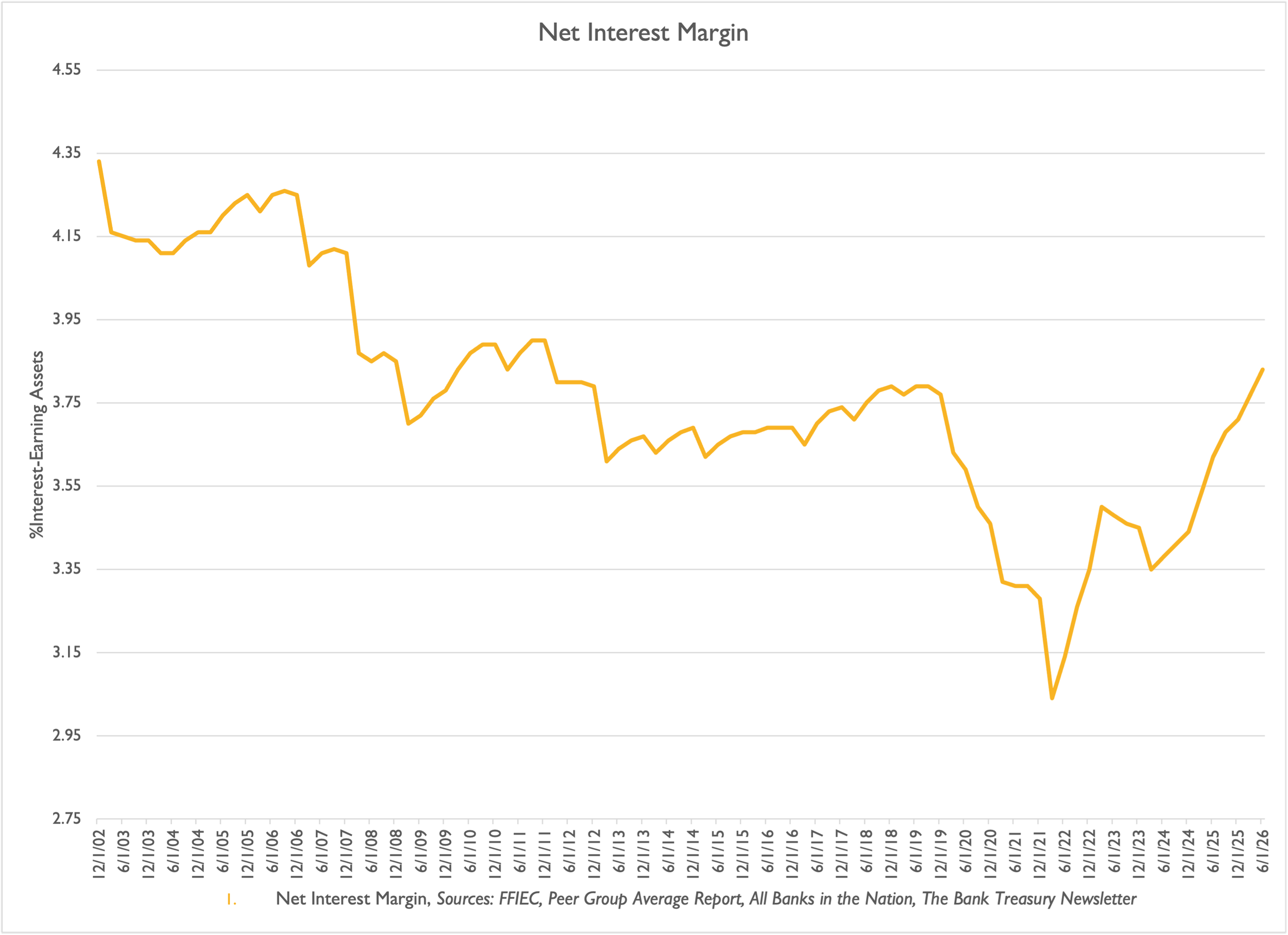
NIMs Continued Higher in Q3 2026
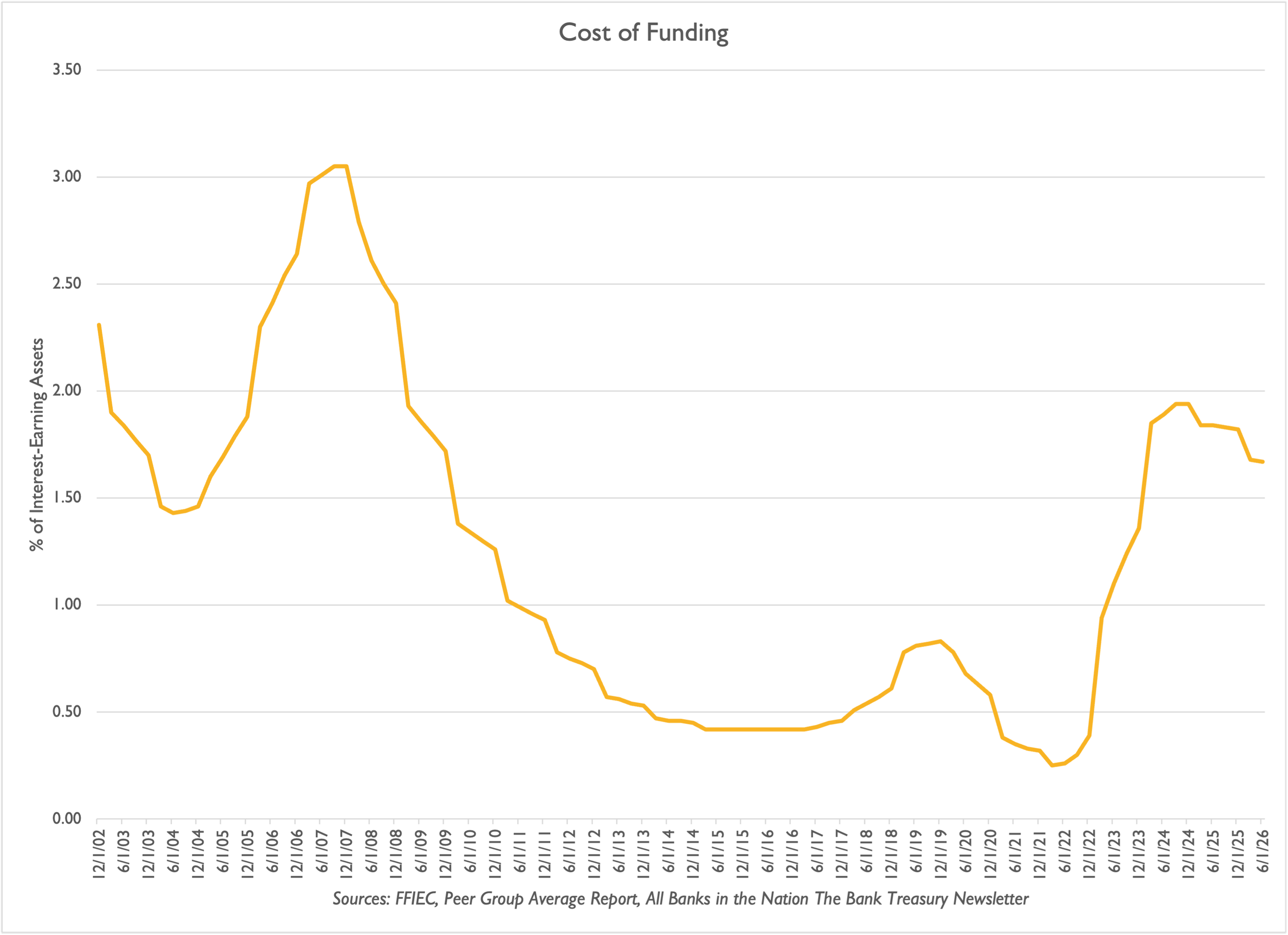
Lower Cost of Funding Pushed NIMs Higher
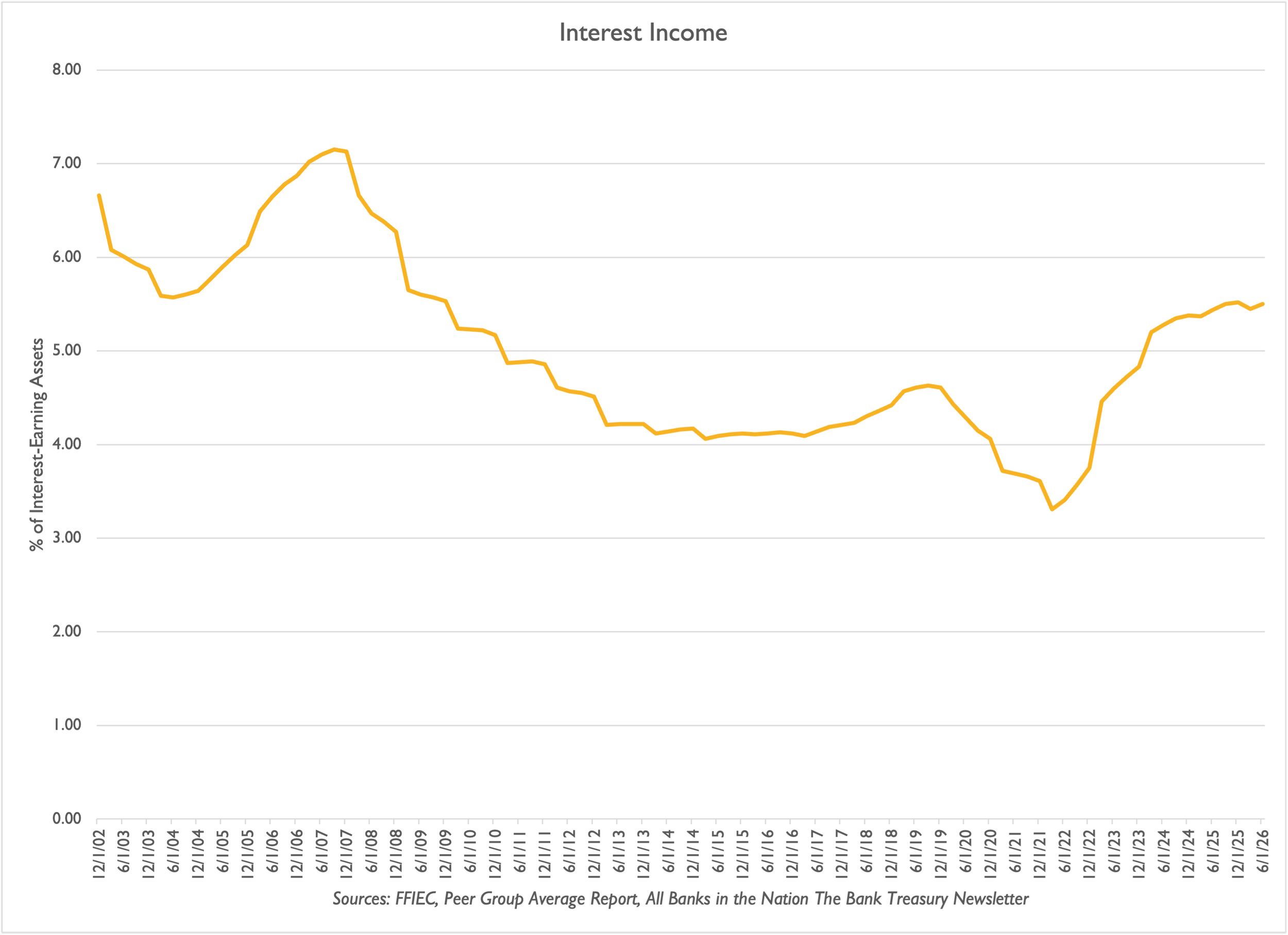
Interest-Earning Asset Yields Continue to Flatten
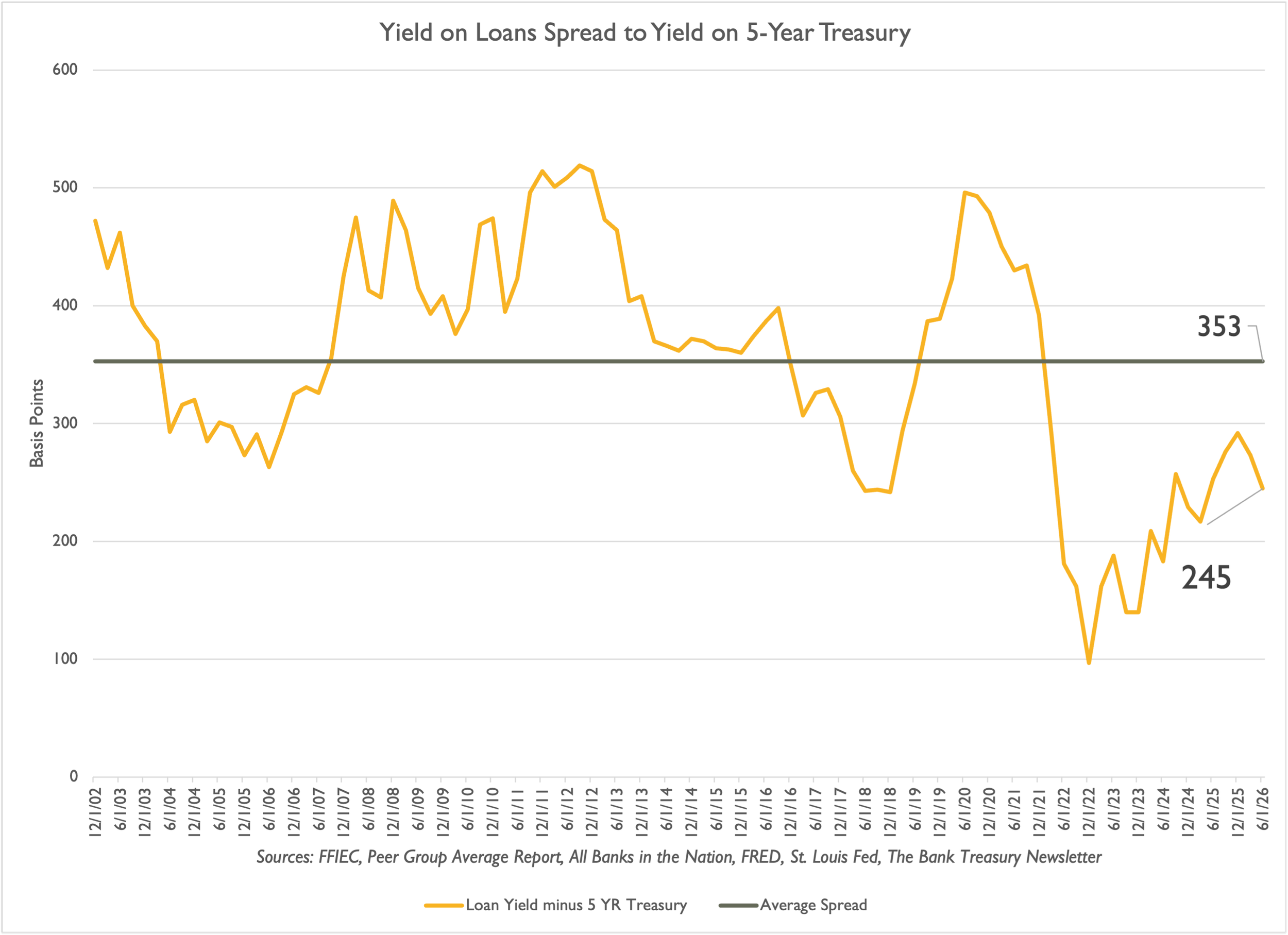
Loan Spreads Improving to Treasurys
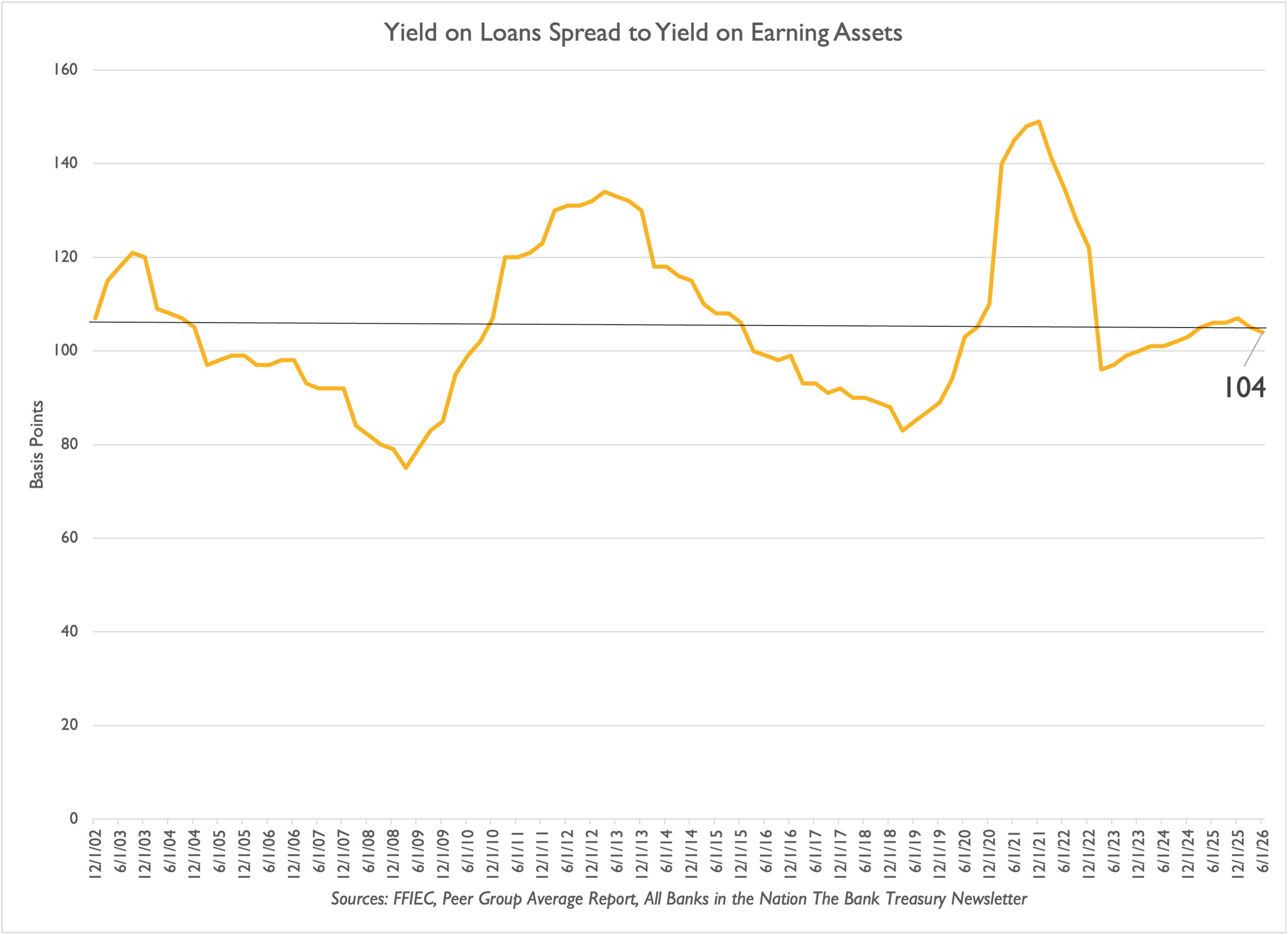
Loan Yield Spread to Yield on Earning Assets
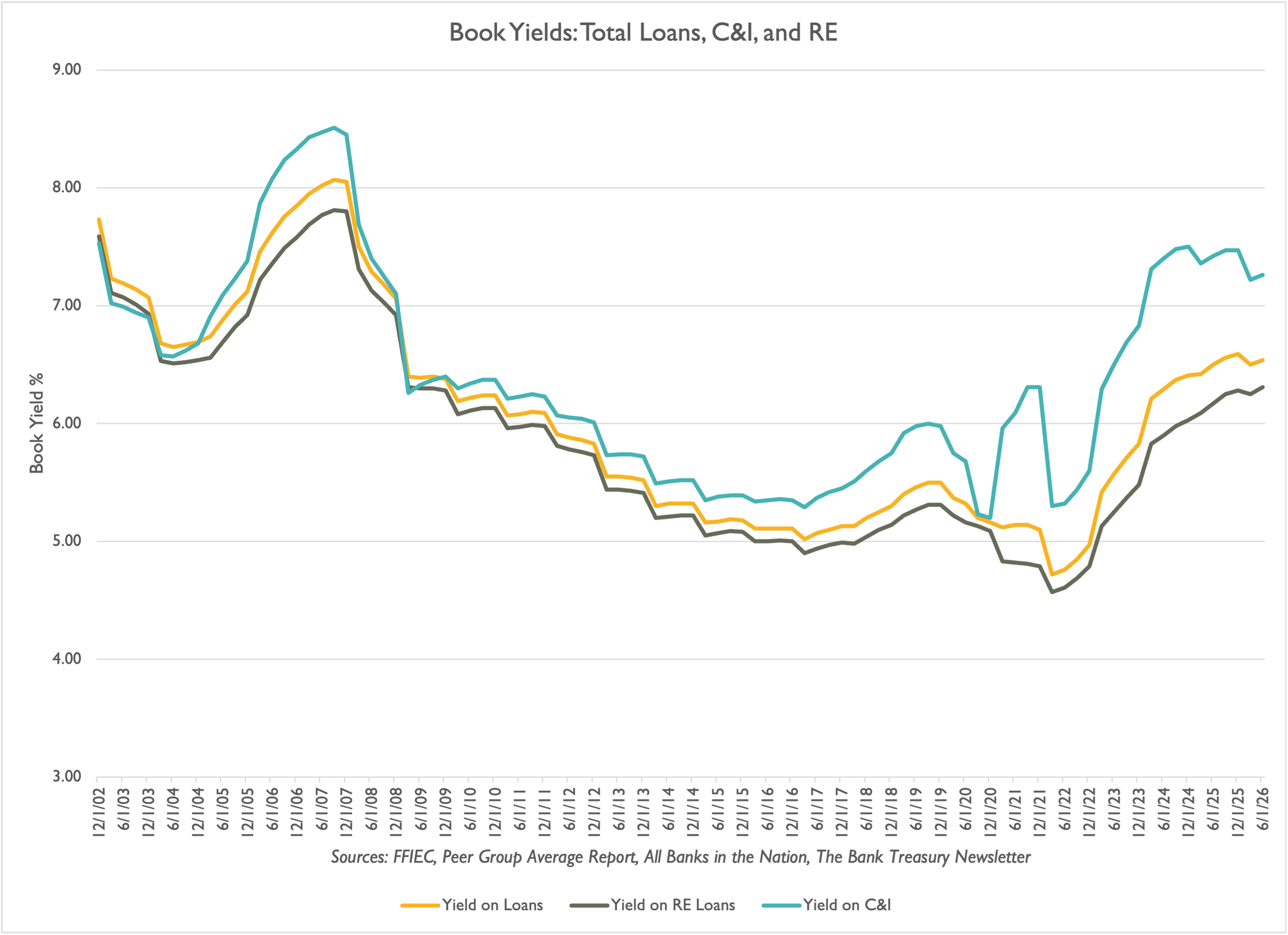
C&I Loan Yields: Historical Wide To Total Loan Yields
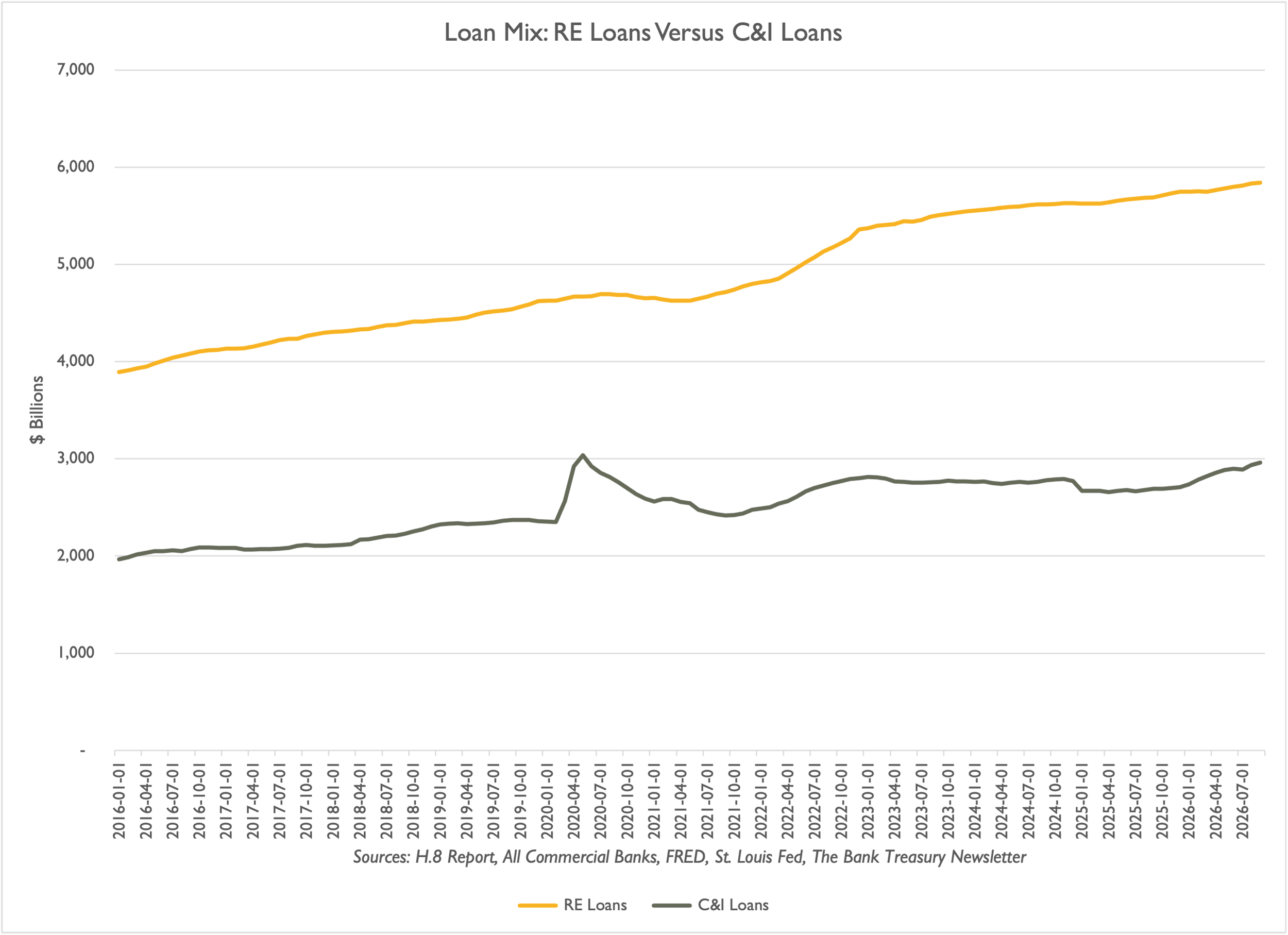
Real Estate Lending Continues Growing Faster Than C&I
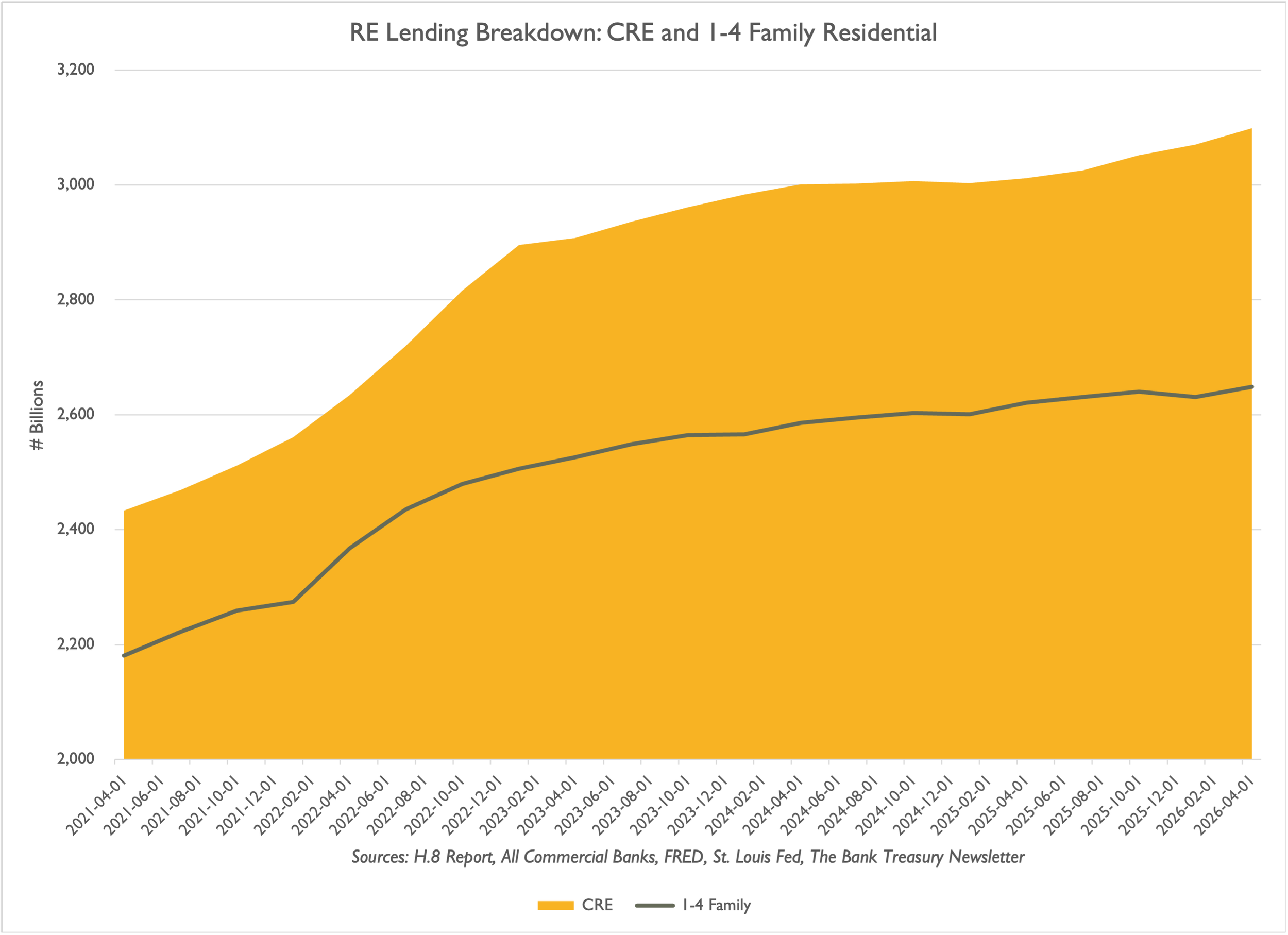
Data Centers Driving Bank CRE Balances Higher
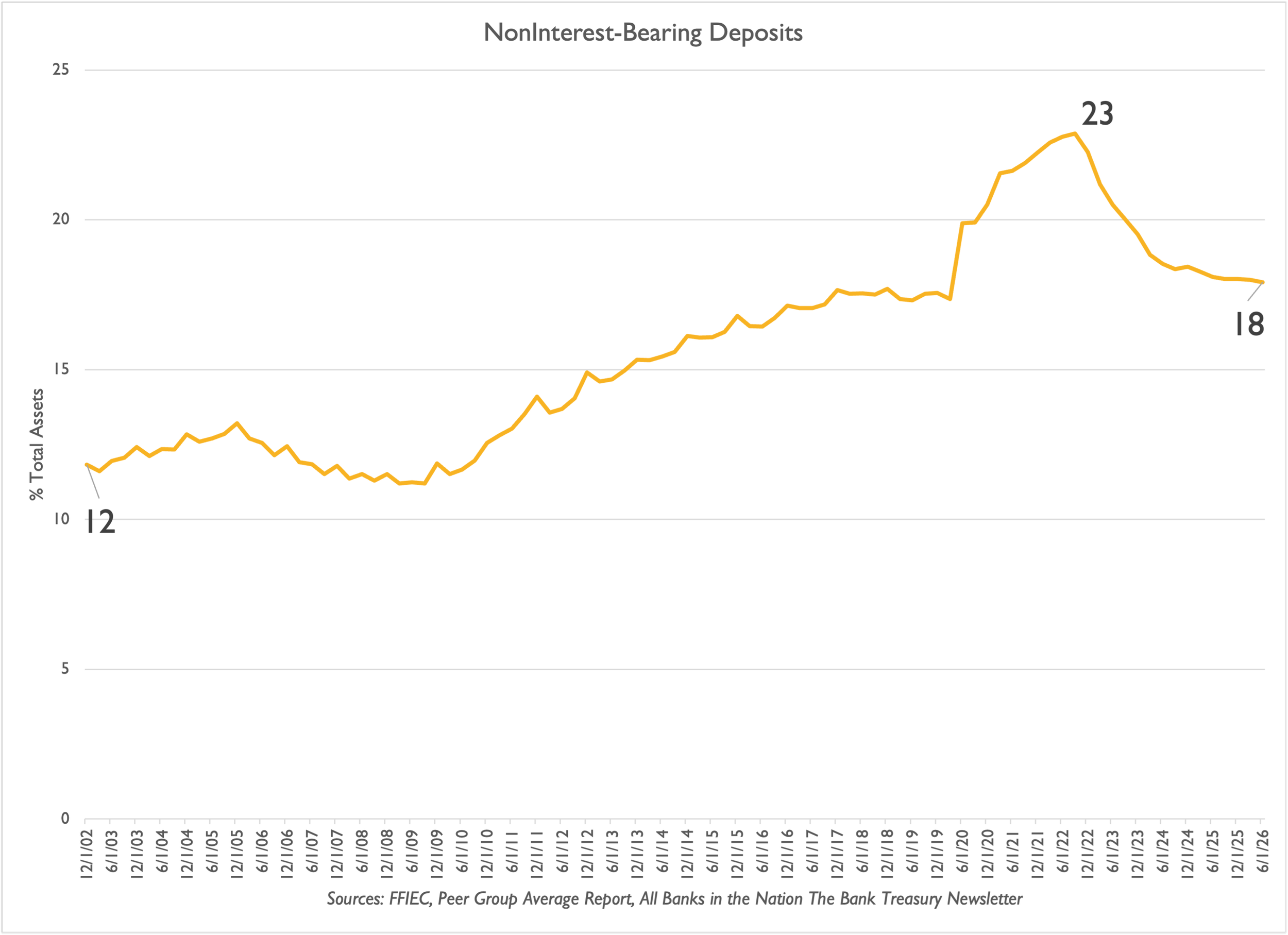
Deposit Mix Shift Will Raise Funding Costs
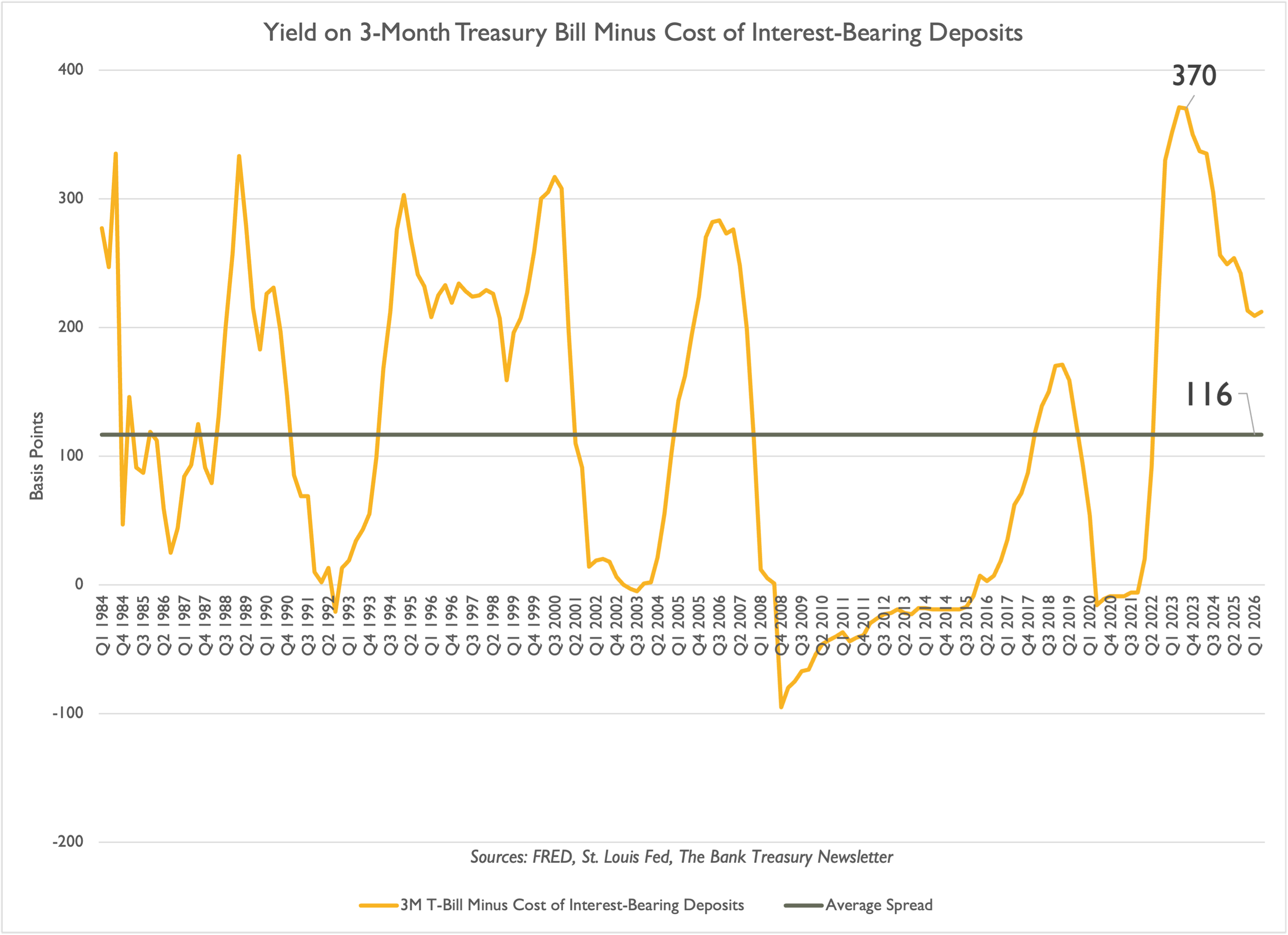
Value of a Core Deposit Heads Lower