

BANK TREASURERS SHRUGGED
Nine members of the Federal Open Market Committee (FOMC) voted on July 29th to keep the target Fed funds rate at 3.50%-3.75%, while three dissented, favoring a 25-basis-point increase in the target range. Even committee members who voted to maintain the current target range expressed frustration with the progress made so far in reining in inflation. In statements after the meeting, some hinted that if more material progress was not made by the next meeting in September, they would join the votes in favor of a quarter-point hike. Meanwhile, Fed Governor Lisa Cook, who voted to maintain rates, is under renewed pressure from the Department of Justice to force her off the Board of Governors, renewing market worries about the Fed’s independence, while the 30-Year Treasury topped 5.30%, the highest it has been since before the Global Financial Crisis (GFC).
The vote contrasts with the distribution a year ago at the July 2025 meeting, when a couple of committee members favored cutting the Fed funds rate by 25 basis points. It also underscores the volatile, hard-to-predict economy the Fed has had to navigate since the COVID pandemic. Indeed, part of the problem for the committee may be that it doubts the accuracy of the economic data it uses to track the economy.
Last June, when Kevin Warsh became the 17th chairman of the Federal Reserve, bank treasurers had high hopes that the Fed would finally rein in inflation, which has remained above its 2% target for 63 months. However, he voted with the rest of the committee to leave the rate unchanged at the FOMC’s June meeting and again at the July meeting. His second post-FOMC press conference appeared to confuse markets by refusing to explain his decision to maintain the target rate, insisting that the market would need to make its own judgment about the economy and the appropriate level of interest rates. He even seemed to question the role of a rate hike in controlling inflation, referring to the option as “may be part of the solution.” According to press reports, he raised the possibility of reducing the number of FOMC meetings, but the Fed is bound by statute to meet at least four times a year.
Heading into the July meeting, June 2026 inflation data suggested that, even though numbers were still above target, inflation was cooling. Meanwhile, employment data indicated cooling demand for new hires. Thus, even though the inflation the new chairman had promised the U.S. Senate would be his life mission remained a problem, it showed no signs of worsening. Indeed, July inflation numbers continued to show that inflation pressures were cooling, while new jobs fell, a potentially troubling sign about the economy’s fragility and its ability to withstand the tough medicine the committee may need to administer to tackle inflation.
According to the Chicago Mercantile Exchange (CME) Group FedWatch Monitor, the probability that the FOMC would vote to keep the Fed funds rate in its current range was 71% on July 1st and rose to 89% after Kevin Warsh’s Senate testimony on July 15th. By July 22nd, the probability that the FOMC would maintain its current policy had fallen to 62%, while the probability that it would hike by a quarter point had risen from 11% on July 15th to 31% on July 28th. Notably, Citadel Securities had published a bold market call the week before the Fed met, suggesting that the Fed, led by the new chairman, would vote to hike rates, which could have influenced market expectations.
Following the July meeting, arguments for a September hike were bolstered by hawkish comments from both dissenters and majority voters. However, with July employment and inflation statistics in the books, the probability of a September rate hike is also fading. For example, as of August 1st, the odds of a September hike on Polymarket were 58%, but have fallen steadily through the month to 25%. The CME’s FedWatch monitor pegs the probability of a September hike around 35%, down from 67% when the month began. The
The Fed holds more than $530 billion in Treasury Bills in its System Open Market Account (SOMA), and the New York Fed announced this month that it would delay further purchases under its Reserve Management Purchase program until October. The program is designed to stabilize the Fed’s balance sheet at its current level, with reserve deposits at just under $3 trillion. It also shortens SOMA’s maturity profile as T-bills replace some of the Agency MBS portfolio as it runs off. For example, in July 2025, its Agency MBS portfolio was $2.1 trillion, 33% of SOMA. This month, the balance in its Agency MBS was $1.9 trillion, or 29% of SOMA, shortening its maturity profile from over 9 years in August 2025 to 8 years this month (please see Slide 4 in this month’s chart deck for more details).
Notably, for the first time since 2022, the Fed has earned positive net interest income on its SOMA portfolio after paying interest to banks on reserve deposits. This positive net income is reducing its cumulative negative Treasury remittances, which puts downward pressure on reserves. Please see Slide 6 in this month’s chart deck for more details.
The national debt outstanding will grow by more than $2 trillion in fiscal year 2026, marking the fifth consecutive year since the end of COVID stimulus measures that it has grown at this pace, as deficit spending has ballooned the national debt outstanding to $39 trillion. The increase over the last year equaled 7% of GDP, down from 10% in 2022. Money created through federal deficit spending is feeding inflation by expanding the money supply and boosting balances in bank deposits and money markets. It is also fueling a historic surge in equity valuations, led by the hyperscalers. Money is even flowing into farmland, driving the price of an acre of farmland from $3,130 in 2020 to $4,500 this year, even as economic output has fallen. Please see Slide 9 in this month’s chart deck for more details.
The Bank Treasury Newsletter

Dear Bank Treasury Subscribers,
On July 29th, Kevin Warsh voted with his fellow Fed Governors and the presidents of the New York and Philly Feds to keep the Fed’s target range for the Federal funds rate at 3.50%-3.75%. The presidents of the Dallas, Cleveland, and Minneapolis Feds dissented, voting for a 25-basis-point hike. There was a “robust, active” debate, or, as the Chairman described the meeting to the press afterward, “I asked for a good family fight, and I got one.”
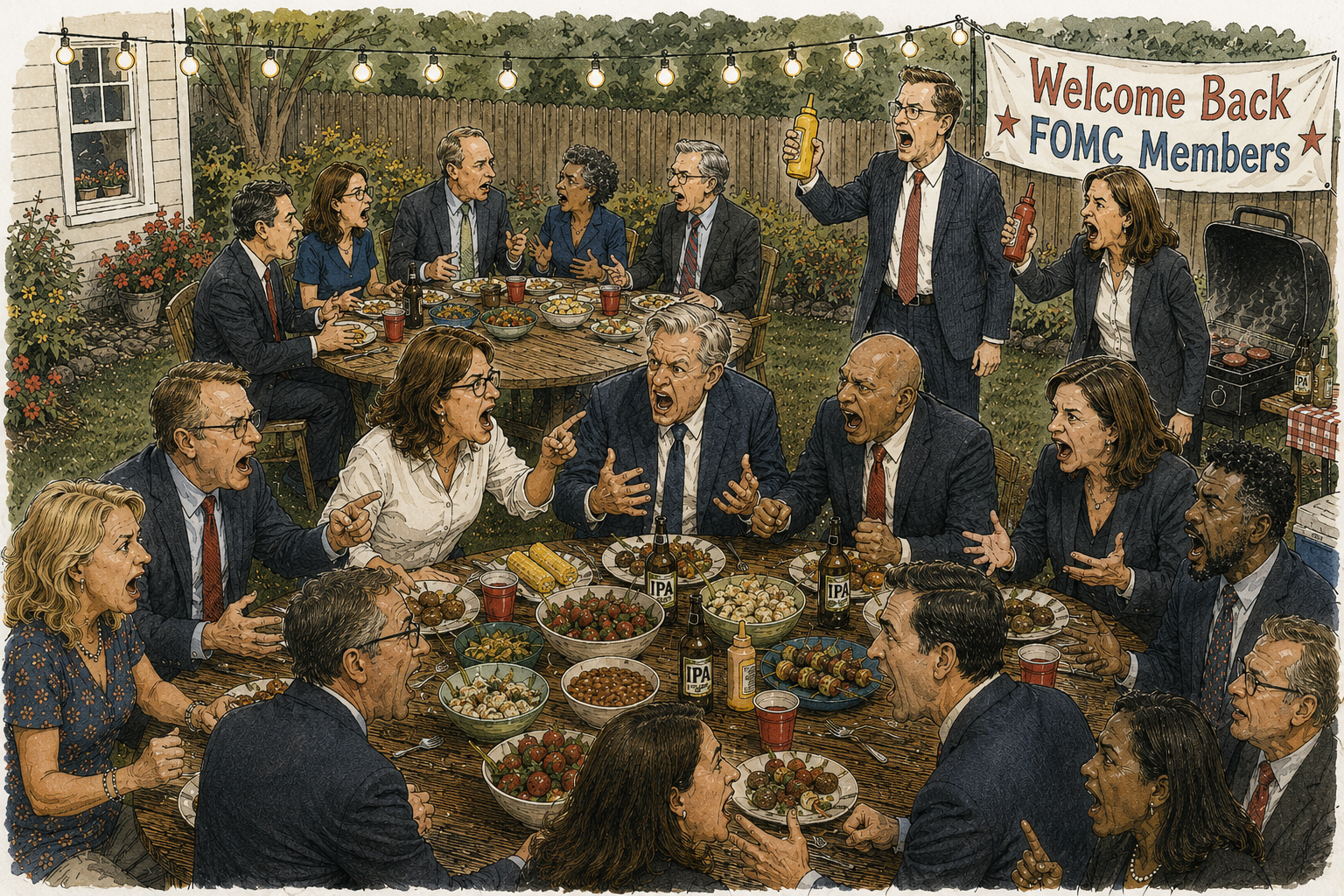
Bless his heart, he sure did, but not like a typical family fight: the dramatic, awkward, emotional knockdown-drag-out fights over dinner that the novelist William Faulkner described in “Go Down, Moses.” You know, the heated ones where people’s faces turn red, things better left unsaid are said, and there is even some spitting.
Let’s be honest, the FOMC “fight” wasn’t a feud, and it wasn’t even a squabble. No one was calling anyone else across the “family” table a “hawk-tard” or a “dove-tard.” It was more like a friendly disagreement at a backyard family barbecue, where everyone lines up on one side or the other over whether ketchup or mustard goes on hamburgers. (Who puts mustard on hamburgers, really? It’s un-American!)25 basis points doesn’t seem like much to fight over, and no one is debating whether inflation is too high. They just disagree on whether “restrictive” (or maybe just “starting to be restrictive”) means 3.50%- 3.75% or 3.75%- 4.00%. Tomatoes, tomatos, whatever.

What’s the Point?
What is 25 basis points for an economy running at 5-6% nominal GDP growth that has not seen a real recession in years? What is 25 basis points for an economy that shrugged off 5.25%-5.50% for 14 months (July 2023 to September 2024) and still churned out positive job growth? What is 25 basis points to inflation, which still has not gone away long after the lag effects of past rate hikes would have kicked in by now? What is 25 basis points for an economy where it is not even clear that the Fed funds rate has any causative effect on what is fundamentally a service, not a manufacturing, economy in the middle of an AI supercycle, or that it played any significant role in restoring supply chain disruptions after COVID that contributed to inflation? What is 25 basis points if the members and alternating members of the FOMC are not even sure that a nominally higher 3.75%-4.00% rate will be even marginally more restrictive than 3.50%-3.75% in real terms?
Even dissenting voter Beth Hammock admitted it was not much.
"I would say in general one 25 basis point move probably doesn't do a whole lot for the economy."
Great, so why not go 50 basis points for the first hike? Or 100? Or why not get right into it by selling long Treasurys and MBS outright from the SOMA portfolio and replacing those bonds with more Treasury Bills? That would be shocking, but a much better start on finally taming the inflation beast than a measly 25 basis points. No? There would be political heat from the Treasury secretary, who has refunding and new debt to issue, sure. Taxpayers are already paying over $1 trillion in interest on the debt (even if they pay it to themselves, as the majority of bondholders holding Treasurys). But if persistent inflation above target is a national emergency (much less a monetary policy-setting embarrassment, some might add), why not act like it? Why not show the global financial markets that the Fed means business about the 2% inflation target?
This was his second meeting as chairman of the Federal Reserve and the FOMC, and his second vote in six weeks to leave the benchmark overnight rate unchanged. Maybe he got a pass for going along with the other FOMC members at the June meeting, but by his second meeting, the honeymoon period is over, fella. Time to get to work on conquering inflation. There are just three more meetings left on the schedule this year: one in September, one in October, and one in December, when the committee will have a chance to review its policy, vote, and show the world what credibility is all about.
Instead of just saying what the chairman said at his post-meeting press conference,
“There’s only one target, and it is 2 percent…We’ve begun a new chapter…This Fed will not waver. Our credibility rests on performing our duties and delivering on our responsibilities. Americans are right to expect that because our nation’s prosperity depends on it.”
Do something. Spare us the words about how you mean it and show us! Sure, sure, 25 basis points could be a start, as the Dallas, Cleveland, and Minneapolis Fed presidents basically said in statements after their votes. But how courageous is it to say, as other Fed presidents and Fed Governors have this month about their open minds, that if inflation does not improve soon after 63 months, gosh darn, by the next meeting I sure will vote for a 25-basis-point hike? Seriously?
Got it that it would be symbolic. Got it that you’ve got to start somewhere, and maybe now you go early so you can go slowly and raise rates less than if you go later and need to go faster and higher. Got it. But is 25 basis points a symbol of resolve or of a lack of serious intent? There is no virtue in pusillanimity. After five-plus years of above-target inflation, isn’t it long past time to go big or go home?
The FOMC must have been relieved that they did not raise rates just before the weak employment number hit the tape this month, right after the meeting. Imagine the optics of that! Fortunately for the committee members, the tame inflation numbers that followed spared them from second-guessing their collective decision to hold the target range for the Fed funds rate. The inflation problem persists, but it is neither improving nor worsening.
Lately, maybe they are less confident than they used to be that the data they are looking at is as reliable as it used to be (or as they thought it was), and that the specificity in an inflation rate, say, 2.4% or 2.2%, means all that much? How much confidence should FOMC members have that the tamer inflation numbers released this month are real? Change a few definitions, and an inflation number could look very different from the heartening or dismaying picture it presents. Maybe the consensus is not to make a move because they do not know what move to make and think they can wait to know more?
And how about this? What are 25 basis points when the Federal government has been pumping more than $2 trillion in new money into the economy every year for the past five years? And there seems to be no end in sight to deficit spending at 7% of GDP (Figure 1). In addition, the COVID stimulus cost another $5-plus trillion. Each new dollar of national debt adds to the money supply, fueling increases in grocery prices, computer prices, streaming subscriptions, and even the price of candy. How does one even afford a decent sugar high anymore? But inflation is not just about the price of eggs. Historic deficit spending is driving significant asset inflation, too.
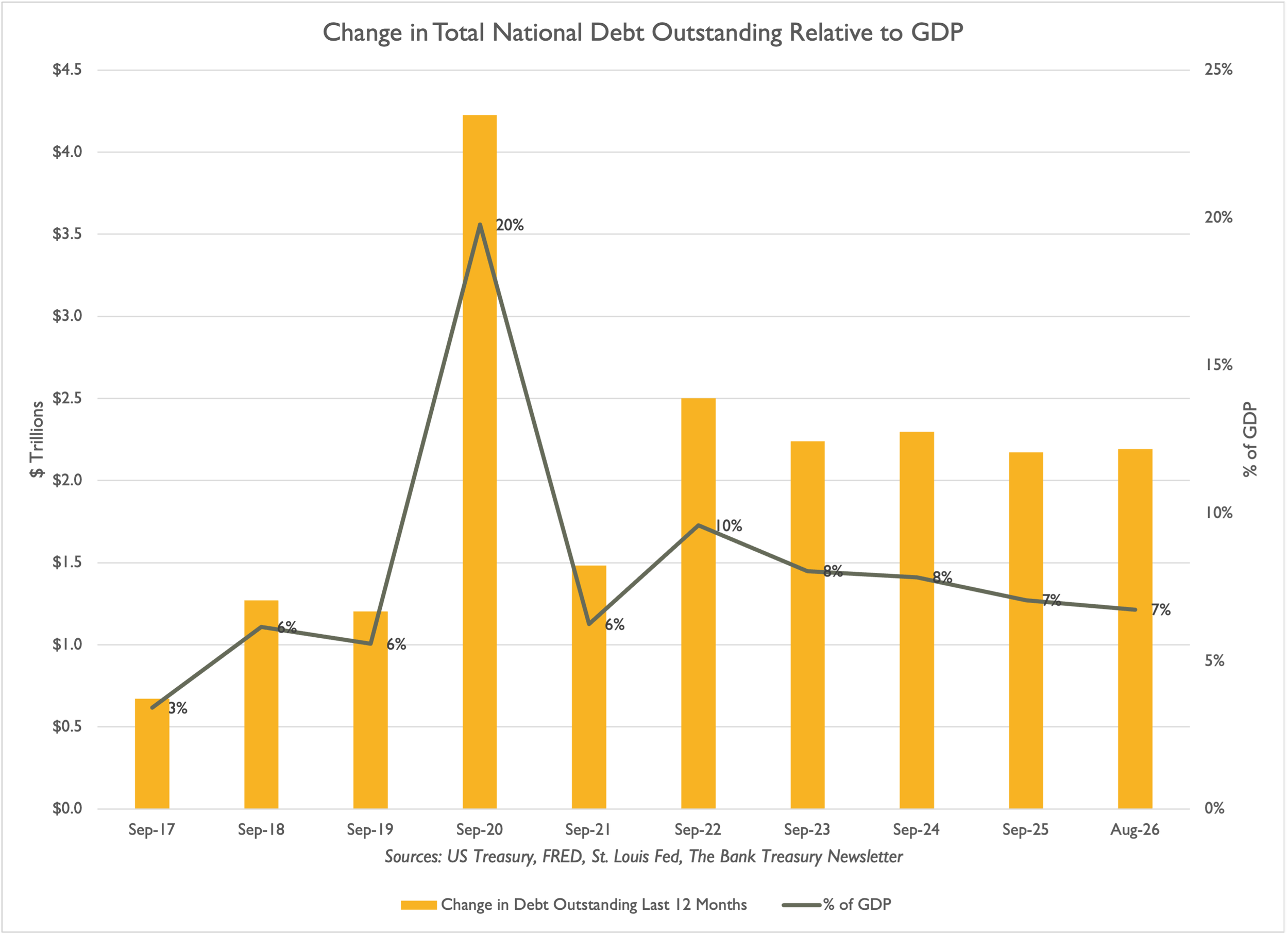
Figure 1: Change in Total National Debt Outstanding Relative to GDP
Forget about the printing press. Most of the money created by the Federal Government’s profligate spending did not go into wallets and purses or into pocketbook economics. The money the Fed printed on demand, the currency in circulation, has grown by only $0.7 trillion since 2020. That is pocket change. But it also went directly into bank deposits, which rose from $13 trillion to $19 trillion since 2020, and into the balance of money market funds, which has doubled from $4 trillion to $8 trillion.
The money is flowing into risk-free assets, fueling every solid Treasury auction and bolstering a well-bid secondary market. And then there are the equity markets, which continue to set new daily records, on a sugar high, no doubt oblivious to strains emerging in the private equity markets, for example, where firms are having trouble exiting investments at acceptable prices—the greater fool theory in action. The money is flowing into real assets, too. Farmland prices are reaching record highs, even as output per acre has plunged to new lows since 2022.

And you think, what are people doing with the money the government puts in their pockets, bank accounts, money market funds, stocks, and real and virtual crypto assets? Why are they crowding into trades and buying every dip? Don’t they know that nothing goes up forever? Don’t they see the cracks forming? Aren’t they hearing the alarm bells ringing? Haven’t they seen the movie enough times to know how it ends? OMG! A senior executive at a global bank thought the private credit lenders were pulling back for that very reason, telling a reporter this month,
“These are all warning shots. Valuations get out of hand, leverage in the system gets too high…You must be careful. You always look and say, ‘OK, what happened? Should we learn from it? Should it change? And so the tendency is to tighten the underwriting standards, just a hair, to adjust — especially with big run-ups in stocks.”
But the thing about money is that when you are a money manager, sitting on the sidelines is like holding your breath underwater. If you have extra reserve tanks and you have trained for it, you can hold out for a while to find better entry points. But eventually, you come up for air and buy. You are not paid to sit in cash, so you capitulate. You buy and hope the mistake you know you are probably making isn't discovered until after your retirement.
So, what are 25 basis points, really, when you are running against a mega-tidal wave of money and trying to address chronic inflation, as if you were pushing on a string?


Say Nothing Useful
In any case, if bank treasurers were hoping Kevin Warsh would offer insights into his thinking on inflation when he spoke to the press after the meeting, they were in for a disappointment. As far as he was concerned, the committee issued a statement, and that was all the public was going to get. It was that simple. There was nothing more to say, and nothing worth wasting time on, since he said nothing he had not said before. But he was glad to take reporters’ questions and answer them with reasonably-sounding but ultimately frustrating nonanswers.
Sure, he reviews the data, but he won't say whether he favors one metric over another for tracking inflation. Maybe his favorite metric even changes. He has task forces examining how the Fed conducts monetary policy, but one thing is certain: he does not believe in spoon-feeding information to Mister Market. Mister Market will need to do his job.
If Mister Market is unhappy with interest rates and wants them higher, he can go right ahead and raise them himself. He does not need the Fed to help (ignoring the fact that the Fed only controls the overnight rate). Go ahead and have a tantrum, Mister Market, if you want, he said, politely but firmly. The chairman wouldn't come right out and say that Mister Market was doing his work for him, but he kinda was.
Who knows? The chairman said he might even reduce the number of meetings going forward. There is no rule that requires the FOMC to hold eight meetings a year. Mister Market will need to be more self-reliant and use his brain. Thinking is a virtue that is sorely lacking, and the chairman wants to change that, as difficult as that may be.
Oh, he is all about transparency, and we should thank his idol, Alan Greenspan, for instituting the practice of issuing a statement to the public immediately after FOMC meetings. Otherwise, maybe he would be thinking of cutting them out. The FOMC used to release that 90 days after the meeting. In Volcker’s day and before, economists needed to divine the Fed’s monetary policy from the equivalent of tea leaves, parsing changes in line items on the Fed’s balance sheet. Veteran Fed watchers, the market soothsayers of the day, were well paid to divine the Fed’s unspoken messages.
But he voted the way he voted because that’s how he voted. He was not going to get into a whole discussion about economic trends, the Personal Consumption Expenditure (PCE) Index, trimmed and untrimmed, CPI, PPI- who cares! He and his fellow FOMC look at a lot of stuff, and sometimes they look at some things, and sometimes they look at other things. Got it? Oh, and no, he is not going to worry about what the market thinks of his vote. He voted the way he voted. Deal with it.
Nothing should come as a surprise, as the chairman said.
“Surprise is not the objective function. Surprise is not what we’re solving for.”
But if Mister Market expects to be told the Fed’s reaction function to economic developments, he needs to understand that he is a partner in the decision-making process. It is a two-way street. But what about inflation, which has not returned to the 2% target for 63 months? Weren’t you the guy, a reporter asked, who told Senators at your confirmation hearing?
“Inflation is a choice, and the Fed must take responsibility for it.”
For all the tough talk about inflation and all the hope and hype, the man who said, on his swearing-in as Fed chair last June,
“Like Alan, I intend to fill the role of chairman with energy and purpose, just the way Chairman Greenspan did, faithful to the mission and the very best traditions of the Fed,”
After all he had said, that man told a roomful of reporters, after almost two months on the job, that monetary policy does not need to change right now. Can’t you almost hear the late Senator Lloyd Bentson telling Dan Quayle at the vice-presidential debate in 1992 that he was no Jack Kennedy? To paraphrase,
“I knew Alan Greenspan; Alan Greenspan was my friend, and you, sir, are no Alan Greenspan.”
The man who forwent forward guidance told reporters at his press conference after the FOMC vote that he could not say more than that it is time for Mister Market to do his own work. Channeling Greenspan, he chose to be unclear. The “Maestro” was famous for saying little and for saying nothing when he did speak, as he would boast,
“Since I’ve become a central banker, I’ve learned to mumble with great incoherence. If I seem unduly clear to you, you must have misunderstood what I said.”
Talking too much is harmful because it stifles Mister Market’s free speech, Chairman Warsh told reporters.
“What I've really been trying to do… is to get an unfiltered message from markets. Getting a direct message. Letting buyers and sellers meet at prices for Treasurys…and then trying to judge for ourselves, what does that mean about our remit? How are we doing on inflation? How are we doing on employment? We're trying not to interfere with that market signal.”
How are you doing on inflation? Good grief! How about no stars? According to New York Fed researchers, it is debatable whether Mister Market even correctly sees the Rs, Us, and Ys. But no matter, as he said in response to another reporter's question,
“By not spoon-feeding markets, by not previewing our decisions, by not sort of giving nudges and leans, my colleagues and I have found in the intermeeting period what we're getting is the views from a very accomplished economist.”
Great, but did you really have to tell the press, when asked whether you would raise rates if inflation proved persistent, that it was just one of your options?
Question: “If inflation is too high and not coming down, is the best remedy to raise interest rates?”
CHAIRMAN WARSH: “Is that the dominant remedy? If inflation remains elevated throughout the forecast period, interest rates could well be part of that solution. But I wouldn't say it's in isolation.”
Really? Why? Don’t be cute! You had one job: to instill confidence. Does leading off with answers like this help?
The chairman strongly believes in the Fed's credibility. You know what credibility is? You say what you are going to do, and then you do it. If you say you have no tolerance for inflation, inflation persists, and you shrug, that is not credibility in the making. And logically speaking, if you do what you do when you do it—you raise rates one day or lower them—but you keep everyone guessing until you do it, how can you possibly establish credibility? That is just called surprise, and the chairman said his objective is not to surprise, so what gives?
Mister Market Speaks
And what is Mister Market saying to you, Mister Chairman? Bank treasurers want to know.
…We've seen a material tightening, not just in nominal rates, but in real rates too.”
What exactly does that mean? Do you like this or not? Hold on. Before we hear you tell us nothing more, let’s look at some numbers.
Start with the 10-year Treasury. At the end of February, it yielded 4%. Persistent inflation and higher energy costs tied to the war in Iran fueled a sell-off. Five months later, a day before the FOMC vote, it was yielding 4.60%, plus or minus a basis point. A day after the meeting, the yield, according to FRED, shot up 7 basis points, and the next day it peaked at 4.75%. It has since rallied a bit, but the yield on a 10-year Treasury in the secondary market is still higher than before the FOMC meeting. That is not a vote of confidence from Mister Market, even if the new chairman was not worried.
“I look at the Treasury curve, if I look at the dollar, if I look at a lot of things that are internals inside of financial markets, I think what they’re broadly saying is that this Committee does own it—has the credibility to deliver it. And they believe, like I do, that we will.”
Well, let’s just say that Mister Market and the Treasury market are not sure what to make of it. The 2s-10s spread on the eve of the Iran War was positively sloped by 70 basis points. It has since narrowed: on the eve of the FOMC vote, it was 45 basis points, and it has remained relatively unchanged this month. Who knows what the shape of the yield curve means econometrically, but one thing bank treasurers will tell you they do know. They do not ask for much, but one thing they all want to see is a steeper curve, and the FOMC vote did not deliver.
Heading into the meeting, traders must have seriously believed the Fed would hike rates, as the 2-Year yield rose from 4.10% at the beginning of the month to 4.35% a week before the meeting. That definitely sounds like Mister Market thought the Fed should be singing, “A Hiking We Will Go,” and for more than 25 basis points. After the meeting, that yield is back under 4.3% as traders covered shorts, but make no mistake: Mister Market expected rate hikes and got zilch.
So, if Chairman Warsh was supposed to vote for ketchup--er, sorry, a 25-basis-point hike during the “family fight,” as a sign that he is the guy to fix inflation, that he will stay true to his ideals, that his word is his bond, that the Fed’s commitment to 2% inflation is credible enough for fixed-income buyers to buy with confidence, that all the hype about this guy restoring credibility was not just air, and that the Fed is prepared to deal with inflation sooner so it will not have to go higher and faster later, then the sell-off was not a good thing. No, sir! Not a good sign at all. It says that Mister Market is sorely disappointed, and that is putting it mildly, because some traders must have been spitting mad.
Maybe not as disappointed as when Ben Bernanke, his predecessor’s predecessor’s predecessor, told the markets in May 2013 that the Fed would begin tapering quantitative easing (QE). Traders went wild, and the sell-off in the 10-year sent its yield from under 2% to 3% in a couple of months. But Mister Market got huffier than when former Fed Chairman and now just a plain old Fed Governor Jerome Powell told the markets that the Fed was starting to taper QE 2 in July 2021. The 10-year did not move a basis point then.
Who knows whether Mister Market has a better view of the economy than members of the FOMC? Amazingly, it was not too long ago that Mister Market believed the Fed needed to act on its “restrictive” overnight rate. Before the war with Iran began, the spread between the 3-month Treasury Bill and the 2-Year Treasury Note was inverted by 30 basis points, signaling lower rates. Now that spread is plus 40. Mister Market clearly has a view on what the Fed should do right away, even though that view seems to be evolving in many directions. Nu, so what do you hear him saying, Mister Chairman?
“So, interpreting markets is an imperfect business…But let me offer some speculation. First, as we said in the FOMC statement that you got at two o'clock, the economy’s output is solid. Capex and productivity are strong. Labor markets are solid and steady. The bond market, the Treasury market, it seems to be saying that as well. If I were to try to break down, just aggregate the Treasury market signals, I wouldn't be able to do it perfectly, but the bond market's saying many of those same things, and that's why we're seeing a tightening both in nominals and in reals, even while at some level, we haven't done much in 42 days. The markets have done quite a bit.”
Sometimes you wonder about the Fed chairman and the business of letting the market do the work. Is that really what Chairman Warsh wants? To let Mister Market lead the way? Mortgage rates are higher, as Philly Fed president Anna Paulson, who voted to hold off on rate hikes, explained, because the market is already doing the Fed’s work of constraining the economy, at least for the little guy.
“One possibility is that the current setting of the federal funds rate is mildly restrictive and this will bring inflation to 2 percent in an acceptable time frame. Moderate wage growth and subdued expectations for future wage growth support this argument. Elevated mortgage rates and muted housing market activity demonstrate how higher interest rates are constraining many households. While second quarter consumption increased 3.2 percent, there are signs of weaker demand among low- and middle-income families.”
New York Fed president John Williams said in a recent interview that he would not say the Fed wants Mister Market to do the work. He held a more nuanced view.
“Obviously changes in financial conditions…affect the cost of borrowing or the returns on assets that households and businesses face…or affect the economy in some ways. I never like the phrase that the markets are doing the work for us because I know that we have to do the work ourselves, but sure, those are factors that affect conditions.”
Not to be cheeky or overtly disrespectful to the chairman, but if Mister Market is sort of, but not exactly, doing the Fed’s work for it, why are we paying the Fed chair over a quarter of a million dollars a year? Seven Fed governors, twelve Fed presidents, plus teams of economists, and these people cannot figure out what is going on with the economy? Maybe they could all be replaced with AI. That would be one way to hasten the productivity boom the chairman believes will, one day, deflate our way out of inflation.
Ask Mister Market! Seriously? What if our faith in Mister Market’s wisdom and the invisible hand is misplaced? Mister Market cannot even figure out what is going on with the Fed because it thought rates were going higher.
And by the way, if members of the FOMC think asking market participants what they think will yield any worthwhile insights, what New York Fed president John Williams said he was hearing does ’t inspire confidence or credibility. Why are market participants not freaked out enough by worsening oil supply issues as the Iran war continues? Is anyone paying attention to the news about our country’s depleted oil reserves? The New York Fed president said this month in an interview,
“I think that when you talk to people in the financial markets, especially around why are they not as worried as you might expect about the running out of inventories is, I think they often point to, well this is understood and at some point this would be, would lead to very very high oil prices and things and that would be part of an argument why various parties would want to come to a resolution of this and I would say on both sides. I mean, the cost to the various countries involved in this goes up if we get to that point.”
So, everyone will listen to reason, and that is how an existential problem will just go poof away. Wow, that sounds encouraging! Isn’t this kind of thinking what the late Fed chairman Greenspan called irrational exuberance? Rational thinking is a major assumption in economic models. You buy low to sell high. Finance is not rocket science; it is just the sum of 2 plus 2. But in real life, economic decisions are not all about dollars and cents, and hence being a bank treasurer means living with a degree of unpredictability. The truth is that Mister Market is no better at forecasting the economy than the Fed is, he continued.
“I think there is uncertainty about how the economy is going to evolve and how the data are going to evolve. The idea that everybody would act as if we all know what's going to happen in terms of the economy and therefore monetary policy, I think, is inconsistent.”
And even if Mister Market could make an accurate forecast if it wished, it is doubtful that Chairman Warsh or anyone else on the FOMC would be able to understand it, as he said at his press conference.
“What I see is…Treasury markets are responding to the economic news, they're responding to geopolitical developments and oil prices and what's happened in the Middle East and they're responding to a lot of different factors, and I don't, I don't opine on whether they're right or wrong because I don't know.”

Why Did Kevin Shrug?
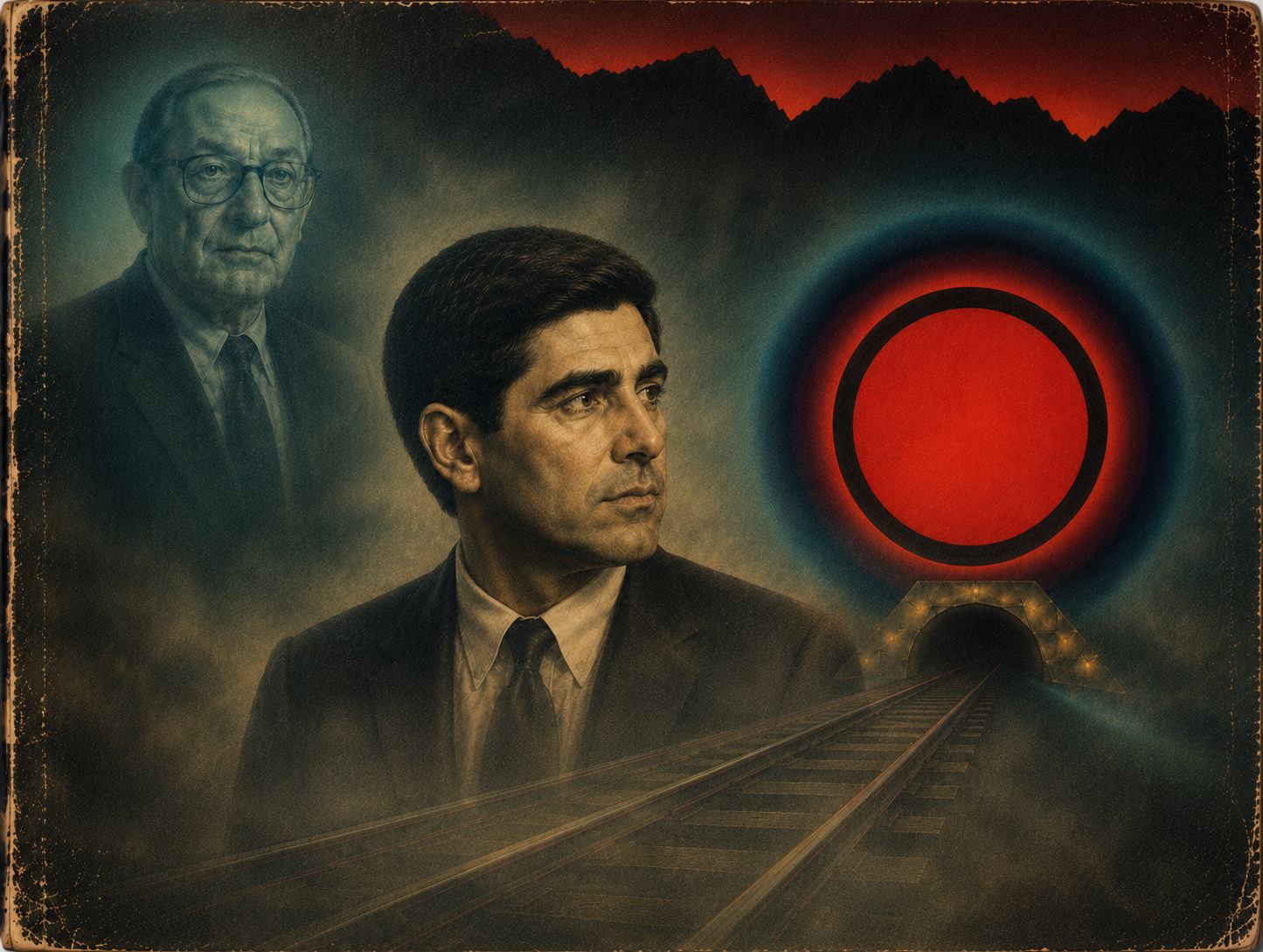
Chairman Warsh abandoned forward guidance, withheld his dot from the dot plot, and perfected the art of holding a post-FOMC press conference and saying nothing. He believes in letting Mister Market do his own work and not relying on spoon-feeding from the Fed. He views the late Alan Greenspan as a role model for how to do his job and communicate with the public. Thus, to understand the new Fed chairman, bank treasurers probably should study Greenspan.
Long before he became chairman of the Federal Reserve, a position he held for 18-plus years, the second-longest tenure after McChesney Martin, he was a member of a jazz band. More significantly for his career, he became a devoted fan of Ayn Rand after reading her 1957 1,168-page original issue tome, “Atlas Shrugged.” Because he liked her book, he went to work for her magazine, “The Objectivist,” as a contributing editor. Objectivism is best summed up as a philosophy that wealthy people have nothing to feel guilty about and that the have-nots are at fault for their own situation. The haves owe nothing to the have-nots, or, as Scrooge would say, “Bah humbug.”
Her book extolled the virtues of those who produce what others consume and imagined a future in which, tired of the government’s abuse and of socialists taking their hard-earned wealth without so much as a thank-you, the producers (a.k.a. Atlas) go on strike. They let the ball drop, leaving the world to hold itself up. Left to serve themselves, the moochers descend into chaos, and the government collapses. John Galt, the leader of the producers’ strike and the book’s principal protagonist, declares at a pivotal moment in the book, in his broadcast to the world explaining why he and the other producers were striking,
"Public welfare' is the welfare of those who do not earn it; those who do, are entitled to no welfare."
Socialists and communists, such as Karl Marx and Vladimir Lenin, believed money was the root of all evil because it reduced a worker’s sweat and tears to an abstraction, making exploitation easier. Speaking for the industrialists, Ayn Rand had a lot to say about money. Money is not the root of all evil; it is a virtue, as Francisco d’Antonia, another character in her book, said.
“So you think that money is the root of all evil? Have you ever asked what is the root of money? Money is a tool of exchange, which can’t exist unless there are goods produced and men able to produce them. Money is the material shape of the principle that men who wish to deal with one another must deal by trade and give value for value. Money is not the tool of the moochers, who claim your product by tears, or of the looters, who take it from you by force. Money is made possible only by the men who produce.”
Alan Greenspan believed the root of all evil was not money; it was inflation. Inflation is not caused by the Fed holding rates down for too long or by QE. Inflation is caused by the federal government spending more than it taxes. Deficit spending creates money and drives inflation. It is a product of political cowardice, with politicians all too happy to spend but not brave enough to tax. The end result is on display today, as rising interest expense adds to the national debt.
In an essay he wrote in 1966 for Ayn Rand’s magazine, “Gold and Economic Freedom,” he lamented the end of the gold standard in the United States and the economic prosperity he believed it had brought. The gold standard constrained the banking industry’s ability to extend credit, a constraint the architects of the Federal Reserve mistakenly believed had caused the many recessions that plagued the U.S. economy throughout the 19th century. By ditching the gold standard, they opened the door to deficit spending and, ultimately, to wealth confiscation by the government, as he wrote,
“Stripped of its academic jargon, the welfare state is nothing more than a mechanism by which governments confiscate the wealth of the productive members of a society to support a wide variety of welfare schemes. A substantial part of the confiscation is effected by taxation. But the welfare statists were quick to recognize that if they wished to retain political power, the amount of taxation had to be limited and they had to resort to programs of massive deficit spending, i.e., they had to borrow money by issuing government bonds to finance welfare expenditures on a large scale.”
Deficit spending leads to more money and inflation, which is ultimately taxation by other means.
“The holder of a government bond or of a bank deposit created by paper reserves believes that he has a valid claim on a real asset. But the fact is that there are now more claims outstanding than real assets. The law of supply and demand is not to be conned. As the supply of money (of claims) increases relative to the supply of tangible assets in the economy, prices must eventually rise. Thus the earnings saved by the productive members of the society lose value in terms of goods.”
The end of the gold standard was an affront to every hard-earning American and an unconstitutional taking of property, as Alan Greenspan wrote in 1966.
“In the absence of the gold standard, there is no way to protect savings from confiscation through inflation. There is no safe store of value. If there were, the government would have to make its holding illegal, as was done in the case of gold.”
The Fed could be part of the problem. If recessions were linked to a shortage of gold, as the Fed’s architects believed, the Fed would provide banks with sufficient reserves so they could lend freely to businesses and support economic growth. As Alan Greenspan saw it, the Fed’s role as a central bank was to ensure that the supply of reserve deposits would always be sufficient, so there would never be shortages and, therefore, no business slump caused by a lack of liquidity. Long before anyone at the Fed used the term “ample reserves,” the Fed could create as many reserves as needed if it believed the economy needed more. You cannot do that with gold. Gold cannot be created out of thin air. He continued,
“If a shortage of bank reserves was causing a business decline-argued economic interventionists-why not find a way of supplying increased reserves to the banks so they never need be short! If banks can continue to loan money indefinitely-it was claimed-there need never be any slumps in business.”
One of Kevin Warsh’s task forces is supposed to examine the size of the Fed’s balance sheet and explore options to shrink it. Any solution will inevitably require reducing the supply of reserves, which sit on the liability side of the Fed’s balance sheet, opposite the SOMA portfolio on the asset side. Every dollar that leaves the SOMA would need to be offset by a dollar from reserves and/or the Treasury General Account. Unless the Fed canceled paper money as legal tender, there is not much that can be done to shrink the $2.5 trillion the Fed already issued.
Alan Greenspan was no fan of QE, which ballooned the reserves balance from $6 billion when he left the Fed to $3 trillion today. First, lending data has never shown that it led to credit expansion, which was one of the reasons for QE. And as Kevin Warsh will no doubt appreciate after he talks to his task force on the balance sheet, it is difficult to reverse once it’s instituted.
You can never go back. Having replaced the gold standard with fiat paper money, you can never go back. Fiat money doesn’t stand a chance against gold if the public has a choice. Thus. the government must ban gold as legal tender. Otherwise, as Alan Greenspan put it,
“If everyone decided, for example, to convert all his bank deposits to silver or copper or any other good, and thereafter declined to accept checks as payment for goods, bank deposits would lose their purchasing power and government-created bank credit would be worthless as a claim on goods. The financial policy of the welfare state requires that there be no way for the owners of wealth to protect themselves. This is the shabby secret of the welfare statists' tirades against gold. Deficit spending is simply a scheme for the confiscation of wealth. Gold stands in the way of this insidious process. It stands as a protector of property rights.”
His view that fiat money and gold cannot coexist echoes concerns among bank treasurers about the rise of stablecoins and digital cryptocurrencies in the financial system and the disintermediation they pose to bank deposits and even to the dollar's primacy. Chairman Warsh once suggested that Bitcoin is the new gold, but as he said in an interview at the Hoover Institute last May, echoing comments Fed Governor Powell made a few years earlier, it was a digital alternative to gold, not to dollars.
"Bitcoin doesn't trouble me. I think of it as an important asset that can help inform policymakers when they're doing things right and wrong…It is not a substitute for the dollar."

After Bubbles Burst
Chairman Warsh believes that cryptocurrency payment technology and AI will be economically transformative, though, as a report from the Bank for International Settlements last month notes, exactly how that transformation plays out remains uncertain. So far, productivity gains have been limited. His Congressional testimony and public speeches echo his role model’s measured enthusiasm for the information technology that boosted productivity in the 1990s. The future looked so bright. Speaking at a financial crisis conference in July 2000, then-Chairman Greenspan saw an unfolding economic miracle.
“In short, information technology raises output per hour in the total economy principally by reducing hours worked on activities needed to guard productive processes against the unknown and the unanticipated. Narrowing the uncertainties reduces the number of hours required to maintain any given level of production readiness. In economic terms, we are reducing risk premiums and variances throughout the economic decision tree that drives the production of our goods and services. This has meant that the employment of scarce resources to address heightened risk premiums has been reduced.”
Two months later, the NASDAQ index peaked at 5048, and then the Dot.Com bubble burst. The Maestro said in an interview that it was not a policy error for him not to intervene in the financial markets to cool what he called irrational exuberance, any more than he believed it would have been appropriate for the Fed to have tried to forestall the GFC, which followed after he left the Fed in 2006.
Some of his reasoning traces back to his gold standard essay. Business cycles are a normal part of a healthy economy and financial system, and interventions could create unintended consequences, prolong an inevitable crash, or make it worse. In his view, history shows that any economic shock is temporary: Mister Market quickly finds his footing and moves on without help. In a 2005 lecture, he channeled Adam Smith to explain his faith in rational markets.
“Over the past two centuries…the vast majority of economic decisions…individuals acting more or less in their rational self-interest…Indeed, without the presumption of rational self-interest, the supply and demand curves of classical economics might not intersect, eliminating the possibility of market-determined prices. For example, one could hardly imagine that today's awesome array of international transactions would produce the relative economic stability that we experience daily if they were not led by some international version of Smith's invisible hand. The inference is not that people always act rationally in commercial transactions. The periodic bubbles in product and financial markets prove otherwise. But, by and large, the description of economic process that Smith developed, and others have since extended, does appear to adequately describe today's determinants of world commerce and the wealth of nations.”
But the GFC and the Great Recession that followed shook his confidence in these long-held beliefs: that Mister Market’s invisible hand is best left alone to resolve its own problems without government intervention. As he continued to explain,
“We had been lulled into a sense of complacency by the only modestly negative economic aftermaths of the stock market crash of 1987 and the dot-com boom…Given history, we believed that any declines in home prices would be gradual. Destabilizing debt problems were not perceived to arise under those conditions.”
Unfortunately, central banks are good at cleaning up after bubbles burst, not before, he continued.
“Unless there is a societal choice to abandon dynamic markets and leverage for some form of central planning, I fear that preventing bubbles will in the end turn out to be infeasible…Assuaging their aftermath seems the best we can hope for.”
As a matter of public policy, central bankers face a choice about the financial system. They can either impose draconian regulation on the financial industry to curb risk-taking that can lead to market bubbles, or they can prepare to step in after the bubble bursts to clean up the mess. The first choice can stifle market growth and the industry’s ability to compete. The alternative requires public policy to accept that moral hazard is unavoidable and that bailouts are the price of a healthy, economically productive banking system, however politically unpopular they may be. Central banking requires a middle way to devise economically efficient bank regulation. Therein lies its art form.
The Fed is not for ideologues, and sometimes exceptions are necessary. Thus, the FDIC insures deposits up to $250,000, and uninsured depositors at failed banks are not guaranteed payment at par. However, the FDIC can still bail them out if circumstances warrant it, as happened with SVB and Signature Bank when they failed; uninsured depositors suffered no loss and were paid in full at par. The FDIC thus acted under the Systemic Risk Exception law, which it can use under Least Cost Resolution (the other “LCR” that bank treasurers know and love). The FDIC invokes the exemption whenever it worries that a bank failure might spill over and cause a crisis and when the cost of bailing out uninsured depositors is less than the cost of resolution if it did not.
Central banking and flexibility go together. Like his role model, Kevin Warsh believes that bank supervision needs to step back from an industry it undermines with self-defeating, contradictory, and possibly pointless regulations that prevent good banks from prospering for the benefit of the community and their investors. Alan Greenspan supported deregulation of the banking industry, but he also voted to adopt the Basel I risk-based capital rules in 1988. He opposed market interventions, yet he intervened in the case of Long-Term Capital Management in 1998 to help stabilize the market and developed a reputation for the “Greenspan Put.”
Kevin Warsh does not present himself as someone with rigid ideas about how to do his job. For example, he opposes forward guidance and is skeptical that it even worked as a monetary policy tool. But he is not prepared to rule out using it again. As he told reporters,
“Coming out of the 2008 crisis, when we were in crisis mode, we were purposely providing a lot of information. Trying to provide a lot of assurance, trying to tell people exactly what we're going to do, offering forward guidance with clarity, as if we're tying our own hands behind our backs. Well, in crisis mode, that strikes me as a very prudent policy. But in more benign conditions, it strikes me as worth revisiting.”
He has a task force to examine bank supervision. It is a hot topic at the Fed, given the swirl of changes in the financial industry, including instant payments, the introduction of stablecoins, bank consolidation, changes to de novo requirements, and a rethinking of the weight given to qualitative over quantitative factors, to name a few. With Michael Barr, the former vice-chair of supervision, and Miki Bowman, the current vice-chair, holding different perspectives on bank supervision, there is bound to be more than one “family fight” at the Fed about more than just monetary policy. But as he told reporters, he wanted a good family fight, and he will get one.
The Bank Treasury Newsletter is an independent publication that welcomes comments, suggestions, and constructive criticisms from our readers in lieu of payment. Please refer this letter to members of your staff or your peers who would benefit from receiving it, and if you haven’t yet, subscribe here.
Copyright 2026, The Bank Treasury Newsletter, All Rights Reserved.
Ethan M. Heisler, CFA
Editor-in-Chief
This Month’s Chart Deck
The 2-Year Treasury sold off heading into last month’s Federal Open Market Committee (FOMC) meeting, and its spread over the Fed funds rate widened on expectations that Kevin Warsh’s seating as chairman would usher in a new era of Fed hawkishness. The yield fell back (Slide 1) after he and most of the committee voted to keep rates stable. Weak unemployment data following the vote, along with more evidence that core inflation might be cooling post-meeting, further took the momentum out of the thesis that the Fed is about to get tougher on inflation. Committee members who dissented, and even some who voted with the majority, said after the meeting that their patience with persistent inflation is running out, but markets appear to be fading the odds of a September hike or any hike this year.
Bank treasurers began the year expecting interest-rate relief from the Fed to help them recover the market value of their bond portfolios, which remain deeply underwater (Slide 2) after the Fed raised rates in 2022 and 2023. Today, however, with or without a rate hike this year, they increasingly worry that the long end of the yield curve, on which Agency Mortgage-Backed Securities are priced in secondary markets, will steepen and prolong the pain in their bond portfolios. On the other hand, as the Fed held front-end interest rates steady, the banking industry has been able to reinvest runoff into higher-yielding earning assets, which helped raise its average net interest margin to its highest level since 2012 (Slide 3).
The Fed announced this month that it would not make additional purchases of Treasury Bills (T-Bills) under its Reserve Maintenance Purchase program until October. Its T-Bill portfolio in its System Open Market Account (SOMA) totals $538 billion, up from the new year, lowering the portfolio's weighted average maturity from 9 to 8 years (Slide 4). Reserve deposits continue to average about $3 trillion (Slide 5). The Fed began earning more interest income on SOMA than it pays out to banks as interest on reserves this year, the first time since 2022. Consequently, the balance of cumulative negative Treasury remittances, which sits on the liability side of its balance sheet, is falling, adding downward pressure on the balance of reserve deposits (Slide 6).
The massive deficit spending that ballooned the national debt to over $39 trillion this year flowed into the money supply, fueling inflation in grocery prices and boosting bank deposits to record levels (Slide 7). This, in turn, helped fuel the banking industry’s growing investment in nonbanking depository institutions (Slide 8). It also pushed up the value of tangible assets; for example, the price of farmland increased by 50%, to $4,500 per acre, over the last five years, even as crop yields declined (Slide 9).
Primary dealers scaled out of Treasury repo last month, in July (Slide 10), which could reflect hedge funds rotating out of technology risk exposures.
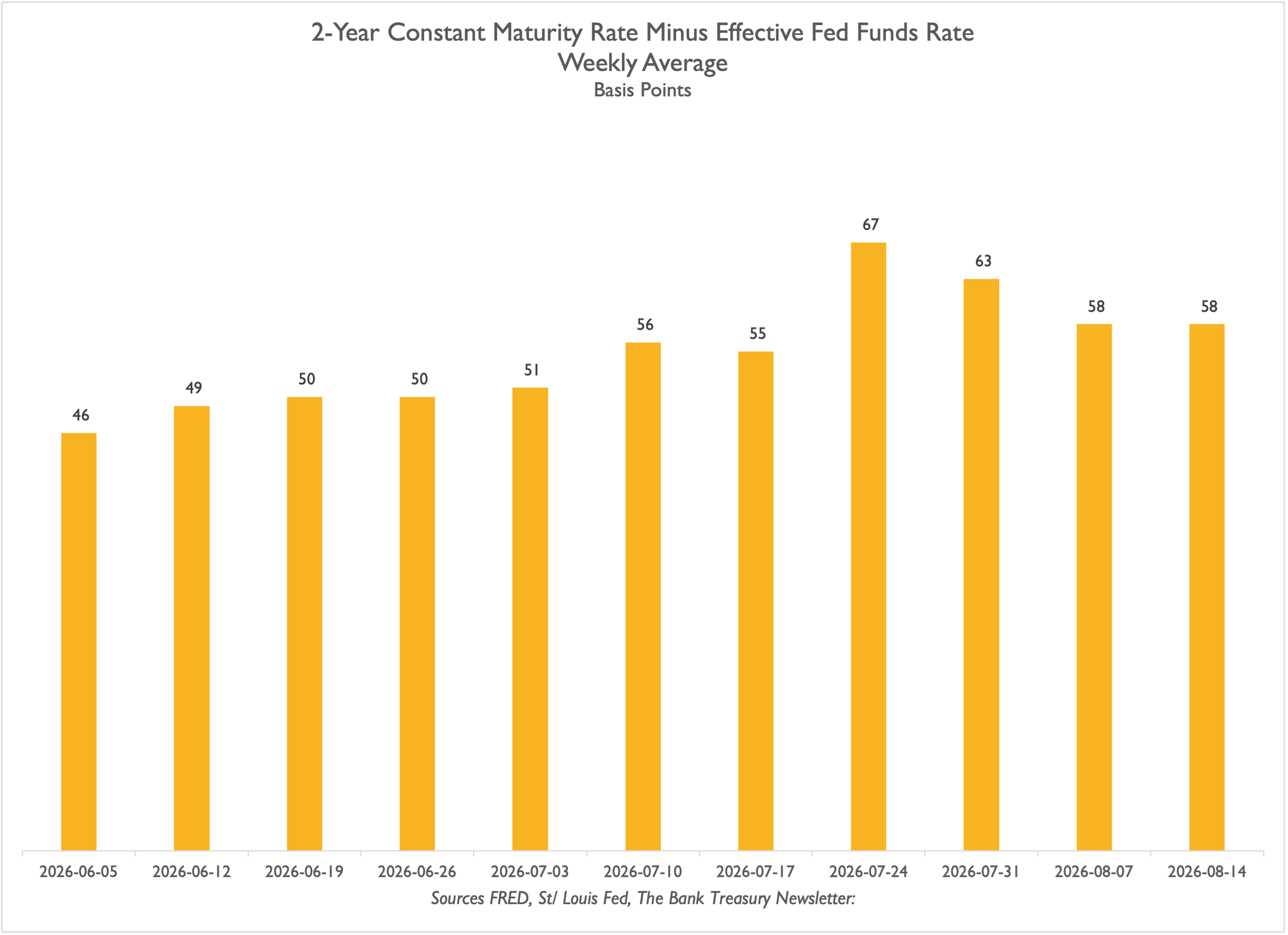
Bond Market Fades A Rate Hike This Year
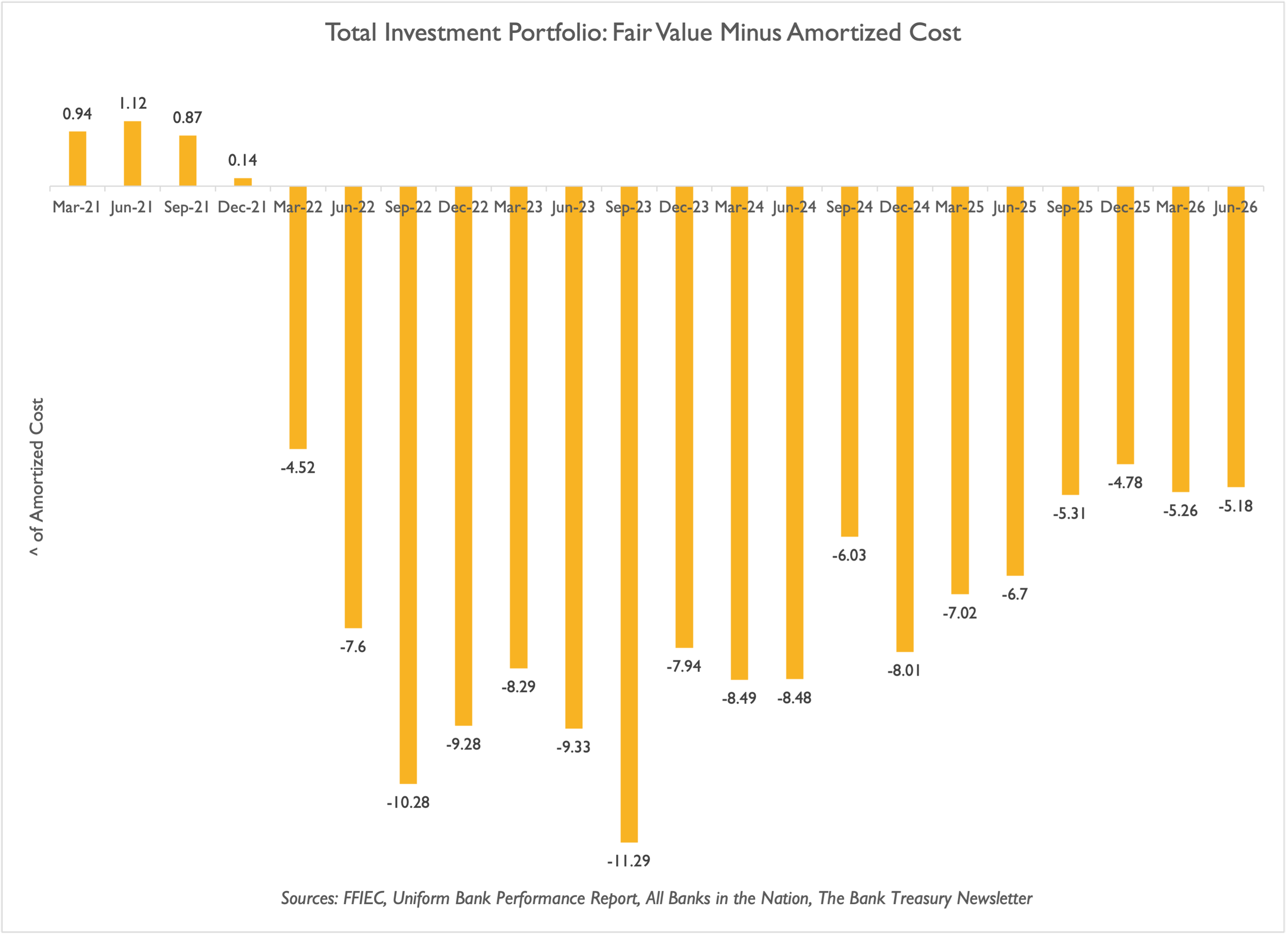
Bank Bond Portfolios Remain Underwater
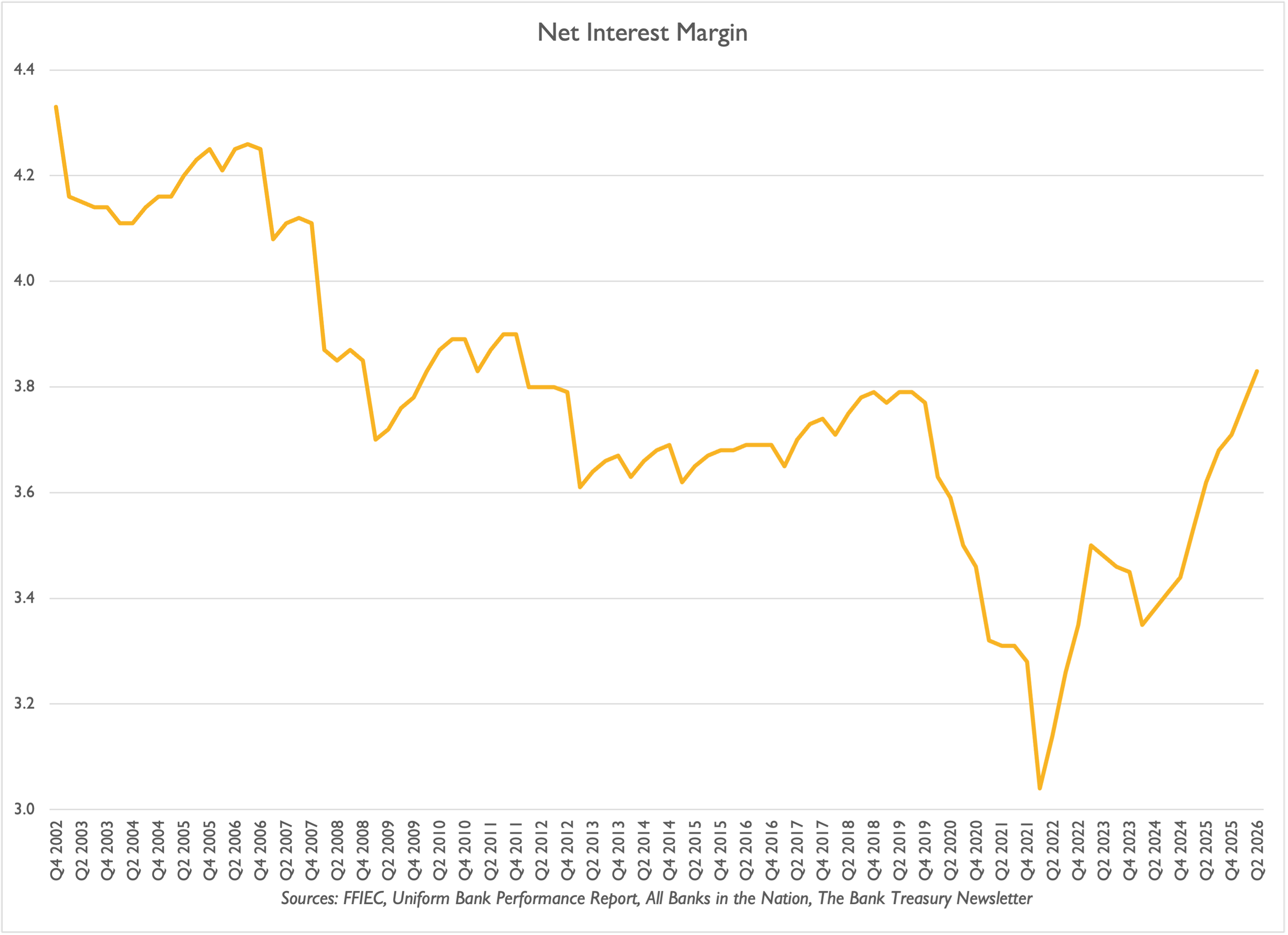
Net Interest Margins Continue Higher
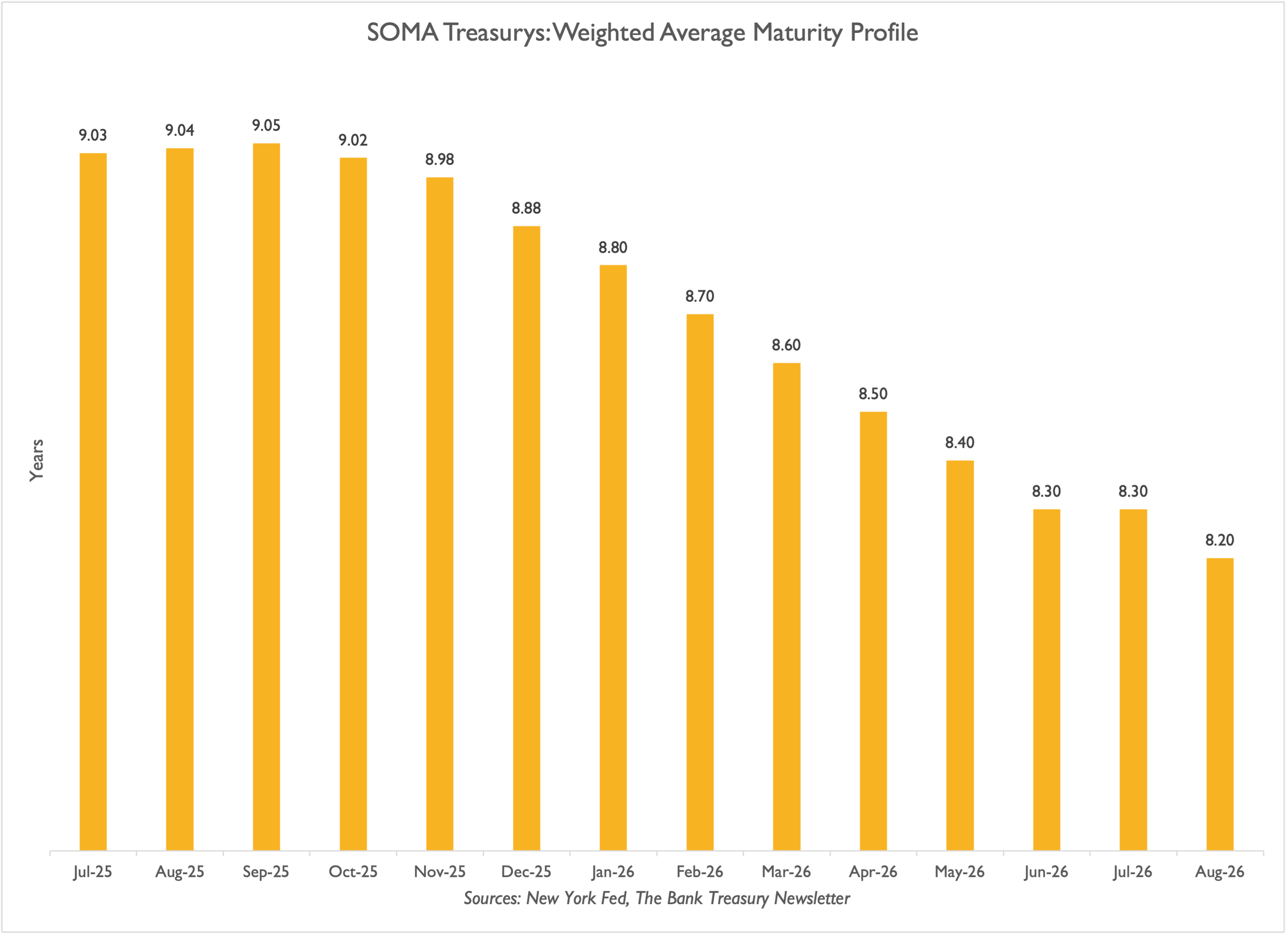
RMPs Shortened SOMA’s Maturity Profile
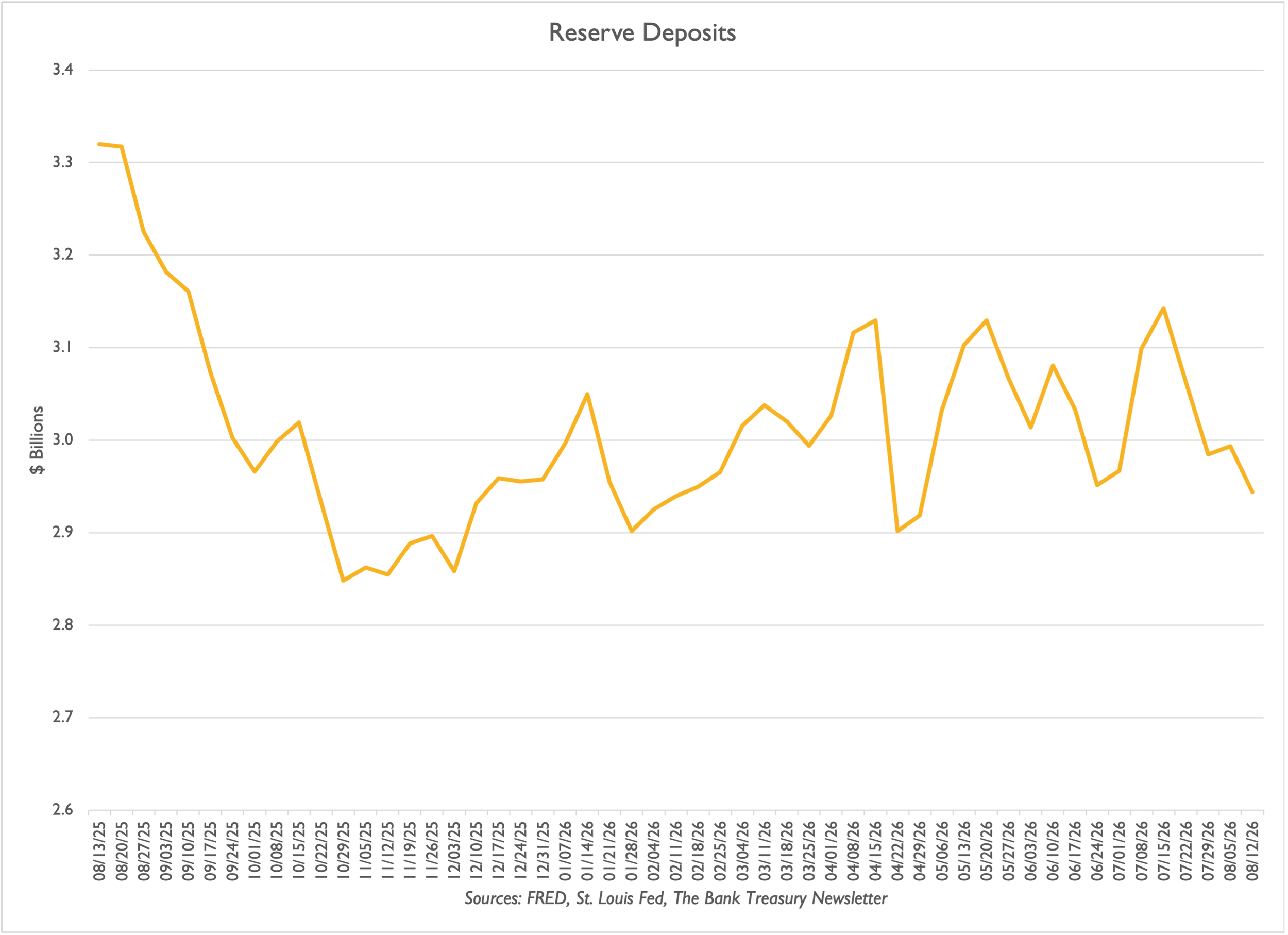
RMPs Helped Stabilize Reserve Deposits This Year
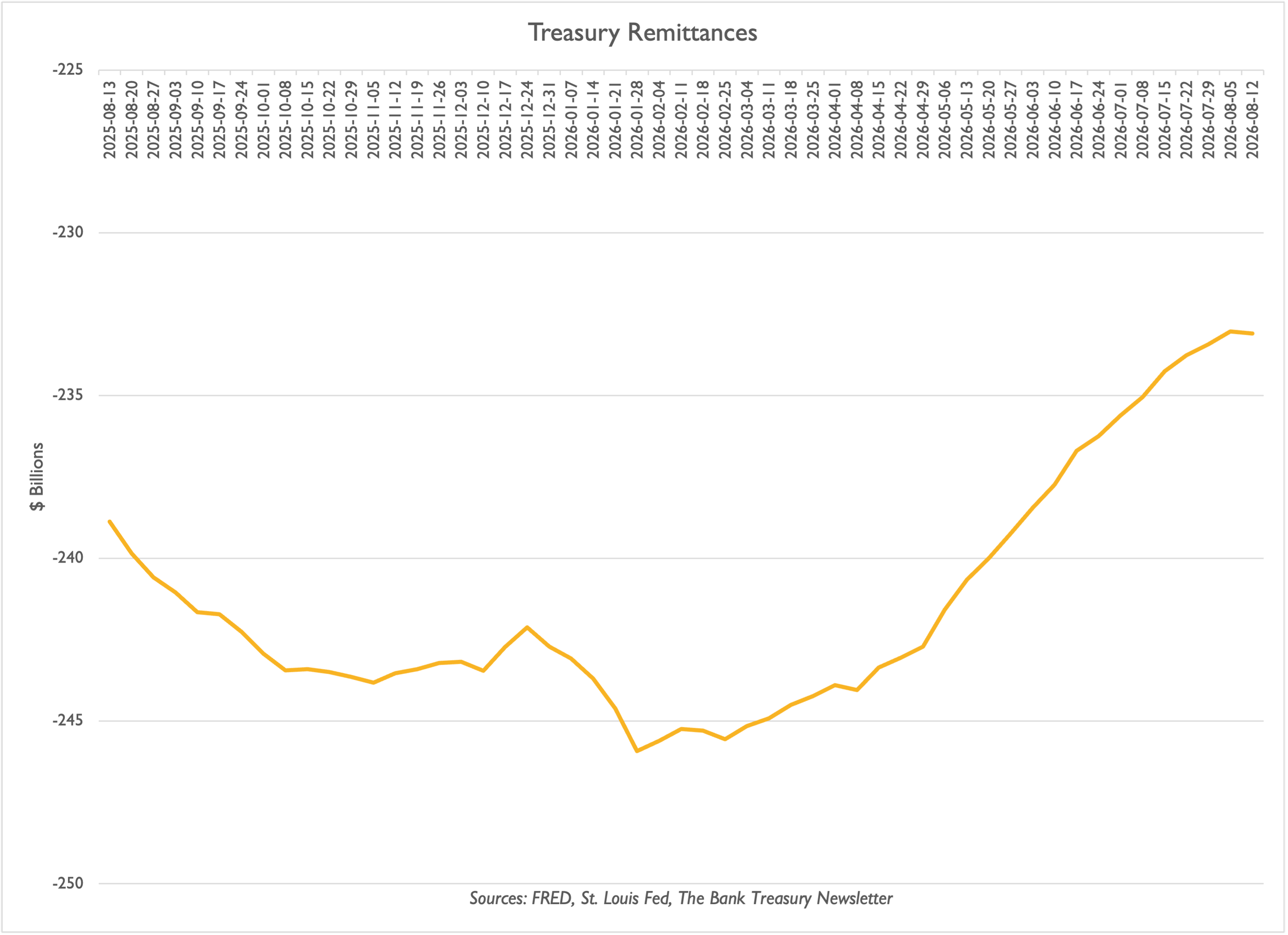
Shrinking Negative Treasury Remittances Add Downward Pressure To Reserve Deposits
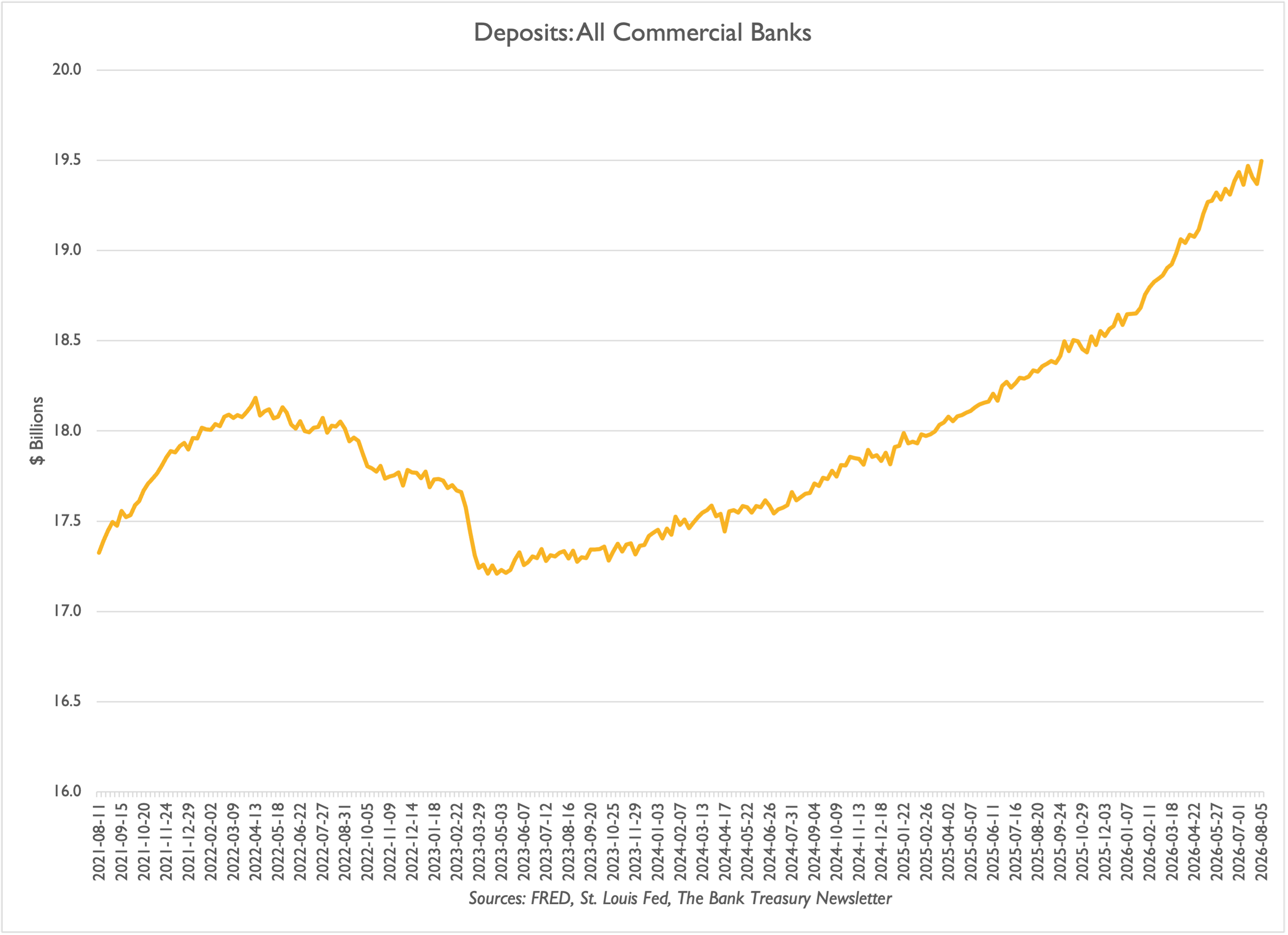
Federal Deficits Fueled Deposit Expansion
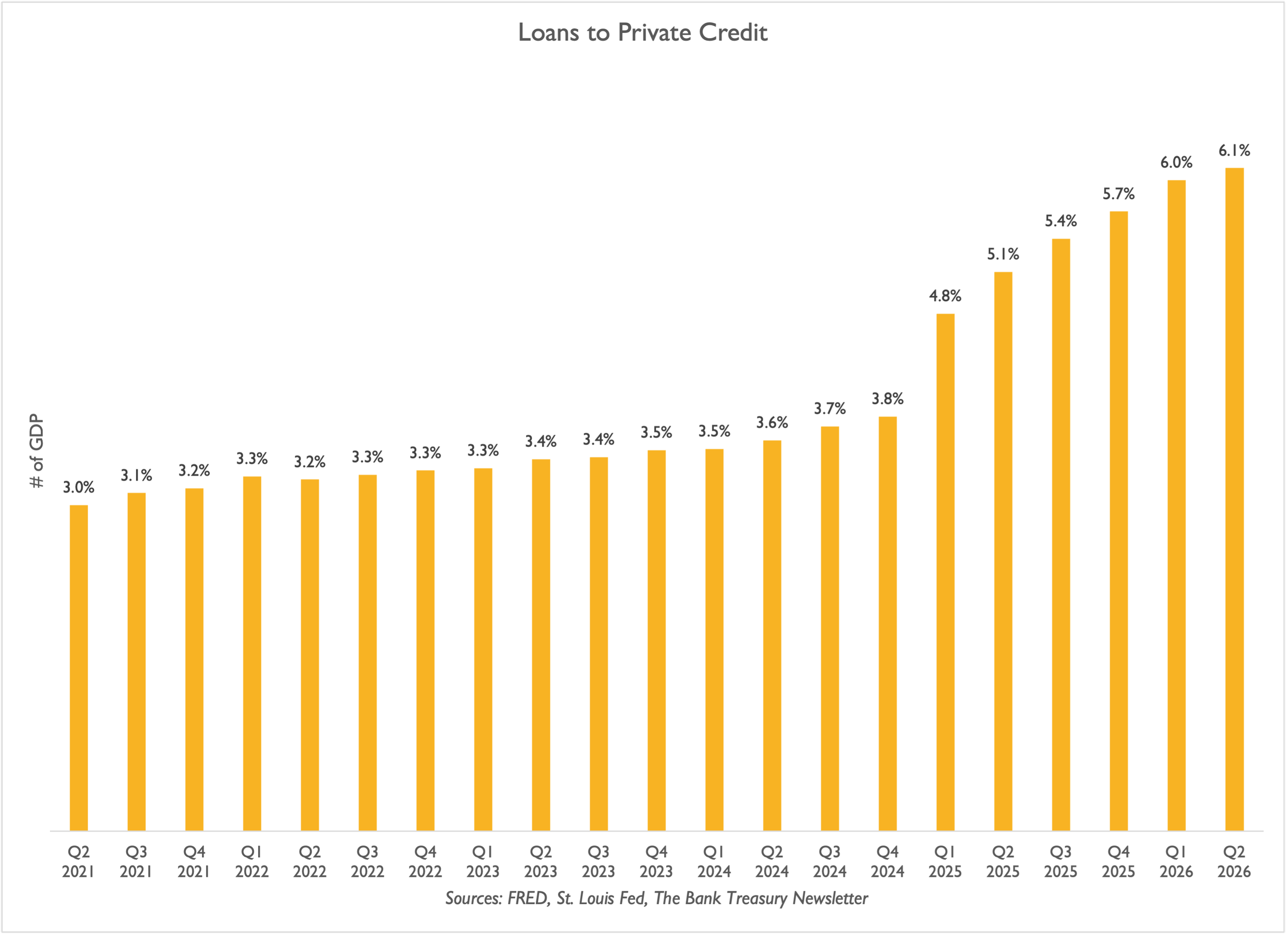
Deposit Dollars Funded Loans To Private Credit
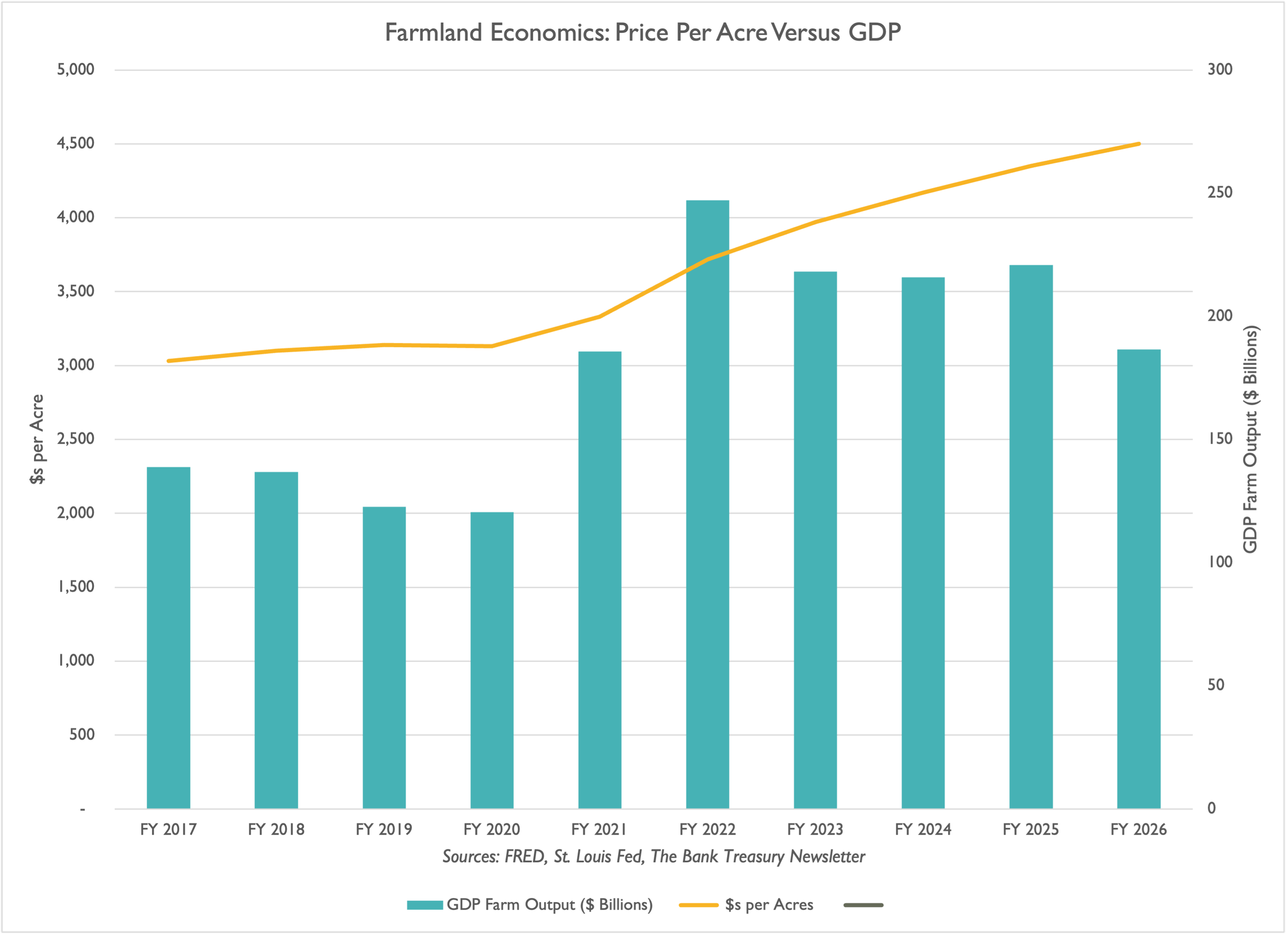
Private Credit Helped Fuel Farmland Inflation
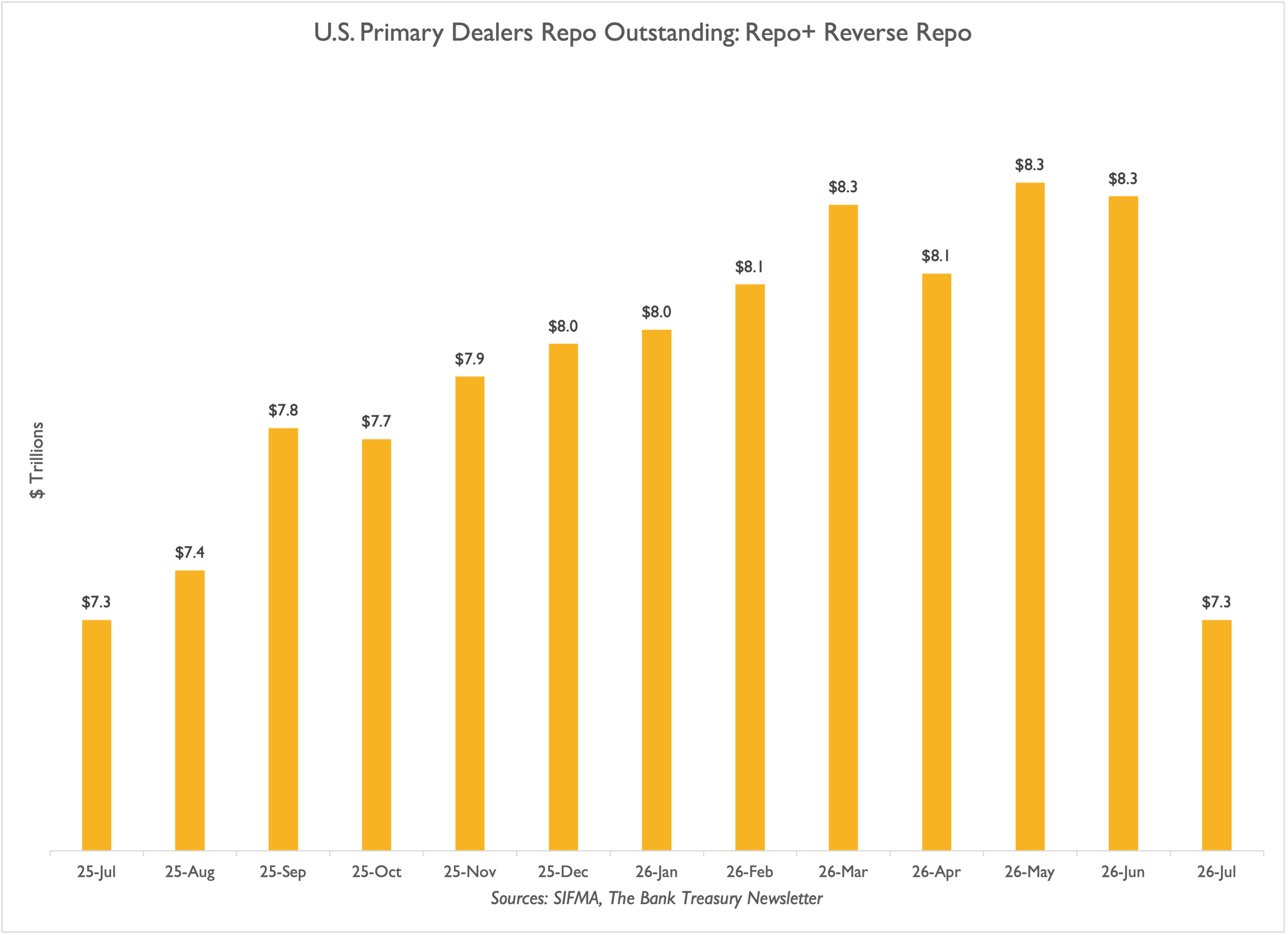
Primary Dealer Repo Activity Drops Amid Hedge Funds' Risk Pullback