

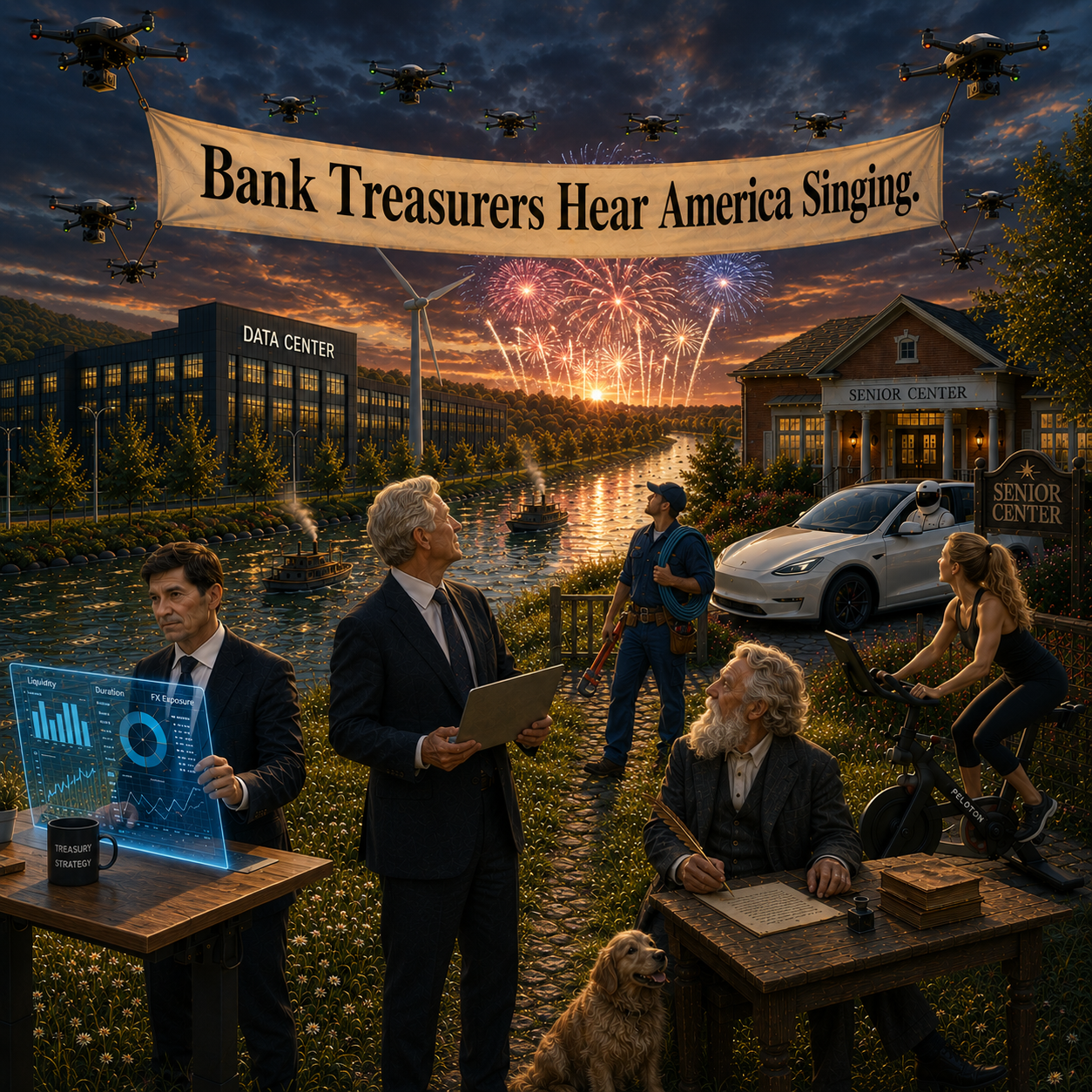
BANK TREASURERS HEAR AMERICA SINGING
The U.S. banking industry not only reported solid Q2 2026 earnings, with strong asset quality and better-than-expected loan growth across consumer and commercial borrowers, but it also told bank analysts to expect the good times to continue. Despite widespread fears that another credit cycle is just around the corner and concerns that the tech boom could turn into a bust, they do not see evidence supporting a negative narrative at this time. Thanks to artificial intelligence (AI) investments, bank executives see their institutions in the early stages of an investment super-cycle, and seasoned bankers said that conditions are close to as good as they can get. Moreover, they insisted that the business they are seeing goes beyond data centers, extending to the broader economy, and both large and small banks across the country reported solid performance.
They also contend that, contrary to the belief that AI will eliminate jobs and harm the economy, it is enhancing their workforce’s productivity. Recent research by the Dallas Fed shows that “high AI use in the U.S. is leading to high productivity growth in sectors such as finance, professional and technical services, and information.” These AI-driven sectors are the main contributors to the 40% of U.S. productivity gains since early 2024, while other parts of the economy are experiencing slower growth. The U.S. AI surge is also leaving European economies behind. The Fed’s latest Monetary Policy Report confirms this trend and notes that financial stability remains resilient. Interestingly, Dallas Fed researchers also found that the current oil supply shock from the Strait of Hormuz closure during the Iran conflict is less severe than the 1973 Arab-Israel war's shock, and its impact on GDP has been minimal so far, thanks to the U.S. becoming a net oil exporter.
Nationally, the Fed’s H.8 data show that commercial and industrial loans grew 12% year over year in Q2 2026, up from 9% in Q1 2026 and four times the rate in Q2 2025. While bank executives described the deposit market as competitive, deposits grew 8% in Q2 2026, up from 6% in Q1 2026 and 4% in Q2 2025. Thus, domestically chartered commercial banks reported $12.5 trillion in loans and $17.8 trillion in deposits at the end of Q2 2026.
A broad push by bank supervisory agencies to ease bank regulations and give institutions a freer hand to manage risk contributed to bank management’s optimism and encouraged them to pursue mergers and acquisitions (M&A). In the last month, the Federal Deposit Insurance Corporation (FDIC) raised the thresholds defining a large bank from $10 billion to $30 billion, cut the insurance assessment rate for small banks (below $30 billion) by 2 basis points, and for large and complex banks by 1 basis point. Recent changes by the Financial Accounting Standards Board (FASB) to Generally Accepted Accounting Principles (GAAP) covering Current Expected Credit Loss (CECL) will also help spur more M&A by eliminating the effective double-counting of losses expected in acquired assets. FASB also tweaked GAAP on hedge accounting to reduce barriers that bank treasurers complained were hindering interest rate risk management.
Congress also helped improve the operational environment for bank treasurers by allowing banks with under $10 billion in assets to exclude custodial deposits from brokered deposits definitions and expanding the brokered deposit exclusion for reciprocal deposits. The potential impact of Title IX of the new 21st Century Road to Housing Act on the brokered deposit market remains uncertain. In Q1 2026, brokered deposit volumes slightly declined, while FHLB advances increased. This rise in advances may be partly due to the new FHLB policy of not publicly posting advance rates, which previously enabled deposit brokers to surpass the rates with brokered CDs for their bank treasury clients.
Congress passed the “Guiding and Establishing National Innovation for U.S. Stablecoins” Act, a.k.a. the GENIUS Act, a year ago, establishing laws governing stablecoins. Kevin Warsh told Congress on July 15th that the Fed was racing to meet the deadline to finalize regulations under the law, but the deadline passed on July 18th with none of the Federal regulators (the FDIC, Fed, OCC, and the NCUA) having anything to show for their efforts beyond published notices of proposed rulemakings. Stablecoins could one day become an economical way to make a cross-border payment, but much of the infrastructure to support that application remains unbuilt. It seems as if announcing task forces is the new way to get things done, and so the U.S. Treasury announced this month that it was setting up one with the United Kingdom’s Treasury to study ways to facilitate the development of digital assets. Last month, the Clearing House announced an initiative to create the infrastructure to support connectivity between blockchain and traditional fiat-based payment rails, including FedWire.
But as things stand today, bank treasurers do not generally consider stablecoins a serious payment method, even as they remain wary of their potential to disintermediate bank deposits if they take off as a scalable payment method. Instead of stablecoins, the industry continues to adopt cashless payments, instant payments, and tokenization to make the payment system more efficient and less vulnerable to disruption. Chairman Warsh is intent on finding ways to shrink the Fed’s balance sheet, which it has kept steady at $6.7 trillion. The road to a smaller balance sheet runs through the payment system, which depends on $3 trillion in reserve deposits to process a growing volume of payment flows.
For example, FedWire, which handles securities trading flows and other large payments, reported $300 trillion settled last quarter, while FedNow, the Fed’s new instant payment service launched in July 2023, reported $275 billion settled. Both payment systems rely on reserve deposits. The Fed is seeking ways to boost efficiency, aiming to reduce demand for reserves, and is also considering liquidity regulations to lessen demand. Nonetheless, as instant payments gain popularity, reserve demand is expected to increase. Additionally, to reduce the balance sheet, Chairman Warsh will need to consider the repo market and the influence of money market funds, especially as the Fed reduces its balance sheet while the supply of Treasury Bills increases.

The Bank Treasury Newsletter

Dear Bank Treasury Subscribers,
Happy semi-quincentennial, America! What’s that? Oh, don’t worry. You don’t look a day over 249. Here’s to the next 250 years. And hey, after that, you’ve got only another 500 years to beat the Roman Empire.
Just thinking ahead, but well done, and thank you for everything. Seriously, thank you. Thank you for the great economy, the largest in the world. Yes, maybe it slows a bit next year, but ignoring the COVID recession, the U.S. economy has grown consistently without a recession since the Great Recession. That is amazing.
And keep in mind, this was no mean feat. In just the past decade, we went through a pandemic, two rate-hiking cycles, political turmoil, tariffs, and two major, still-ongoing geopolitical conflicts. You know what that is called? Resilience.
Resilience! That is the watchword of the day. It’s the word Chairman Warsh used this month during his Congressional testimony. It also appeared in the Fed’s monetary policy report this month on financial stability. Fed officials use the word all the time these days. Even central bankers in other countries talk about it. Senior executives who went before the analyst community this month to answer questions about their bank’s Q2 2026 earnings results used it repeatedly. Despite all the hand-wringing by economists who have been predicting trouble every year since COVID, the economy defied them again.
Our bank treasury subscribers already know this, but this newsletter will say it again anyway. Our U.S. economy was so strong from March 2022 through July 2024, when the Fed raised the Fed funds rate by 525 basis points (a sledgehammer-type rate shock), that it still added 6 million new jobs to payrolls. How is that?
Okay, yeah, participation is down, but that has more to do with the demographics of an aging population than with weakening unemployment. Oh, and stop all that talk about how, under Volcker, it was even worse. Going from 0 to 525 basis points in 16 months is, by all measures, far more shocking than, say, taking the funds rate from 10%, where it had ranged before Volcker took over in October 1979, and pushing it to 20% a year later.
Can’t you just hear America singing? How does that Walt Whitman poem go that he wrote on the eve of the Civil War?
“I hear America singing, the varied carols I hear,
Those of mechanics, each one singing his as it should be blithe and strong,
The carpenter singing his as he measures his plank or beam,
The mason singing his as he makes ready for work, or leaves off work,”
Given what was brewing in the country back then, he might have been a little tone-deaf, or just wearing rose-tinted glasses. Maybe the singing that bank treasurers think they hear is just the hum from those infernal data centers. The only real singing from data centers right now is coming from politicians on both sides of the aisle trying to stop them.
But don’t knock them. They create jobs. Maybe coders being replaced by AI are no longer singing, but construction workers, plumbers, and electricians sure are, all the way to the bank to deposit their paychecks. Also, the computer guy. Oh, and do you know which college graduates are also singing these days, thanks to AI needing their expertise in rational thought to prevent hallucinations? According to a New York Fed survey, the answer is philosophy majors.

Bank treasurers are certainly hearing their margins and pre-tax, pre-provision net revenues singing, and those data centers are part of the reason. Wall Street loves them. Investments in data centers have quadrupled since 2021. So much business to go around with those things. Too much, maybe. You have to buy steel and computers; there is construction. And the water, whoo hoo, the water conservation business is big bucks! Like, in the trillions of dollars. And they may use a lot of electricity, and push up prices, which hurts consumers, but it is not like electricity spending is not part of the GDP.You know what we are in? We are in a super-cycle! As a global bank’s CFO told analysts during his bank’s earnings call this month,
“We are in the middle of an AI cap-x super cycle, where there are demands on financing into every single financing instrument in every region of the world and across every single industry.”
His chairman and CEO added,
“All the indicators we have are that we are in the relative early innings of a very, very significant…AI build-out cycle.”
These times are as close to paradise as it gets, added another global bank’s chairman and CEO.
“I think it’s getting close to as good as it gets.”
As good as it gets! Pinch me! Deposit and loan growth have never been better. Thanks to data centers, commercial and industrial (C&I) lending is thriving. We have not seen such high loan growth rates since the economy climbed out of COVID. In Q2 2026, C&I loans increased by 14% compared to the previous year, marking the fastest growth since Q3 2022. The upward trend continues strongly. There's so much business happening that there is too much business. As a global investment bank executive mentioned,
“There is far more demand across client segments than we're willing to engage when we balance our objectives to serve our clients, drive market share, but also be balanced, diversified, and focused on risk management. So we're at a moment in time when the demand for financing is outstripping what we think is appropriate for us.”

And all of this is occurring within this country, as noted by a senior executive from a global bank.
“The U.S. is unique, and thanks to American entrepreneurs and innovation, the breadth and depth of the funding markets here and the investor base, as well as how much American companies are on the front foot in AI and transformation, all that is driving the boldness we see. It's a good environment.”
God bless America! And we are just at the beginning; there is so much promise, and as the chairman and CEO of a regional bank based in the Southeast said,
“I think anybody that says we're not in the first inning or even just at bat doesn't realize how much this is going to change the world…doesn't realize what the power of this technology…is going to do…I think we're all in the beginning phases. And I think you're going to see costs coming out of all organizations…It allows us to continue to leverage their abilities…it probably means we don't need to add as many people as we continue to grow as an organization, and our efficiency ratio continues to get better and better.”
It is not just an AI story. Business is booming across many industries. For an economy with an aging population and slower growth, we are not doing so badly. A shrinking workforce isn’t ideal for expansion, but it can lead to lower unemployment. Banks are expanding their assets and gaining market share, as the chair and CEO of a major domestic bank explained, describing what a robust economy looks like.
“For the first time, I'm sure this isn't true, but for the first time I can remember, we had strong growth across kind of every category inside of the C&I franchise and with utilization increases. So yeah, it's broad-based…all on the back of what feels like a pretty strong economy.”
This country is firing on all cylinders. And what bank balance sheets cannot accommodate is where the capital markets come in. As another global bank’s CEO described,
“Look, the level of activity is very strong. The pipeline is very healthy…AI is dominating many of the conversations. So tech, data center, energy, and defense Cap-X are accelerating. Companies are accessing public equity and bond markets alongside bank debt on a large scale.”
These deals are complex, reflecting how the banking industry has adapted to its customers' needs. As the president, CEO, and chairman of a global bank detailed,
“I think when you look at the exposures being created to help finance the build-out, you're absolutely right. There are different types of things being financed, right? There are core and shell, power, chips, and a whole series of things that go into the data center. And we underwrite those different pieces of those financings very differently because we rely on different types of credit support for those to be paid off. And it's very, very different lending to a chip maker that has 80% margins, where we get paid back in 1.5 years, versus lending to someone else in the supply chain, where it's going to take 15 years to get paid back, or 10 years, and hoping that the LLM provider who's renting that space is going to be there.”
And by the way, good times are not just for large global and large domestic banks. Even smaller regional banks right in the middle of the country are singing, as the chairman and CEO of a regional bank based in the Midwest told analysts,
“Yeah, we're seeing good -- we're honestly seeing really good originations out of everywhere, places we haven't gotten it before.”
It is good times everywhere and for everyone, as a large domestic bank’s CFO said.
“It's in all areas. It's in food and beverage. It's in media and technology. It's in power…People are feeling very optimistic. They want to grow their business, and we're here to support them.”


Growth may have started in AI, but it has broadened, as the head of commercial banking at a large regional bank on the East Coast said,
“We are starting to see it start to widen out. AI…and the businesses that surround AI, like digital infrastructure and the stuff that goes into digital infrastructure, has been a big piece of it in the first and second quarter. But as we look at our pipeline, it's not just digital infrastructure; we're seeing a lot of activity in the industrial sector -- industrial subsectors are starting to pick up with things that don't necessarily fall under digital infrastructure, which is great. We're seeing…healthcare. We've seen a pickup in biotech…In the first and second quarter…a lot of the deals were very large transactions. Now, we're getting much more granular in the middle market.”
Nor is business growing at the expense of standards, because the banking industry’s asset quality is as good as it gets, or darn near, as the CFO at a large domestic bank on the East Coast pointed out,
“The nonaccrual number went down…probably bumping along the bottom. It's like a two-decade low.”
And why is everything so great? Because the corporate clients are resilient, as the chair and CEO of a global bank said.
“The global corporate client base we serve has been a source of resilience and growth.
The consumer is also doing great, added the CFO at the same global bank.
“The U.S. consumer is…, and I know I sound like a broken record, but the U.S. consumer has been resilient…you can see that the spend…is very healthy and…on the higher end versus the last few quarters…Across the portfolios…both delinquency and credit losses are down.”
Consumers and commercial businesses are doing well, at least those banking with the U.S. banking industry, as the CFO from another global bank said,
“On the consumer side, it really is good. The delinquency trends are better than we modeled…And that's supported by the strong employment picture we see more broadly, and we've seen good wage growth to counteract some of the inflationary pressures we've had. On the commercial side, same. Really, there are no systemic issues that we're seeing come through the portfolio.”
Do not take the CEO’s or the CFO’s word for it. Listen to what the chief credit officer at a large regional bank in the Southeast told analysts, because all the sectors you would expect to show signs of problems by now are fine.
“The sectors we continue to watch closely. I will say they have proven to be very resilient so far. We need to continue to monitor them because I do believe there is increasing pressure, especially on lower-end consumers and their spending power. But all of that said…retail restaurants, things that are closest to the end-consumer, have been surprisingly resilient. And so we'll continue to monitor it.”

AI Supercycle Downsides: Higher Inflation, a Less Effective Monetary Policy, and an Inevitable Bust
Now, you could say that dark clouds lurk behind every silver lining. Forget the Iran war and how much it complicates inflation. As Fed researchers discussed in a Fed Note this month, data centers are inflationary. You know why? What goes into those data centers? Computers. In the last few years, thanks to surging demand, computer prices have risen faster than at any time in the past two decades.
And do you know what else demand for computers causes? Growing trade deficits. Because, you know what goes into computers? Computer chips. And do you know where most of those chips come from? Taiwan and Korea. And do you know where the hardware with the chips is assembled? Mexico.
This raises an interesting question: if most computers and chips are produced overseas—driving inflation in countries like Taiwan, Korea, and Mexico where factories and workers are located—then why is the Fed raising the effective Fed funds rate (EFFR) here? While higher rates do impact household spending decisions, their influence is limited because people still need to buy food and gas for their cars to reach the supermarket, regardless of fluctuations in the Fed funds rate, the Secured Overnight Financing Rate, or the Fed’s interest on reserve balances.
You know what you get when a service economy has insatiable demand for AI technology made overseas? How about this? There is growing evidence that monetary policy no longer works as it used to, thanks to AI. We were already observing this trend even before our current A-supercycle began.
Think about it. After the Global Financial Crisis, the Fed cut rates to the zero lower bound, a policy that economists would normally think could wake the proverbial “dead,” and the economy limped along for another decade, while inflation struggled to hold to a 2% target. Then, after COVID, the Fed raised rates high enough and fast enough to kill a proverbial “cow,” but its efforts to tame inflation did not succeed after four years.
Chairman Warsh promised to eliminate inflation this month, but he might need to raise the overnight rate significantly and keep it elevated longer than the market expects, possibly requiring more than a few 25-basis-point hikes over the next year. If you aim to control inflation, you should also consider whether AI is increasing the natural equilibrium rate—R-star, which Fed Governor Barr alluded to earlier this year. Additionally, if the AI supercycle fails and damages the economy, research from the New York Fed indicates we could remain at the zero lower bound for much longer than during 2009-2015 or March 2020-March 2022.

And it makes sense. When a central bank raises rates, businesses are expected to cut back on investment and hire fewer workers. Laid-off workers consume less, gross domestic product slows, and inflation is tamed. But no one here is spending money to build factories or hire workers. We are a service economy. Plus, in an AI world, it is all about software, which does not require a large factory to produce. Thanks to Gen AI and large language models, the computer programming profession is being replaced, and soon you will not even need people to build software. You will just have to press a button. History suggests that busts regularly follow booms because capitalists always overinvest. Look at what happened with the railroads in the 19th century. Remember how the tech boom in the late 1990s ended? Software spending trends (Figure 1) have been rising exponentially this year, and nothing goes up forever. As the chairman and CEO of one of the global banks said, the bust is coming and inevitable.
“The only point we're always trying to make is when there's a credit cycle, and there will be a credit cycle, how will everybody perform -- and I don't think it's going to be like a bell curve of performance. I think there'd be some pretty -- there'll be some outliers out there just like in the financial crisis.”
And the reason is that nothing can go up forever, certainly not at the pace we are seeing, as the chairman and CEO of a global bank reminded analysts.
“Now we all know because we've all been around for a long time that these things don't go in a straight line, and they can ebb and flow.”

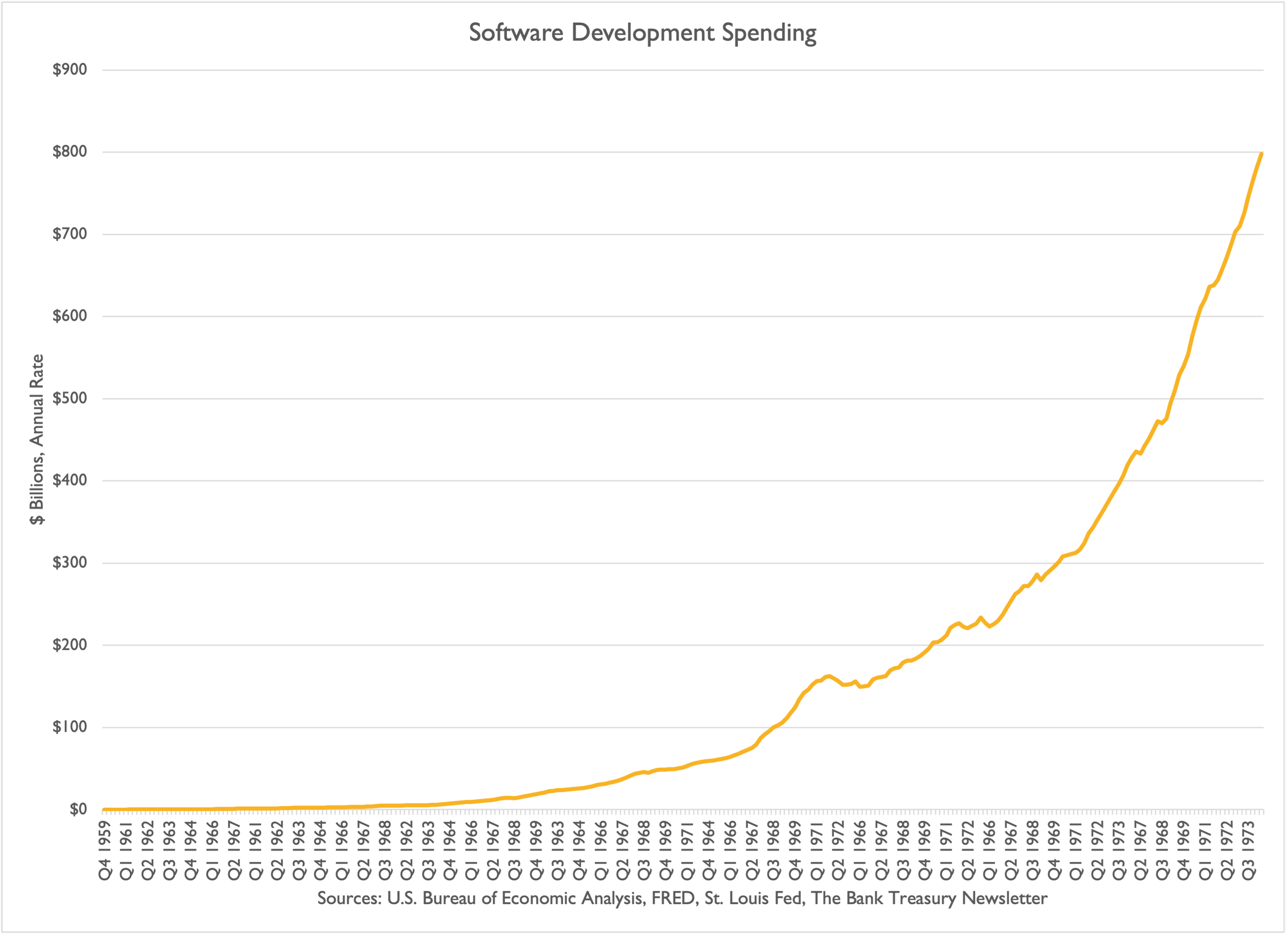
Figure 1: Software Development Spending
America is Singing about Energy Efficiency
But caution aside, optimism abounds on America’s birthday. Who is singing? Shale oil producers are singing. Did you know the oil shock from this war is multiple times that of the Arab oil embargo in the 1970s? Multiples! And do you know what the hit to GDP has been so far? A sixth of the damage caused back then. At its peak this year, the Iran War reduced global oil supply by about 15% from its pre-war level, according to a Dallas Fed study. In 1973, the Arab oil boycott reduced supply by less than half that amount, yet the hit to GDP was twenty times greater (you read that right).
You know why? In 1973, you needed a barrel of oil to produce $1,000 of GDP. Just before COVID, you needed 43% of a barrel. Today, that number is in the low 30s. Economists find that whenever spending on oil surges above 4% of GDP, a recession follows 18 months later. This time, the peak was just 2.6%.
Reinvention is the American Way
This country constantly reinvents itself. We are not anchored in the past; yesterday’s horse-and-buggy driver might be today’s Uber or Lyft driver, or perhaps tomorrow’s private transportation consultant. Who can say? Although AI may lead to some job disruptions, new roles will emerge, as a global bank executive mentioned in a press interview this month.
“There will be job dislocations. The nature of many jobs is going to change.”
Adaptability is a key aspect of resilience, and this is especially true for college grads seeking an entry-level job. Today, entry-level roles at companies investing heavily in AI require recruits not only to master the technology but also to have the capacity to advance to a senior level and lead the team. People skills are critical. Reminiscing about her own career, she continued.
“I remember when I was an analyst – I spent time photocopying microfiche in the library and faxing it to New York – so the jobs will change and there will be new jobs created… the challenge is going to be the puts and takes. I really do see a lot of AI augmenting human beings, but there will be some dislocations as well. I don’t want to give the impression that everything will be perfectly timed. It won’t. But we will tell everyone, please use the tools. Our people are very adaptable.”
You know what is great about you, America? You are constantly reinventing yourself. In Whitman’s day, you had boatmen, deckhands, shoemakers, hatters, woodcutters, and plowboys, as he went on,
“The boatman singing what belongs to him in his boat, the deckhand singing on the steamboat deck,
The shoemaker singing as he sits on his bench, the hatter singing as he stands,
The wood-cutter’s song, the plowboy’s on his way in the morning, or at noon intermission or at sundown,”
Of course, we no longer call people boatmen or plowboys. We call them boatpeople and plowpeople, or maybe replace "boy" with "inexperienced.” One thing is for sure. They earn far more than their forebears did in 1860. According to the U.S. Census, the average worker in 1860 earned $297 per year, working six days a week. Today, some physician assistants earn more than surgeons.
Most of the occupations listed in the 1860 census no longer exist. For example, we no longer have people who deliver milk to your doorstep, aside from reports of the profession’s resurgence and a local sports team’s name. Fewer people are employed in shoemaking. Back then, precisely 165,086 people worked as shoemakers. Today that number is 9,512. The day when making shoes was anything to sing about is long gone, even if the ones who are left believe they are making a difference. When Walt Whitman said he heard shoemakers singing, he might have mistaken the chants of 3,000 striking shoemakers in Massachusetts, protesting the machines that were replacing them.
How times have changed, though. Where are the coders protesting AI replacing them? Then again, for all the talk about lost manufacturing jobs, the Census reports that 12.6 million people were employed in the U.S. making things in 2026, compared with 1.3 million in 1860, although down some since Liberation Day last year. As for deckhands, there are 10,000 people in that profession today who will bait hooks when you go on a day-trip fishing boat with friends. That is still a fraction of the 140,000 brave souls who tried to make a living from the sea in 1860, and sometimes paid with their lives when they succumbed to disease or drowned in shipwrecks. But what price progress?

That’s right! Thank you, shale oil producers. Thanks for your vision twenty years ago to develop shale oil fields in the West, despite all the opposition from environmentally minded local residents. That decision has made this country what it is today, a net oil exporter (well, sort of, ignoring the different types of oil). Energy makes the world go round, but not here. Europe is down, yet despite all the green talk those countries make and the complaints about U.S. energy consumption, it is our country that has reduced its dependence on oil from 27% of the world's oil supply to 20%.
And how about a big shout-out to our industrial companies on America’s birthday. Thank you, guys, who still make things in this country and have not moved their jobs overseas. Thanks for investing in energy efficiency, which is paying off, even if households consume more petroleum to power their air conditioners this summer and we now consume more oil than we did even 50 years ago, when we were less energy efficient. And by the way, on that note, we Americans should be proud that we use air conditioners. More Europeans die each year from summer heat than Americans die from gun violence. That is a fact. Over 1,000 recently in France; 1,500 deaths in Western Europe are being attributed to the climate.
AI is not about replacing entry-level jobs. It is about making entry-level workers more productive, as a global bank CEO explained.
“AI technology is letting our people do more and be more productive, and that's the way we're thinking about investing. We want our world-class people to be more productive and do more for clients. As they become more productive, they may feel less need to replace people that, in the ordinary course, flow through the system. But right now, it's not a moment for a structural rework of our human capital footprint. It's a moment to invest and utilize this new technology and learn how to deploy it in the best possible way for our people and our clients.”
There is the spirit! No wonder surveys suggest that the Gen-Z generation, whose wages go to pay Social Security to support the boomers, a generation of adapters if ever there was one, is just as optimistic as every other demographic on America’s birthday, looking to the future.
Working in the maritime support trade is physically demanding. You need to learn the ropes in the dock business, and you need the strength to throw them around a lot. So, the good news in today’s amazing economy is that today’s laid-off dockworker is tomorrow’s gym trainer. And gyms are the new “it” investment for venture capitalists in 2026 because they are where those “inexperienced” workers and would-be plowpeople go after work to network, if not to sing, and to feel connected.
“The delicious singing of the mother, or of the young wife at work, or of the girl sewing or washing,
Each singing what belongs to him or her and to none else,”
In Walt Whitman’s day, women did much of the menial work, as sewing machines were just coming to market and washing machines were still a few decades away from mass production. The official 1860 census pegs women at 16% of the total workforce, but when you take into account all the uncompensated work they did on family farms and in businesses, they accounted for close to 57% of the total workforce. Their productivity has not changed much.
Today, slightly fewer women are singing than before COVID, down from a record 58% last year to 56% last month. And there is a good reason women make up a larger share of the labor force than men these days, especially in the care industry. As researchers at the San Fran Fed noted, an aging population and education explain much of the composition of today’s workforce.
Bank treasurers can hear the Baby Boomer generation singing. If the masons, carpenters, plumbers, electricians, and contractors ever slow down the construction of data centers, there is plenty of demand for them to build more senior centers. Senior centers are big business that will continue to grow. A lot of money will go into fields involved in their care. And for good reason. We are an aging population.
And the elder business is all about caregiving, because the older you get, the more likely you are to need help with daily routines, either informally from family or through professional care. According to a study the Chicago Fed published this month, professional caregiving is one of the fastest-growing fields in the labor market. Let’s not forget the tech industry, because one day the aide who helps you down the stairs, lifts you, feeds you, and maybe even tucks you into bed might be a care robot. The technology still has a long way to go before it can truly replace a human, and thus, bank treasurers have all the more reason to sing about the money needed to meet that goal.
Here is to the American Way and Capitalism
Capitalism is as American as apple pie, and you cannot mention capitalism without mentioning the stock market. Talk about up, up, and away, unless, of course, you bought SpaceX at its high last month. But the surging market prices reflected in leading equity indices do not signal irrational exuberance, a phrase the late Alan Greenspan coined. They reflect solid fundamentals, from corporate America to the banks that do business with it. It is indeed morning in America.
Capitalism thrives when government steps aside, competition drives innovation, and big dreams are encouraged. These three elements create a fertile ground for profitable opportunities. Currently, the investment banking sector embodies this ideal mix. A global bank's Chairman and CEO elaborated to analysts on why their pipeline was congested.
“I think the most important thing that's driving the backlog activity is strategic M&A. And…if you're running a big business, you must be focused strategically on scale advantage. And that means you must be open to considering how you can enhance your competitive position. And we're now also in a regulatory environment where the question is, “Can I?” The answer is maybe…where the answer would have been absolutely no way, whatever the question was…CEOs are dreaming more of large-scale opportunity because I think that they've got a multiyear window here where they can potentially execute on it.”
Behind every financial statement is an accountant, and no celebration of American capitalism would be complete without acknowledging their contribution to the American way. Because stock prices ultimately come back to earth, or, more specifically, to the financial data that support their narrative of an even brighter tomorrow. And the numbers will not “foot”; they will not be reliable, meaningful, or useful to decision-makers unless people make sure standards are followed and devise good standards.
Let's applaud the auditors and recognize the efforts of the Financial Accounting Standards Board (FASB) in Norwalk, Connecticut. Recently, FASB has been refining standards to support business and capitalism without unnecessary hurdles. Behind every auditor is a solid accounting standard, so three cheers for FASB. For instance, last year, FASB revised its Current Expected Credit Loss (CECL) standard, which will take effect in 2027, to simplify bank mergers and acquisitions.
Previously, under GAAP, a bank acquiring another bank’s performing loans was required to set aside a reserve for expected credit losses from current earnings at the time of acquisition, even though purchase price adjustments already reflected these losses. The new regulation eliminates this requirement by allowing the establishment of a reserve and adjusting the purchase price accordingly. Banks may adopt this standard early, providing even more incentive for acquirers to buy.
The folks at FASB are also out with a proposal to make hedge accounting easier, so bank treasurers do not find themselves prevented from sound risk-management decisions because “stupid,” complicated, and burdensome accounting rules get in the way. They all remember when hedge accounting became a nightmare. It was 28 years ago last month. In June 1998, FASB published Statement of Financial Accounting Standard (SFAS) 133, “Accounting for Derivative Instruments and Hedging Activities.”
SFAS 133 required bank treasurers to report all derivative instruments at fair value, with changes in their value recognized directly in earnings unless the derivatives were used as hedges. Even then, SFAS 133 posed many hurdles to qualifying a financial instrument as hedged. Seasoned bank treasurers fondly remember the challenges of fair value and cash flow hedging, recall the nuances of the shortcut and long-haul methods, and still have nightmares about proving hedge effectiveness and explaining the principles of “clear and closely related” and the steps behind the “double-double test.” The FASB did not want to see much hedging then, and it is not exactly opening the floodgates to them now, either. So, if a bank treasurer wanted to buy a fixed-rate bond, especially a mortgage-backed security (MBS), without dealing with fair value accounting, the best choice was to classify it as held-to-maturity (HTM).
That attitude began to shift in 2017, when the FASB made its first attempt to ease its hedge accounting rules and issued “Accounting Standards Update (ASU) 2017-12, Derivatives and Hedging,” also known as Topic 815. Topic 815 introduced the concept of “last-of-layer” accounting, allowing a bank treasurer to designate a derivative instrument as a hedge for a specific slice of the portfolio. In late 2022, the FASB relaxed the rules even further, allowing bank treasurers to hedge multiple slices of the portfolio. As most bank treasurers would say, meeting the FASB’s hedge accounting standards is still difficult, but it is easier than before.
Now, the FASB wants to go even further. In the spirit of removing accounting rules that impede sound interest rate risk management, the FASB wants to allow bank treasurers to hedge securities in the HTM book, where assets are carried at book value. Since bank treasurers can already hedge their loans carried at cost, allowing them to hedge HTM bonds is only fair and, as FASB admits, aligns with how bank treasurers manage interest rate risk. In addition, the FASB is prepared to expand the benchmark Secured Overnight Financing Rate (SOFR) and liberalize hedge accounting for cross-currency swaps, allowing securities with different tenors to qualify.
In the same spirit as the FASB, bank regulators want to get out of the way of the banks they supervise. Let’s start with a piece of legislation, the “21st Century ROAD to Housing Act,” that Congress passed this month without the President’s signature. Section 901 directs the FDIC to exclude custodial deposits from its definition of brokered deposits if they are less than 20% of an institution’s total liabilities. That is a big win for community banks, provided their assets are under $10 billion.
Title IX, Section 902 raised the size thresholds, narrowing the definition of brokered deposits so reciprocal deposits would not fall within it. It also directed the FDIC to prepare a report on how the banking industry has used reciprocal deposits for funding since 2018, following Congress’s passage of the Crapo Act, also known as the “Economic Growth, Regulatory Relief, and Consumer Protection Act,” which opened the door to their use.
Meanwhile, with the FDIC’s DIF at 1.43% of insured deposits as of Q1 2026—well above its statutory 1.25% under Dodd-Frank and up from 1.11% recorded right after the failures of Silicon Valley, Signature Bank, and First Republic in 2023—the FDIC board voted to reduce initial assessment fees by 2 basis points for small banks and by 1 basis point for large and complex banks. It also raised the $10 billion asset threshold defining a large bank to $30 billion. Last month, it voted to increase the threshold for resolution planning submissions—the living wills—from $50 billion to $100 billion.
While the FDIC was busy making FDIC insurance assessments, living wills, reciprocal deposits, and custodial deposits great again this month, the new Fed chairman has been working on plans to make the Fed great again, starting with ways to reduce its balance sheet. The Fed’s System Open Market Account (SOMA) portfolio of Treasurys and Agency MBS, at $6.4 trillion, is the largest concentration of financial assets controlled by a single manager in the world. As bank treasurers know, the banking industry holds $3 trillion in deposits at the Fed, the Fed’s single largest liability. If Kevin Warsh wants to reduce the SOMA portfolio, he will need to find ways to reduce those deposits.
Our subscribers can appreciate that the average bank treasurer would love nothing more than to find somewhere else to deposit the deposits the bank cannot lend out that are not needed for liquidity. Those deposits are not easy to come by, as a regional bank based in the Southeast noted.
“First, just kind of overall, I would say these deposits have been challenging. But, that's almost I don't think we even have to say that anymore. As I tell our team every day, I said today is going to be the easiest day of your career to get deposits because tomorrow it's going to be a little harder. I just, I think that whole world is, continue, and you've heard me say this before, and if we have private conversations, I think you're going to continue to be a challenge, just because of the many different payment streams that you have now and the many different types, different ways to hold money.”
They do not even want to park money in bonds, as the chairman, president, and CEO of a larger regional bank in the Southeast told analysts.
“In the securities portfolio today…we try to run that portfolio as small as we can because we don't believe that we create any economic value for our shareholders or for our customers, for that matter. There is a floor to it. We maintain the securities portfolio for liquidity, balancing on our asset-liability situation or sensitivity, and at the same time, providing collateral for public funds and things of that nature. So there is a floor to it. But if given the opportunity, we allow that to migrate down.”
Competition is challenging, but it is the American way. Banks, large and small, compete for deposits, as the CFO at a global bank said.
“We're competing out there for deposits like everyone else. We compete tooth and nail to get deposits where we can.”
The challenge is that reserve deposits are the sole medium of exchange on FedWire, where $4 trillion moves daily and more than $1 quadrillion changes hands over the course of a year. Reserves are also a critical part of the FedNow services, the Fed’s instant payment service launched three years ago this month, which recently reported $3 billion in daily volume. There is a lot of focus on capital regulations, but the real threat to the financial system these days is liquidity, as a global bank CFO told analysts.
“The system is currently quite flush with capital but at the margin, less flush with liquidity…In light of the stated goal of reducing the Fed’s balance sheet, you really need to reduce demand for reserves. And so, in turn, that requires some adjustment to liquidity regulation.”
Reducing demand for reserves could be quite a challenge, and good luck to the task force Chairman Warsh appointed to find solutions. One possibility the Fed is considering is using the available supply more efficiently and turning it over more often, which could even take advantage of the latest developments in AI. Changing regulations on what a liquidity reserve should consist of could help; one idea is for bank treasurers to hold Treasury bills instead of reserve deposits, which could reduce demand by $50 billion-$100 billion, according to research that former Fed Governor Stephen Miran contributed to. But as Roberto Perli, who manages the Fed’s SOMA portfolio, explained this month, instant payments could drive demand for reserves higher, not lower.
“A broader shift in the market landscape to continuous, instant trading and payments may have more mixed implications for bank balance sheet management and demand for reserves. Banks may see higher levels of gross payment flows, and the instant settlement of transactions could reduce netting opportunities and impact firms’ preferences to hold more precautionary liquidity in the form of reserves. Indeed, the Federal Reserve’s most recent Senior Financial Officer Survey sheds some light on this…Respondents widely noted that movement toward instant 24/7 payments could increase their demand for reserves, and some also indicated that greater adoption of payment stablecoins could have similar implications.”
Kevin Warsh also wants to change the Fed’s public communications style, to basically say nothing. He was the notable missing dot on the Fed’s dot plot projection published after last month’s FOMC meeting. He wants the Fed to be less predictable. But it is not clear that market participants are missing his insights any more than they value the insights offered by the other voting and non-voting members of the FOMC. In fact, according to research at the Boston Fed, so-called monetary surprises may simply reflect the markets missing the signs that are right in front of them.
And the signs from the other central banks are that, as much as they would like to end inflation trending above 2%, they almost all voted last month to hold off on rate hikes, with the exception of the Bank of Japan and the European Central Bank, which raised their respective benchmark rates by a quarter point. The Fed’s decision to hold off on a hike was no surprise, with or without forward guidance.
Bank treasurers will all say they do not care what the Fed does, whether it hikes or cuts, at least in the short term. What they care about, if anything, is the shape of the curve, as a CFO at a large regional bank on the East Coast said,
“As far as the rates going up 25, we're really neutral, and our forecast already factors in the steepness in the curve that we have today for the rest of the year. So I don't think you get much change either way with what we have. A chance to get steeper, that would be a good day. If it gets flatter, it'd be a bad day.”
Bank treasurers appreciate the positively sloped yield curve they have, even if, given the positive economic outlook, you would expect it to be even more steeply sloped. But who is complaining? A 60-basis-point spread between the overnight and 5-year Treasury rates is fine and better than a year ago, when the front-end curve was inverted. The market expects the curve to look much like it does today, but CFOs are free to dream. As the CFO of a large domestic bank based in the Midwest said, describing prospects for his bank’s net interest margin in the second half of the year.
“The Fed funds versus five-year Treasurys is around 60 bps or so, and that's been hanging in there. We obviously watch the forwards, and we know that the forward curve is flattening. But to the extent that it stays around here, we feel really good about the fact that we can hopefully keep at that level or expand as we move forward.”
The day is done, and the evening is a time for bank treasurers to celebrate a brighter tomorrow. As Whitman concluded,
The day what belongs to the day—at night the party of young fellows,
robust, friendly,
Singing with open mouths their strong melodious songs.”
Enjoy the fireworks. They are free to watch.
The Bank Treasury Newsletter is an independent publication that welcomes comments, suggestions, and constructive criticisms from our readers in lieu of payment. Please refer this letter to members of your staff or your peers who would benefit from receiving it, and if you haven’t yet, subscribe here.
Copyright 2026, The Bank Treasury Newsletter, All Rights Reserved.
Ethan M. Heisler, CFA
Editor-in-Chief
This Month’s Chart Deck
Research from the Richmond Fed shows that the spread between a residential mortgage and the 10-year Treasury is influenced by how lenders view the prepayment option, anticipated interest rates, and the shape of the yield curve. When the yield curve inverts and recession fears grow, the difference between a 30-year mortgage and the 10-year Treasury widens, as lenders expect rates to drop and borrowers to prepay, requiring higher compensation for prepayment risk. Currently, with a positively sloped yield curve and market expectations of rising long-term rates, borrowers are less likely to prepay, reducing the value of the prepayment option, as shown in Slide 1.
The spread on Slide 2 between the Secured Overnight Financing Rate (SOFR) and the rate paid by the Fed to cash providers using its Reverse Repo Facility (which uses securities in the System Open Market Account as collateral and receives cash) reflects the level of reserve deposits in the system. This is because the repo market operates over FedWire using these reserves. The narrowing spread since the start of the year shows the Fed’s effective management of reserves after ending Quantitative Tightening, mainly through buying Treasury Bills as part of its Reserve Management Program (RMP). A year ago, the Fed held just under $200 billion in T-Bills, and now that amount has increased to $550 billion. Although Chairman Warsh is exploring options to shrink the Fed’s balance sheet, any plan would likely involve reducing reserve deposits. Transfers over FedWire, which depend on reserves, continue to increase (Slide 3).
The AI boom reflects broader optimism in financial markets about the economy, which is driving up stock prices and attracting new offerings. The market's excitement was evident when SpaceX launched its IPO last month: the stock rose from $135 to over $200 shortly after but has fallen below $135 again (Slide 4). SpaceX also announced it will release its first earnings report on August 4.
Although economists are concerned about AI's potential impact on employment, blue-collar workers such as plumbers (Slide 5) and electricians (Slide 6) are experiencing increased demand and earning higher wages. The rising demand for computers, driven by data centers (Slide 7), has also boosted the job security of computer repair specialists (Slide 8).
While Congress and bank supervisors work to support the cryptocurrency market, investors seem to be losing enthusiasm for Bitcoin (Slide 9). Meanwhile, bank treasurers show more optimism about developing tokenized deposits than about providing stablecoins to their customers for payments.
This month, the Deposit Insurance Fund (DIF) reached a record 1.43% of insured deposits, prompting the Federal Deposit Insurance Corporation (FDIC) to announce a reduction in insurance assessment costs. The agency is increasing the threshold for a bank to be classified as “Large” from $10 billion to $30 billion. Additionally, it is lowering the initial base assessments by 2 basis points for banks with total assets under $30 billion (“Small” banks) and by 1 basis point for “Large” and “Complex” banks. These initial assessments can be as low as 5 basis points for “Small” banks that are rated as “satisfactory” or “strong” by bank examiners.
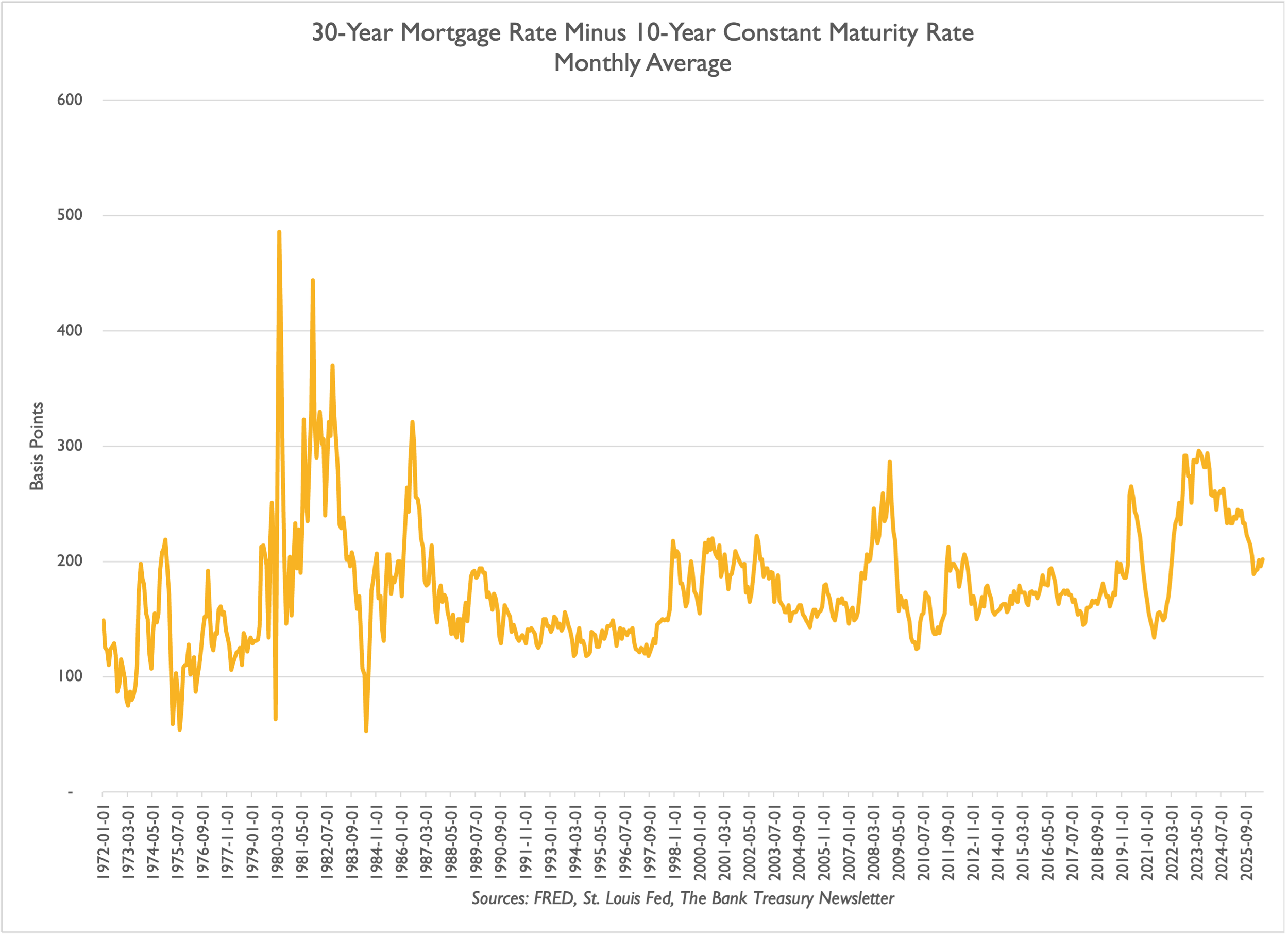
Mortgage Prepayment Option Value Declines
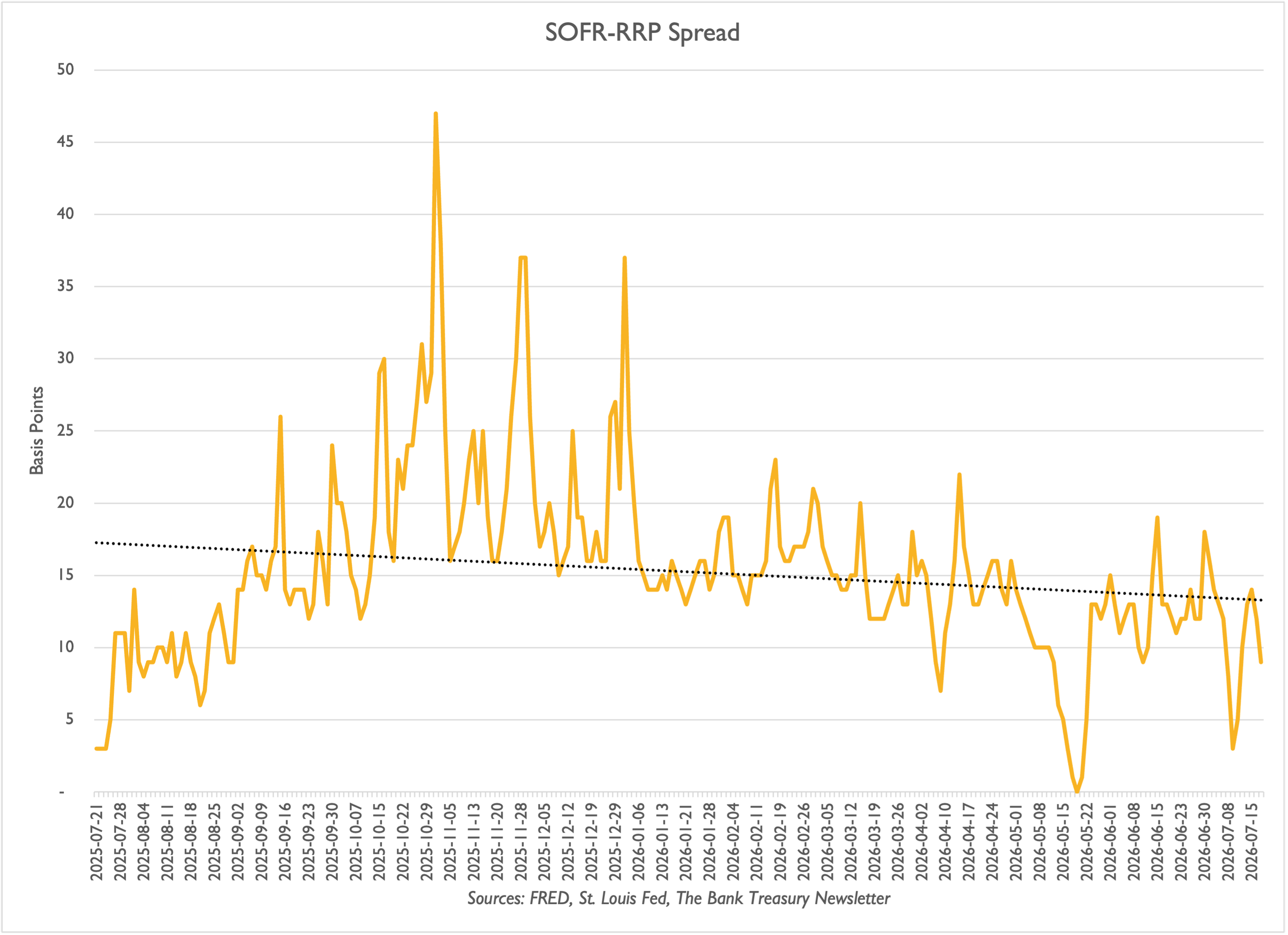
RMP Keeps SOFR-RRP Spread Positive
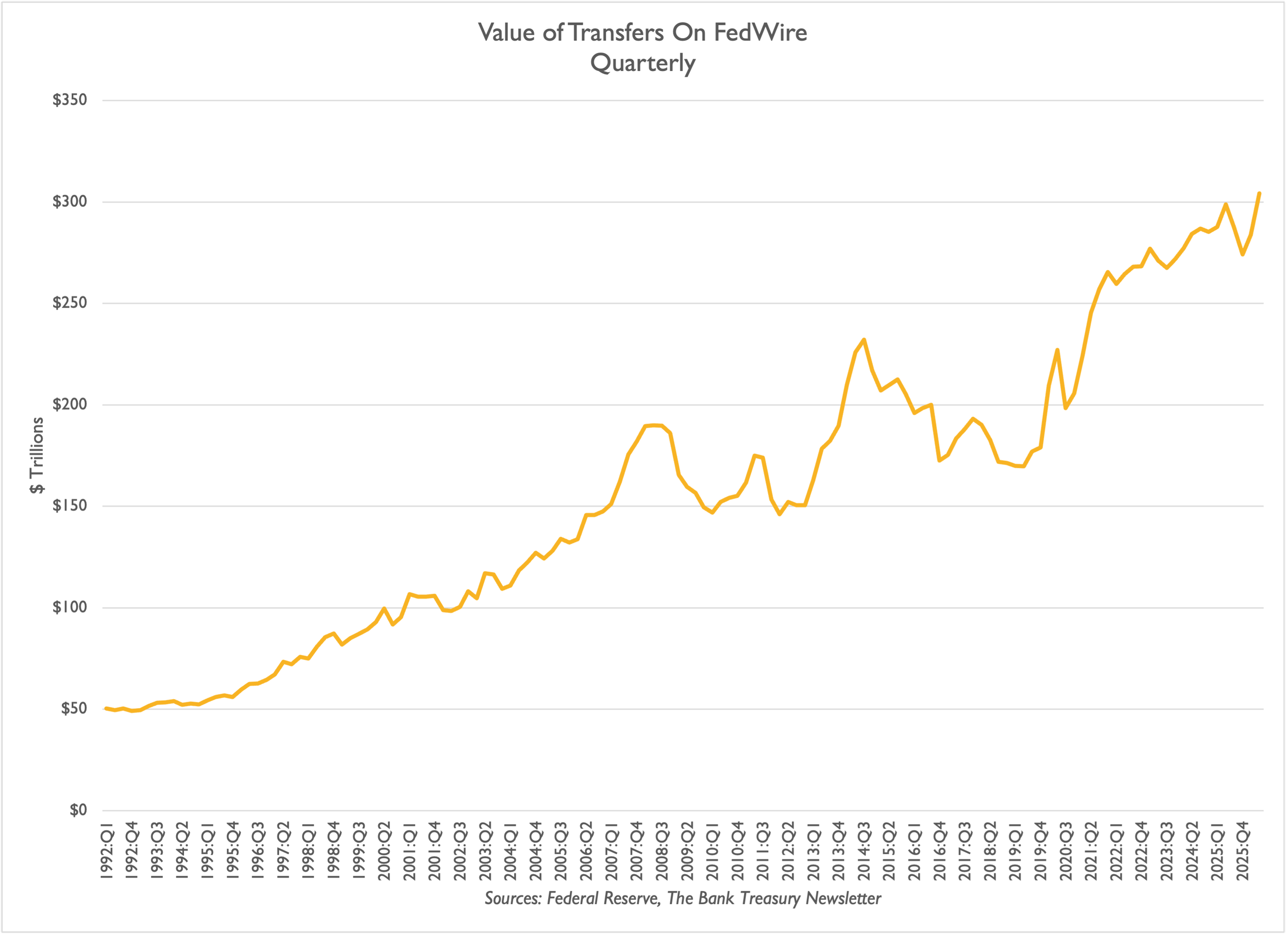
Payments Put A Floor Under Supply Of Reserves
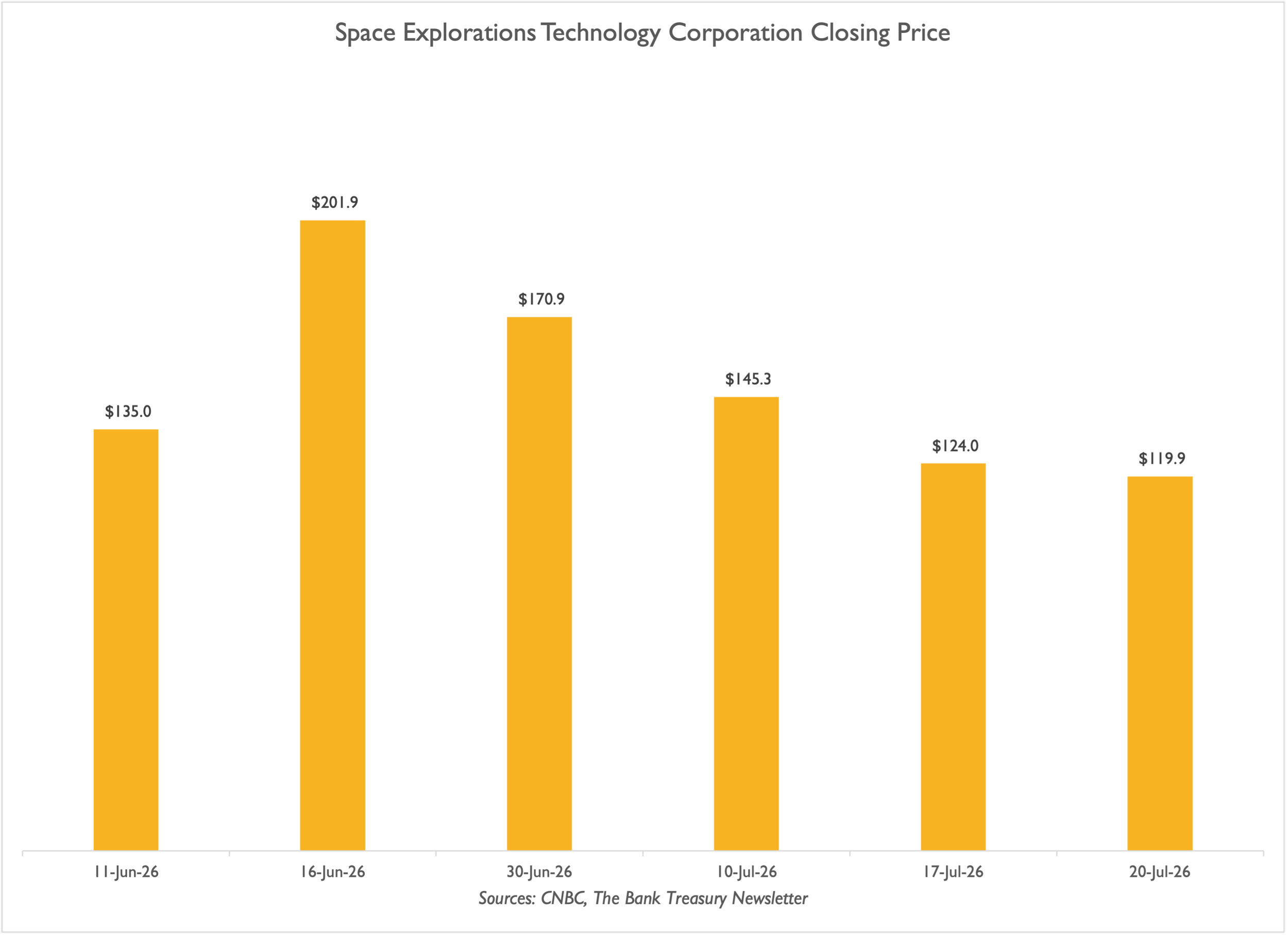
Irrational Exuberance Fades On SpaceX
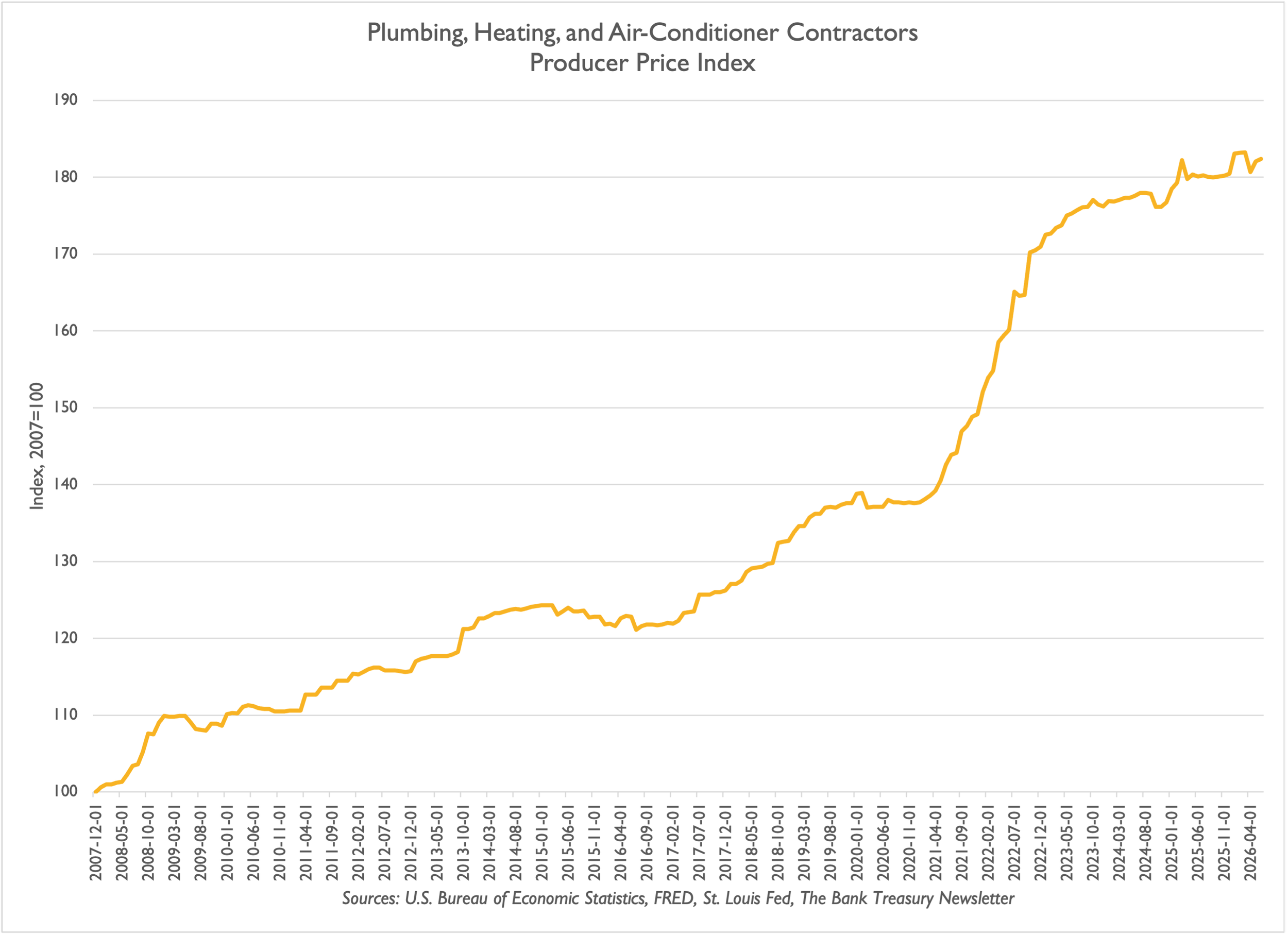
HVAC Specialists in Demand
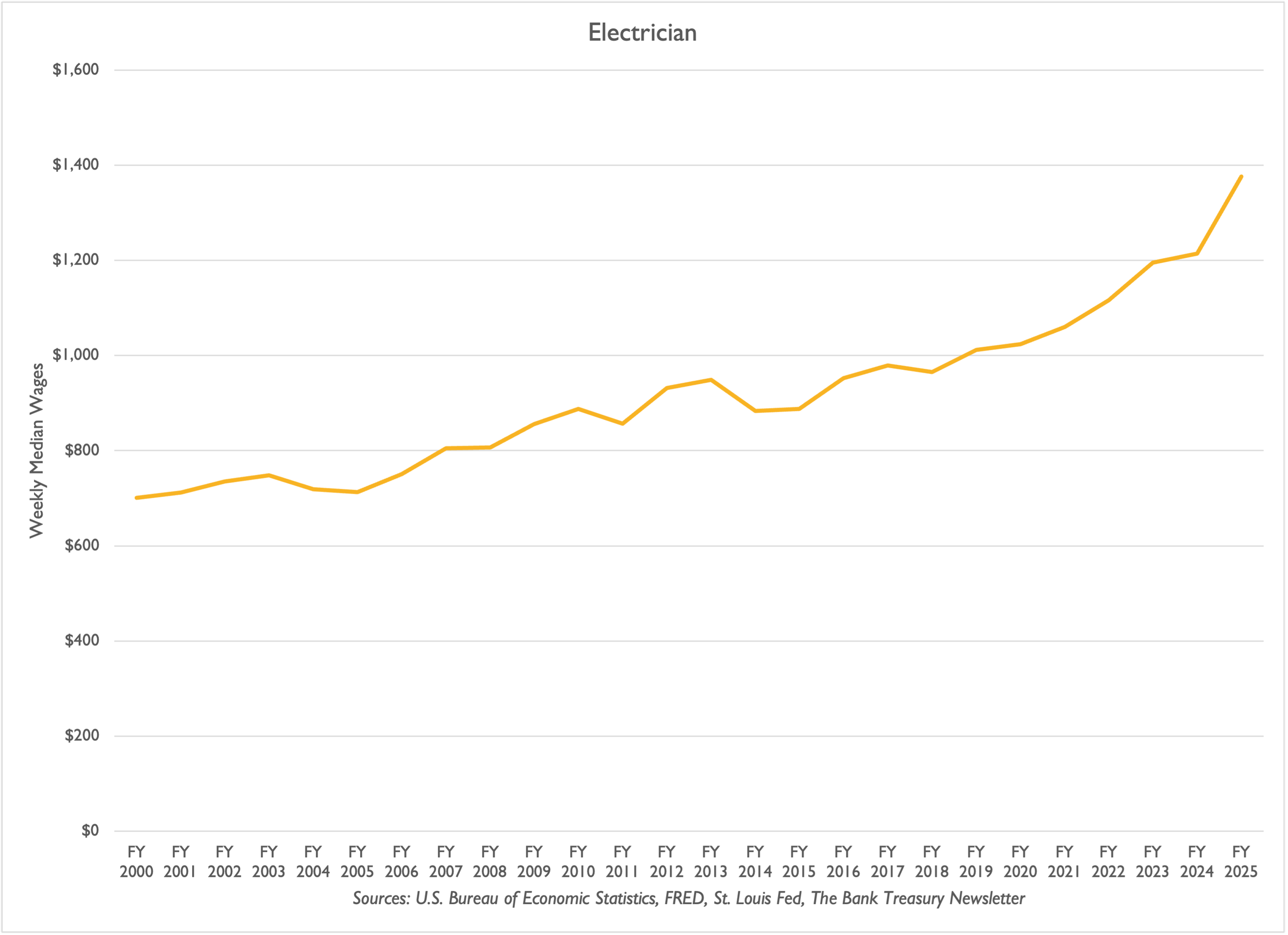
Electricians in Demand
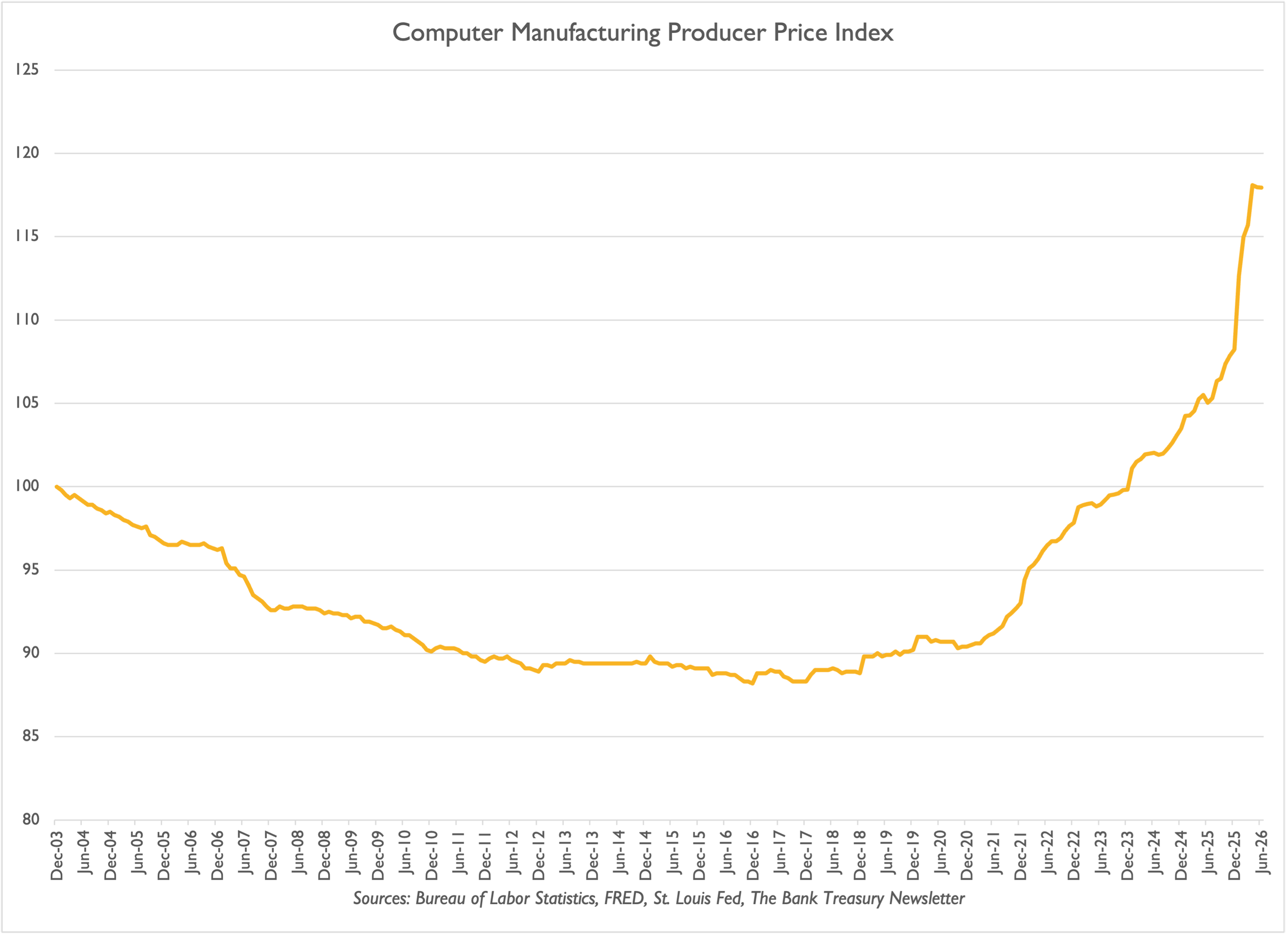
Computer Prices Soar
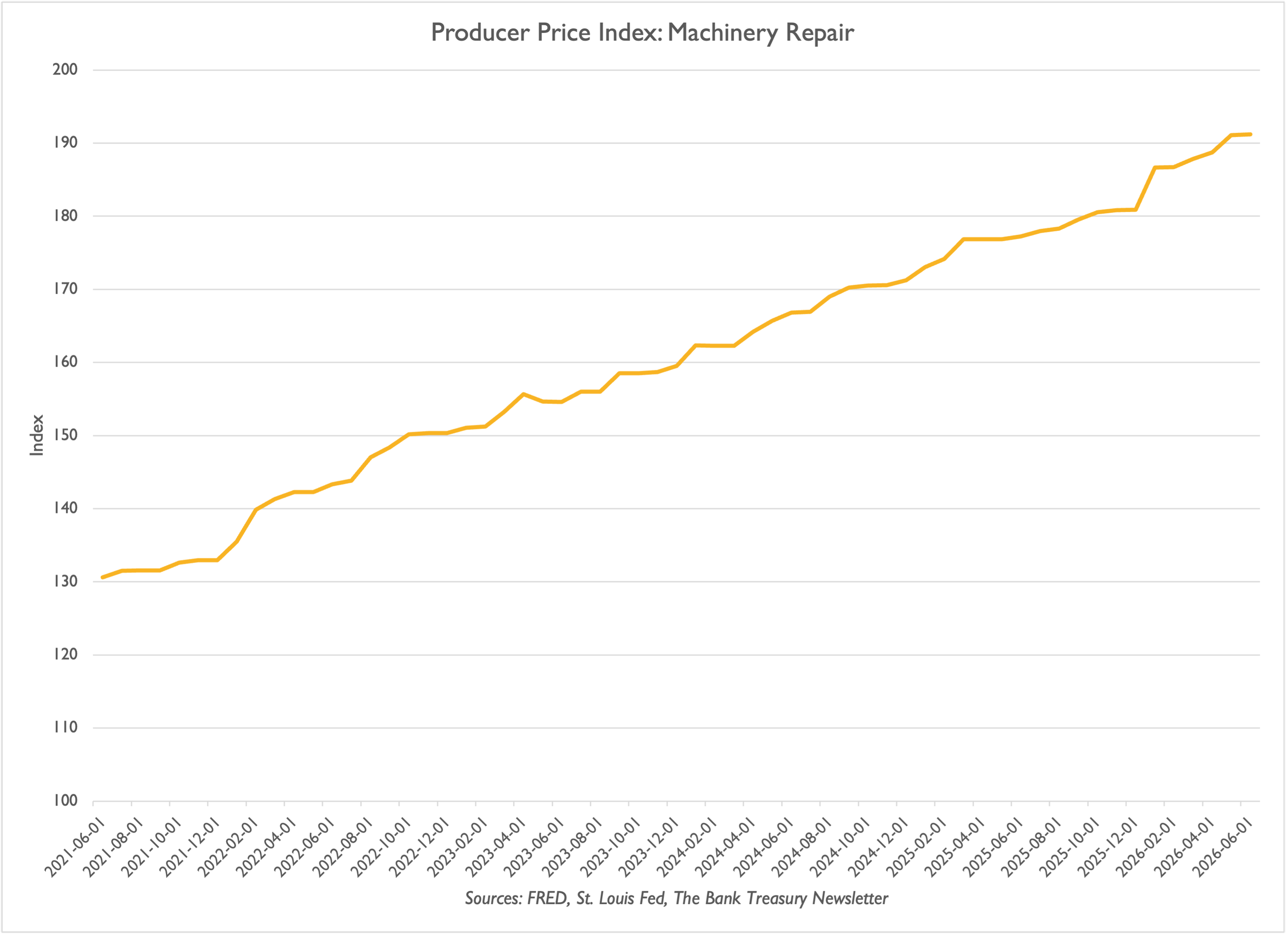
Computer Repair Costs Soar, Too
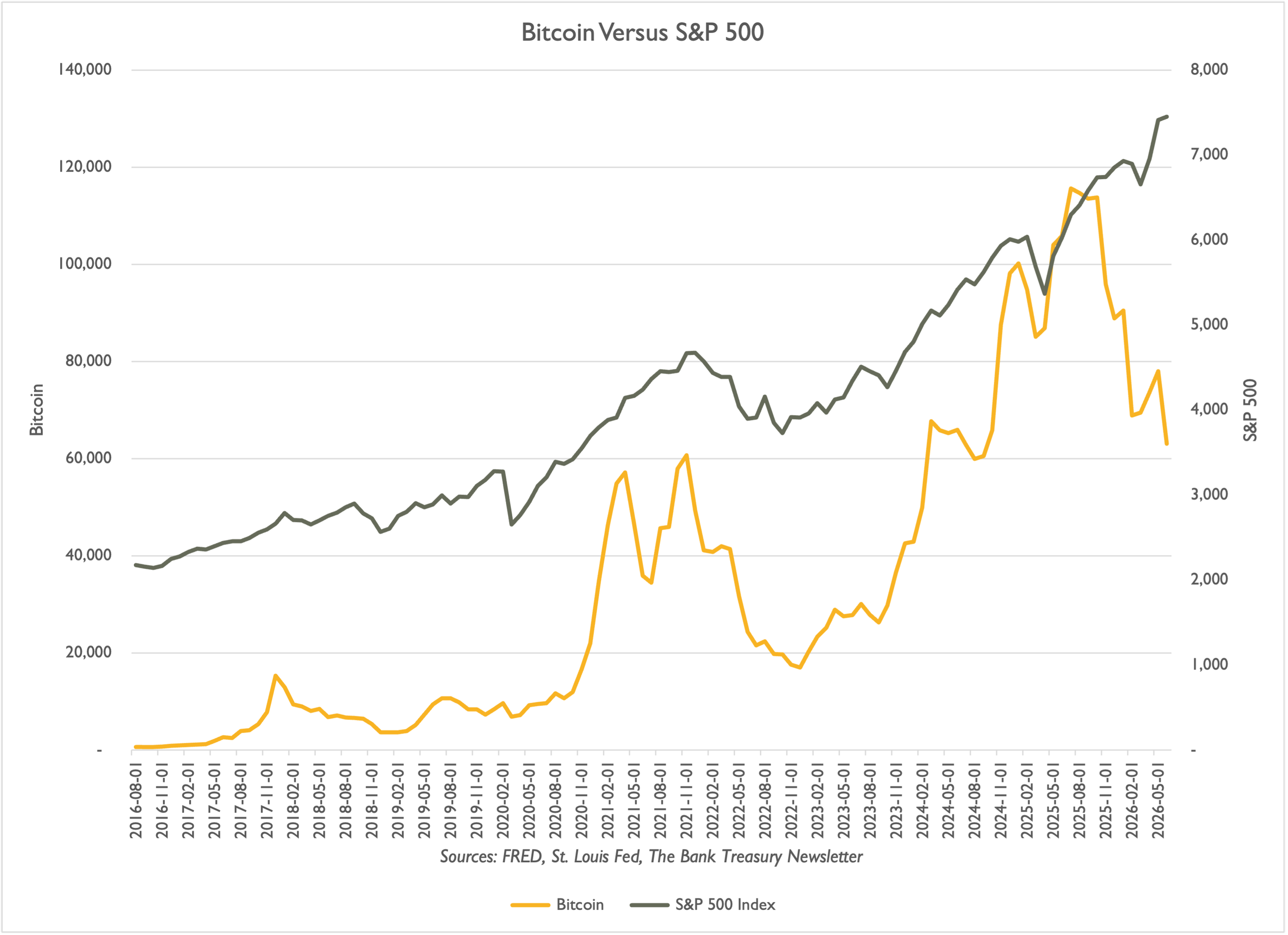
Investors Still Backing Away From Crypto
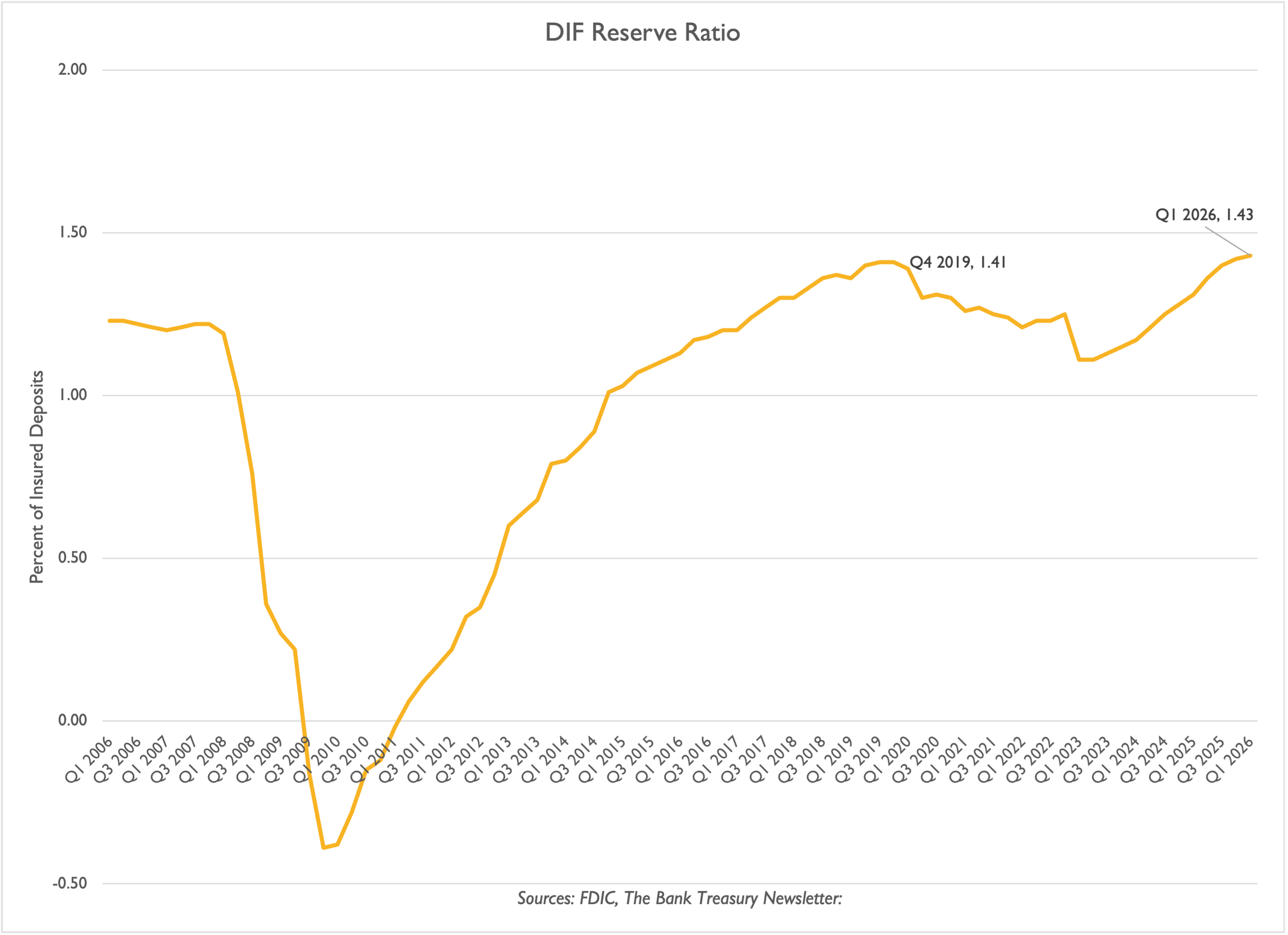
Record DIF Leads FDIC To Cut Assessment Rates